


Remaining challenges in predicting patient outcomes for diffuse large B-cell lymphoma
- PMID: 31513757
- PMCID: PMC6821591
- DOI: 10.1080/17474086.2019.1660159
Remaining challenges in predicting patient outcomes for diffuse large B-cell lymphoma
Abstract
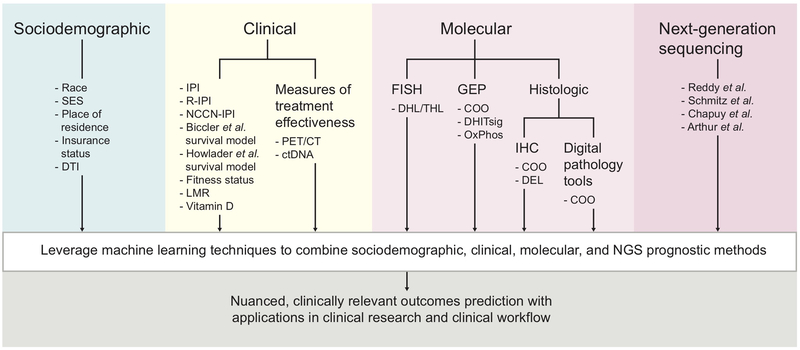
Introduction: Diffuse large B-cell lymphoma (DLBCL) is the most common non-Hodgkin lymphoma and is an aggressive malignancy with heterogeneous outcomes. Diverse methods for DLBCL outcomes assessment ranging from clinical to genomic have been developed with variable predictive and prognostic success.Areas covered: The authors provide an overview of the various methods currently used to estimate prognosis in DLBCL patients. Models incorporating cell of origin, genomic features, sociodemographic factors, treatment effectiveness measures, and machine learning are described.Expert opinion: The clinical and genetic heterogeneity of DLBCL presents distinct challenges in predicting response to therapy and overall prognosis. Successful integration of predictive and prognostic tools in clinical trials and in a standard clinical workflow for DLBCL will likely require a combination of methods incorporating clinical, sociodemographic, and molecular factors with the aid of machine learning and high-dimensional data analysis.
Keywords: B-cell lymphoma; DLBCL; diffuse large B-cell lymphoma; non-Hodgkin lymphoma; outcomes prediction; prognosis.
Conflict of interest statement
Declaration of interests
CR Flowers has served as a consultant for: Abbvie, AstraZeneca, Bayer, BeiGene, Celgene (unpaid), Denovo Biopharma, Genentech/Roche (unpaid), Gilead, OptumRx, Karyopharm, MEI Pharmaceuticals, Pharmacyclics/ Janssen, Spectrum. CR Flower has also received research funding from: Abbvie, Acerta, BeiGene, Celgene, Gilead, Genentech/Roche, Janssen Pharmaceutical, Millennium/Takeda, Pharmacyclics, TG Therapeutics, Burroughs Wellcome Fund, Eastern Cooperative Oncology Group, National Cancer Institute, and the V Foundation. JL Koff has received research funding from the American Association for Cancer Research and the Lymphoma Research Foundation. The authors have no other relevant affiliations or financial involvement with any organization or entity with a financial interest in or conflict with the subject matter or materials discussed in this manuscript apart from those disclosed.
Figures
References
-
-
Alizadeh AA et al. Distinct types of diffuse large B-cell lymphoma identified by gene expression profiling. Nature 403, 503–511, doi:10.1038/35000501 (2000).
Seminal work defining cell-of-origin subtypes of DLBCL by gene expression profiling.
-
Publication types
MeSH terms
Grants and funding
LinkOut - more resources
Full Text Sources
