


The effect of methylphenidate on social cognition and oxytocin in children with attention deficit hyperactivity disorder
- PMID: 31514201
- PMCID: PMC6901562
- DOI: 10.1038/s41386-019-0522-5
The effect of methylphenidate on social cognition and oxytocin in children with attention deficit hyperactivity disorder
Erratum in
-
Correction: The effect of methylphenidate on social cognition and oxytocin in children with attention deficit hyperactivity disorder.Neuropsychopharmacology. 2020 Jan;45(2):438. doi: 10.1038/s41386-019-0533-2. Neuropsychopharmacology. 2020. PMID: 31597958 Free PMC article.
Abstract
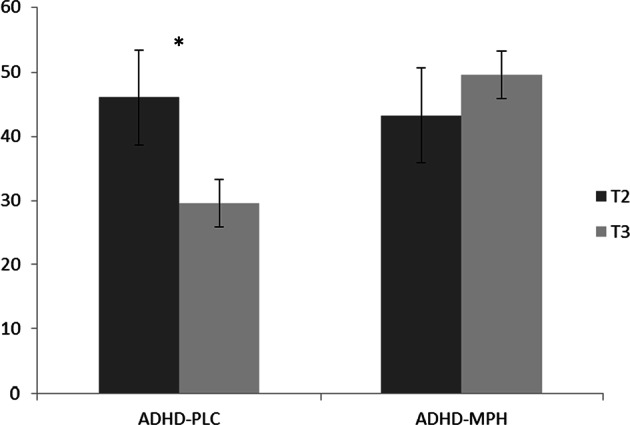
The current study aimed to explore the possible effect of stimulants on oxytocin (OT), a neuropeptide which regulates social behavior, as a mediator of the pro-social effect of methylphenidate (MPH) in children with attention deficit hyperactivity disorder (ADHD) compared to healthy controls (HCs). Utilizing a double-blind placebo-controlled design, we compared the performance of 50 children with ADHD and 40 HCs in "theory of mind" (ToM) tasks and examined the effect of a single dose of MPH/placebo on ToM and salivary OT levels in children with ADHD at baseline and following an interpersonal interaction. Children with ADHD displayed significantly poorer ToM performance; however, following MPH administration, their performance normalized and differences between children with ADHD and HC were no longer found. Salivary OT levels at baseline did not differ between children with ADHD and HCs. However, after a parent-child interaction, OT levels were significantly higher in the HC group compared to children with ADHD. Administration of MPH attenuated this difference such that after parent-child interaction differences in OT levels between children with ADHD and HC were no longer found. In the ADHD group, OT levels decreased from administration of placebo to the parent-child interaction. However, the administration of MPH to children with ADHD was associated with an increase in OT levels after the parent-child interaction. We conclude that OT might play a role as a mediator of social deficits in children with ADHD and that the reactivity of the OT system to social interaction in children with ADHD might be impaired. Stimulants may improve ToM and social functions in children with ADHD via its impact on the OT system. PRS: OT and Social Cognition in Children with ADHD: Impact of MPH.
Figures

References
-
- Mash EJ, Barkley RA. Child Psychopathology. 2nd ed. New York: Gilford Press; 2003.
Publication types
MeSH terms
Substances
LinkOut - more resources
Full Text Sources
Medical
