Comparison of the Effect of 8-Week Rebound Therapy-Based Exercise Program and Weight-Supported Exercises on the Range of Motion, Proprioception, and the Quality of Life in Patients with Parkinson's Disease
- PMID: 31516672
- PMCID: PMC6710923
- DOI: 10.4103/ijpvm.IJPVM_527_18
Comparison of the Effect of 8-Week Rebound Therapy-Based Exercise Program and Weight-Supported Exercises on the Range of Motion, Proprioception, and the Quality of Life in Patients with Parkinson's Disease
Abstract
Introduction: Parkinson's disease (PD) is a chronic, progressive disorder that mainly affects the central nervous system and, consequently, the patient's functional status. This study aimed to compare the effect of 8-week rebound therapy-based exercise program and weight-supported exercises on the range of motion, proprioception, and the quality of life in patients with PD.
Methods: Twenty patients were randomly divided into two equal groups of weight-bearing exercises and rebound exercise with no significant differences in age, weight, and height. The variables of the range of motion, proprioception, and the quality of life were assessed in pre- and posttest. Data were analyzed using repeated measure ANOVA and t-test at a significant level of P < 0.05.
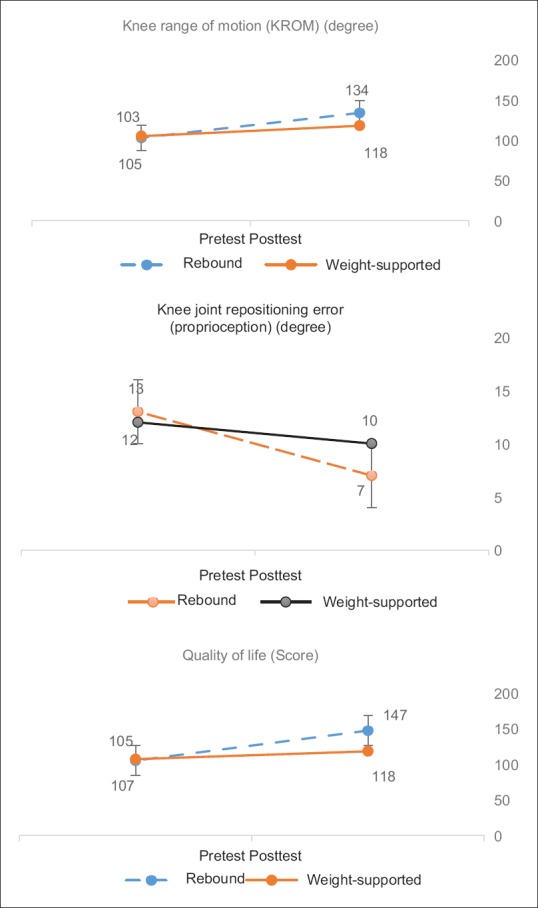
Results: All of the variables in the two groups were significantly improved after 8 weeks of exercise, whereas the improvement rate in the rebound therapy group was more than the weight-bearing exercises group in range of motion (134.60 ± 13.22 vs. 118.38 ± 12.48), proprioception (7.60 ± 3.22 vs. 10.38 ± 2.48), and the quality of life (147.60 ± 13.22 vs. 118.38 ± 12.48) of the patients (P < 0.001 for all variables).
Conclusions: Given that both rebound and weight-supported exercises are effective on improving the range of motion, proprioception, and the quality of life of people with PD, it is recommended that the benefits of these exercises to be used in physical rehabilitation programs. However, rebound therapy exercises have had a greater effect on people with PD, and it seems better to use these exercises more than others.
Keywords: Parkinson's disease; proprioception; quality of life; range of motion; rebound exercises; weight-supported exercises.
Conflict of interest statement
There are no conflicts of interest.
Figures
References
-
- Argue J. Parkinson's Disease and the Art of Moving. 1st ed. Oakland: New Harbinger Publications; 2000.
-
- Pringsheim T, Jette N, Frolkis A, Steeves TD. The prevalence of Parkinson's disease: A systematic review and meta-analysis. Mov Disord. 2014;29:1583–90. - PubMed
-
- Pallone JA. Introduction to Parkinson's disease. Dis Mon. 2007;53:195–9. - PubMed
-
- Herman T, Giladi N, Hausdorff JM. Treadmill training for the treatment of gait disturbances in people with Parkinson's disease: A mini-review. J Neural Transm. 2009;116:307–18. - PubMed
-
- Hirsch MA, Toole T, Maitland CG, Rider RA. The effects of balance training and high-intensity resistance training on persons with idiopathic Parkinson's disease. Am J Phys Med Rehabil. 2003;84:1109–17. - PubMed
LinkOut - more resources
Full Text Sources
Medical