


Long-term Reoperation Rate for Cubital Tunnel Syndrome: Subcutaneous Transposition Versus In Situ Decompression
- PMID: 31517521
- PMCID: PMC8283114
- DOI: 10.1177/1558944719873153
Long-term Reoperation Rate for Cubital Tunnel Syndrome: Subcutaneous Transposition Versus In Situ Decompression
Abstract
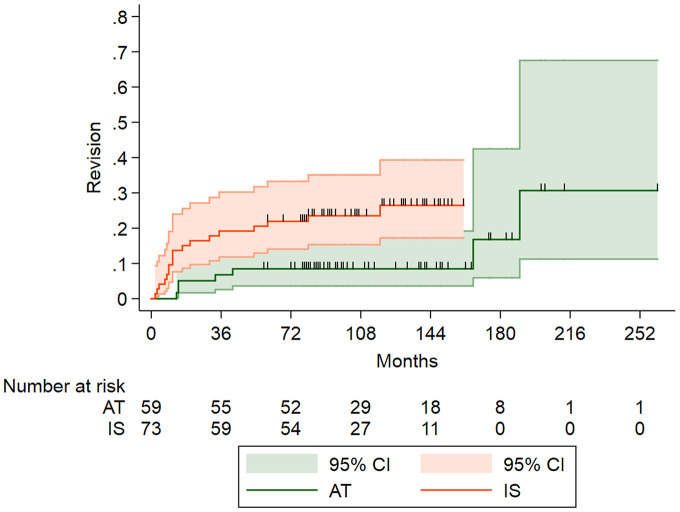
Background: The purpose of this study was to compare the long-term revision rate of in situ ulnar nerve decompression with anterior subcutaneous transposition surgery for idiopathic cubital tunnel syndrome. Methods: This retrospective, multicenter, cohort study compared patients who underwent ulnar nerve surgery with a minimum 5 years of follow-up. The primary outcome studied was the need for revision cubital tunnel surgery. In total, there were 132 cases corresponding to 119 patients. The cohorts were matched for age and comorbidity. Results: The long-term reoperation rate for in situ decompression was 25% compared with 12% for anterior subcutaneous transposition. Seventy-eight percent of revisions of in situ decompression were performed within the first 3 years. Younger age and female sex were identified as independent predictors of need for revision. Conclusions: In the long-term follow-up, in situ decompression is seen to have a statistically significant higher reoperation rate compared with subcutaneous transposition.
Keywords: anatomy; basic science; cubital tunnel syndrome; diagnosis; hand; in situ decompression; long-term; nerve; reoperation; transposition; ulnar nerve.
Conflict of interest statement
Figures
References
-
- Bartels RHMA, Verhagen WIM, van der Wilt GJ, et al.. Prospective randomized controlled study comparing simple decompression versus anterior subcutaneous transposition for idiopathic neuropathy of the ulnar nerve at the elbow: part I. Neurosurgery. 2005;56:522-530. - PubMed
-
- Nabhan A, Ahlhelm F, Kelm J, et al.. Simple decompression or subcutaneous anterior transposition of the ulnar nerve for cubital tunnel syndrome. J Hand Surg Br. 2005;30:521-524. - PubMed
Publication types
MeSH terms
LinkOut - more resources
Full Text Sources
