


Common Behaviors and Faults When Doffing Personal Protective Equipment for Patients With Serious Communicable Diseases
- PMID: 31517977
- PMCID: PMC6743503
- DOI: 10.1093/cid/ciz614
Common Behaviors and Faults When Doffing Personal Protective Equipment for Patients With Serious Communicable Diseases
Abstract
Background: The safe removal of personal protective equipment (PPE) can limit transmission of serious communicable diseases, but this process poses challenges to healthcare workers (HCWs).
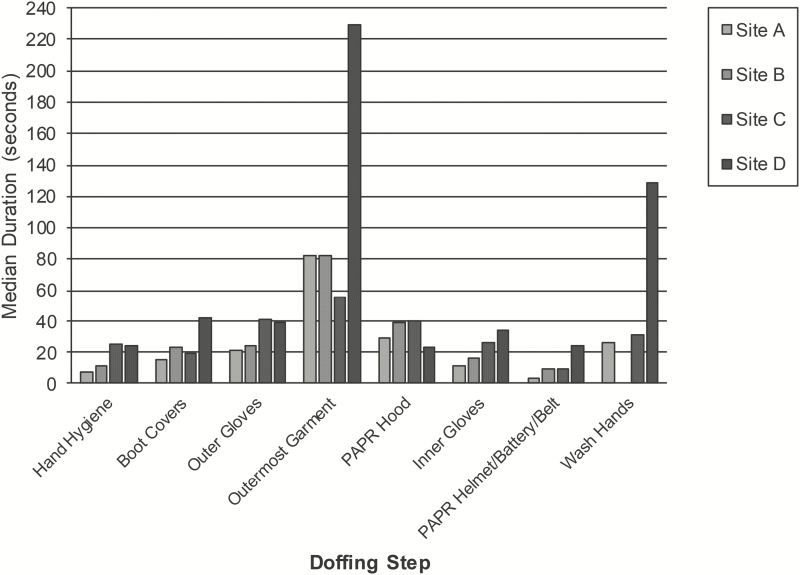
Methods: We observed 41 HCWs across 4 Ebola treatment centers in Georgia doffing PPE for simulated patients with serious communicable diseases. Using human factors methodologies, we obtained the details, sequences, and durations of doffing steps; identified the ways each step can fail (failure modes [FMs]); quantified the riskiness of FMs; and characterized the workload of doffing steps.
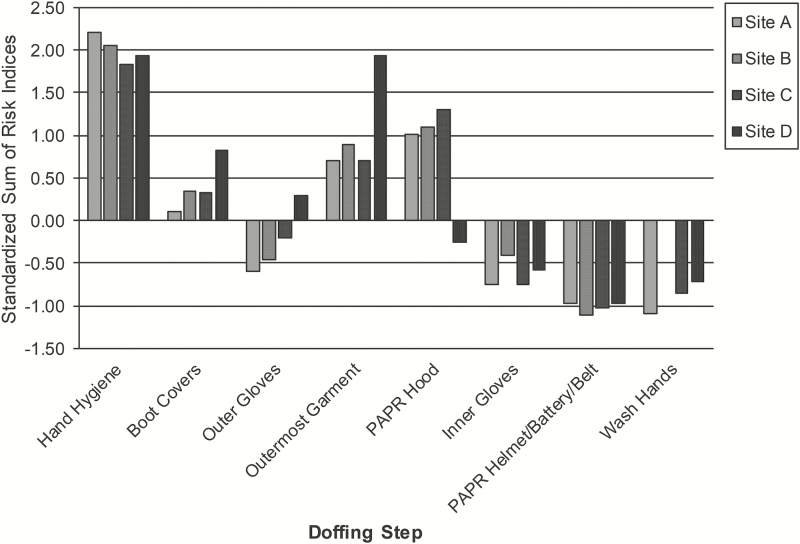
Results: Eight doffing steps were common to all hospitals-removal of boot covers, gloves (outer and inner pairs), the outermost garment, the powered air purifying respirator (PAPR) hood, and the PAPR helmet assembly; repeated hand hygiene (eg, with hand sanitizer); and a final handwashing with soap and water. Across hospitals, we identified 256 FMs during the common doffing steps, 61 of which comprised 19 common FMs. Most of these common FMs were above average in their riskiness at each hospital. At all hospitals, hand hygiene, removal of the outermost garment, and removal of boot covers were above average in their overall riskiness. Measurements of workload revealed that doffing steps were often mentally demanding, and this facet of workload correlated most strongly with the effortfulness of a doffing step.
Conclusions: We systematically identified common points of concern in protocols for doffing high-level PPE. Addressing FMs related to hand hygiene and the removal of the outermost garment, boot covers, and PAPR hood could improve HCW safety when doffing high-level PPE.We identified ways that doffing protocols for high-level personal protective equipment may fail to protect healthcare workers. Hand hygiene, removing the outermost garment, boot covers, and respirator hood harbored the greatest risk and failed in similar ways across different hospitals.
Keywords: serious communicable disease; human factors; occupational health; personal protective equipment; risk analysis.
© The Author(s) 2019. Published by Oxford University Press for the Infectious Diseases Society of America. All rights reserved. For permissions, e-mail: journals.permissions@oup.com.
Figures
References
-
- Centers for Disease Control and Prevention (2014, October 20). CDC Tightened Guidance for U.S. Healthcare Workers on Personal Protective Equipment for Ebola. Retrieved 18 May 2017, from https://www.cdc.gov/media/releases/2014/fs1020-ebola-personal-protective...
-
- Gurses AP, Rosen MA, Pronovost PJ. Improving guideline compliance and healthcare safety using human factors engineering: the case of Ebola. J Patient Saf Risk Manag 2018; 23:93–5.
-
- Edmond MB, Diekema DJ, Perencevich EN. Ebola virus disease and the need for new personal protective equipment. JAMA 2014; 312:2495–6. - PubMed
Publication types
MeSH terms
Grants and funding
LinkOut - more resources
Full Text Sources
Medical
Miscellaneous
