


Smartphones for Real-time Assessment of Adherence Behavior and Symptom Exacerbation for High-Risk Youth with Asthma: Pilot Study
- PMID: 31518299
- PMCID: PMC6716478
- DOI: 10.2196/pediatrics.9796
Smartphones for Real-time Assessment of Adherence Behavior and Symptom Exacerbation for High-Risk Youth with Asthma: Pilot Study
Abstract
Background: Youth with asthma who have poor medication adherence, have limited access to care, and are frequently seen in the acute care setting are often termed "high risk."
Objective: This study aimed to design and test the feasibility of using smartphone technology to assess contextual factors that may impact changes in daily medication adherence and to identify new symptom episodes among high-risk youth with asthma in their home environment.
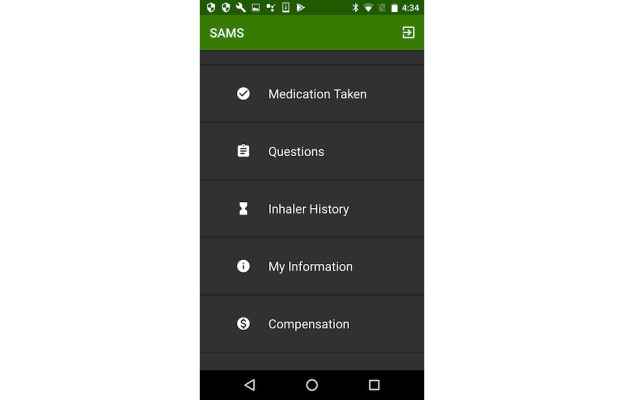
Methods: Youth aged 8-17 years with high-risk asthma from 2 children's hospitals were eligible for the 2-month study. An app was downloaded on participants' phones at enrollment. Daily text message (short message service) reminders were sent to complete ecological momentary assessment of asthma symptoms and other contextual factors such as emotional state using the app. Bluetooth inhaler devices were used to record timestamps of inhaler use with the ability to review and manually enter data. The acceptability was assessed with surveys, key informant interviews (KII), and frequency of days with asthma data. KII data were used in an iterative design approach to identify challenges, strengths, and suggestions for maximizing use. Generalized linear mixed modeling was used to preliminarily explore contextual factors associated with changes in daily adherence.
Results: We enrolled 14 children aged 8-16 years (13/14, 93% were African Americans). Over the 2-month study period, participants reported coughing (42/110, 38%), wheezing (8/111, 7%), chest tightness (9/109, 8%), boredom (57/109, 52%), and 10 new asthma symptom episodes. The controller medication adherence was 30%, which increased significantly on days with asthma symptoms or boredom. Data were received on 89% (606/681) of study days. Surveys and KIIs suggest acceptability among youth and their caregivers. Challenges reported during the study included lost or damaged phones and available memory.
Conclusions: Youth and their caregivers reported the acceptability of using smartphones for real-time asthma monitoring. Overall, the controller medication adherence was low but increased significantly on days with reported asthma symptoms or boredom, suggesting that daily contextual factors may be associated with a change in the adherence behavior.
Keywords: children; ecological momentary assessment; mHealth; medication adherence; medication monitoring device; mobile phone; symptoms; youth.
©Ronald John Teufel II, Sachin K Patel, Anita B Shuler, Anne L Andrews, Michelle Nichols, Myla D Ebeling, Erin Dawley, Martina Mueller, Kenneth J Ruggiero, Frank A Treiber. Originally published in JMIR Pediatrics and Parenting (http://pediatrics.jmir.org), 05.10.2018.
Conflict of interest statement
Conflicts of Interest: None declared.
Figures

References
-
- Akinbami LJ, Moorman JE, Liu X. Asthma prevalence, health care use, and mortality: United States, 2005-2009. Natl Health Stat Report. 2011 Jan 12;(32):1–14. http://www.cdc.gov/nchs/data/nhsr/nhsr032.pdf - PubMed
-
- Roemer M. Estimates for U.S. Civilian Noninstitutionalized Children, Ages 0-17. [2018-08-30]. Health Care Expenditures for the Five Most Common Children's Conditions, 2008 https://meps.ahrq.gov/data_files/publications/st349/stat349.pdf .
-
- Wang LY, Zhong Y, Wheeler L. Direct and indirect costs of asthma in school-age children. Prev Chronic Dis. 2005 Jan;2(1):A11. http://www.cdc.gov/pcd/issues/2005/jan/04_0053.htm A11 - PMC - PubMed
Grants and funding
LinkOut - more resources
Full Text Sources
