Review
. 2019 Sep 13;16(1):180.
doi: 10.1186/s12974-019-1564-7.

The endotoxin hypothesis of neurodegeneration

Affiliations
Review

The endotoxin hypothesis of neurodegeneration

Guy C Brown. J Neuroinflammation. .

Abstract

The endotoxin hypothesis of neurodegeneration is the hypothesis that endotoxin causes or contributes to neurodegeneration. Endotoxin is a lipopolysaccharide (LPS), constituting much of the outer membrane of gram-negative bacteria, present at high concentrations in gut, gums and skin and in other tissue during bacterial infection. Blood plasma levels of endotoxin are normally low, but are elevated during infections, gut inflammation, gum disease and neurodegenerative disease. Adding endotoxin at such levels to blood of healthy humans induces systemic inflammation and brain microglial activation. Adding high levels of endotoxin to the blood or body of rodents induces microglial activation, priming and/or tolerance, memory deficits and loss of brain synapses and neurons. Endotoxin promotes amyloid β and tau aggregation and neuropathology, suggesting the possibility that endotoxin synergises with different aggregable proteins to give different neurodegenerative diseases. Blood and brain endotoxin levels are elevated in Alzheimer's disease, which is accelerated by systemic infections, including gum disease. Endotoxin binds directly to APOE, and the APOE4 variant both sensitises to endotoxin and predisposes to Alzheimer's disease. Intestinal permeability increases early in Parkinson's disease, and injection of endotoxin into mice induces α-synuclein production and aggregation, as well as loss of dopaminergic neurons in the substantia nigra. The gut microbiome changes in Parkinson's disease, and changing the endotoxin-producing bacterial species can affect the disease in patients and mouse models. Blood endotoxin is elevated in amyotrophic lateral sclerosis, and endotoxin promotes TDP-43 aggregation and neuropathology. Peripheral diseases that elevate blood endotoxin, such as sepsis, AIDS and liver failure, also result in neurodegeneration. Endotoxin directly and indirectly activates microglia that damage neurons via nitric oxide, oxidants and cytokines, and by phagocytosis of synapses and neurons. The endotoxin hypothesis is unproven, but if correct, then neurodegeneration may be reduced by decreasing endotoxin levels or endotoxin-induced neuroinflammation.

Keywords: Alzheimer’s disease; Bacteria; Endotoxin; Gut microbiome; Inflammation; Lipopolysaccharide; Microglia; Neurodegeneration; Neuroinflammation; Parkinson’s disease.


Conflict of interest statement

The author declares that he/she has no competing interests.

Figures

Fig. 1
Fig. 1
The central pathway of how endotoxin leads to neurodegeneration. Gut endotoxin may enter blood due to leaky gut, e.g. due to alpha-synuclein aggregates. Gum endotoxin may enter blood as a result of gum inflammation or tooth brushing. Blood endotoxin may cause brain inflammation via blood or brain cytokines, or by entering the brain, resulting in neurodegeneration
Fig. 2
Fig. 2
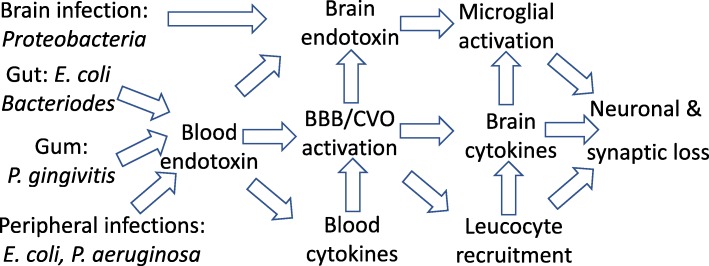
Different species of endotoxin arise from different sources, ending up in the blood or brain. Blood endotoxin increase pro-inflammatory cytokines in blood, and inflammatory activates the blood-brain barrier (BBB) and circumventricular organs (CVO), recruiting leucocytes into the brain and increasing brain cytokines that activate microglia, resulting in synaptic and neuronal loss
Fig. 3
Fig. 3
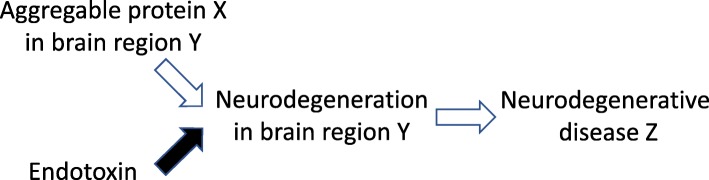
Endotoxin may give rise to different neurodegenerative disease by synergising with different aggregable proteins to induce neurodegeneration. If endotoxin contributes to multiple different diseases, why are these different diseases different? The solution may be a two-hit hypothesis, where the presence of endotoxin or an aggregable protein is not sufficient alone, but together, they induce neurodegeneration and give rise to different neurodegenerative diseases dependent on the particular aggregable protein present and its distribution in the brain. Note that the presence in the brain of an aggregable protein, such as Aβ, Tau or α-synuclein, is not normally sufficient to induce neurodegeneration
Fig. 4
Fig. 4
Endotoxin may act at different steps to promote neurodegeneration. (1) Endotoxin may promote aggregates of Aβ, tau, α-synuclein and TDP-43 by inhibiting removal or by increasing production, spread or aggregation (in part by stimulating ROS production). (2) Endotoxin may prime microglia and stress neurons, making them more susceptible to disease-specific agents. (3) Endotoxin may activate microglia, already primed by disease to execute stressed synapses and neurons

References

    1. VanItallie TB. Alzheimer’s disease: innate immunity gone awry? Metabolism. 2017;69S:S41–S49. doi: 10.1016/j.metabol.2017.01.014. - DOI - PubMed
    1. Pfeiffer RF. Gastrointestinal dysfunction in Parkinson’s disease. Curr Treat Options Neurol. 2018;20:54. doi: 10.1007/s11940-018-0539-9. - DOI - PubMed
    1. Needham BD, Trent MS. Fortifying the barrier: the impact of lipid A remodelling on bacterial pathogenesis. Nat Rev Microbiol. 2013;11:467–481. doi: 10.1038/nrmicro3047. - DOI - PMC - PubMed
    1. Hajjar AM, Ernst RK, Tsai JH, Wilson CB, Miller SI. Human toll-like receptor 4 recognizes host-specific LPS modifications. Nat Immunol. 2002;3:354–359. doi: 10.1038/ni777. - DOI - PubMed
    1. Vatanen T, Kostic AD, d'Hennezel E, Siljander H, Franzosa EA, Yassour M, et al. Variation in microbiome LPS immunogenicity contributes to autoimmunity in humans. Cell. 2016;165:1551. doi: 10.1016/j.cell.2016.05.056. - DOI - PubMed