


Hand size underestimation grows during childhood
- PMID: 31520003
- PMCID: PMC6744419
- DOI: 10.1038/s41598-019-49500-7
Hand size underestimation grows during childhood
Abstract
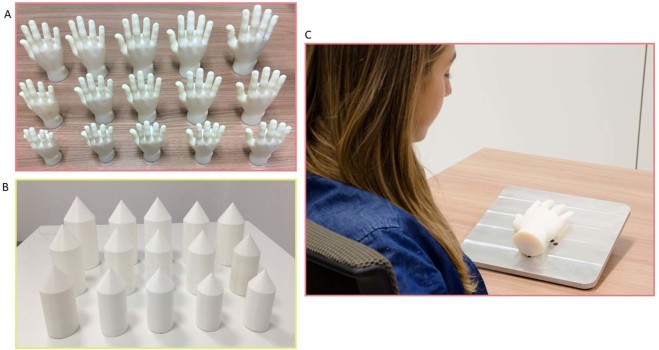
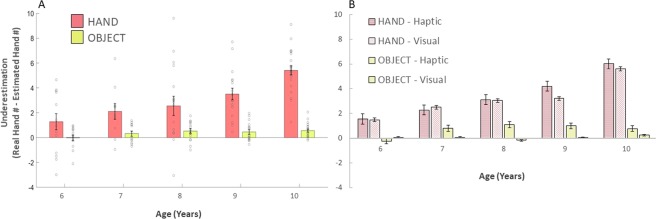
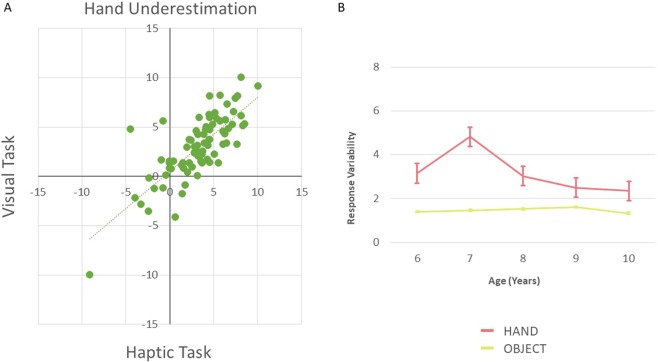
Cortical body size representations are distorted in the adult, from low-level motor and sensory maps to higher levels multisensory and cognitive representations. Little is known about how such representations are built and evolve during infancy and childhood. Here we investigated how hand size is represented in typically developing children aged 6 to 10. Participants were asked to estimate their hand size using two different sensory modalities (visual or haptic). We found a distortion (underestimation) already present in the youngest children. Crucially, such distortion increases with age and regardless of the sensory modality used to access the representation. Finally, underestimation is specific for the body as no bias was found for object estimation. This study suggests that the brain does not keep up with the natural body growth. However, since motor behavior nor perception were impaired, the distortion seems functional and/or compensated for, for proper interaction with the external environment.
Conflict of interest statement
The authors declare no competing interests.
Figures
References
-
- Abarca-Gómez L, et al. Worldwide trends in body-mass index, underweight, overweight, and obesity from 1975 to 2016: a pooled analysis of 2416 population-based measurement studies in 128·9 million children, adolescents, and adults. Lancet. 2017;390:2627–2642. doi: 10.1016/S0140-6736(17)32129-3. - DOI - PMC - PubMed
MeSH terms
LinkOut - more resources
Full Text Sources
