


Effect of play-based family-centered psychomotor/psychosocial stimulation on the development of severely acutely malnourished children under six in a low-income setting: a randomized controlled trial
- PMID: 31521161
- PMCID: PMC6744679
- DOI: 10.1186/s12887-019-1696-z
Effect of play-based family-centered psychomotor/psychosocial stimulation on the development of severely acutely malnourished children under six in a low-income setting: a randomized controlled trial
Abstract
Background: The World Health Organization (WHO) recommends incorporating psychosocial stimulation into the management of severe acute malnutrition (SAM). However, there is little evidence about the effectiveness of these interventions for SAM children, particularly when serious food shortages and lack of a balanced diet prevail. The objective of this study was to examine whether family-based psychomotor/psychosocial stimulation in a low-income setting improves the development, linear growth, and nutritional outcomes in children with SAM.
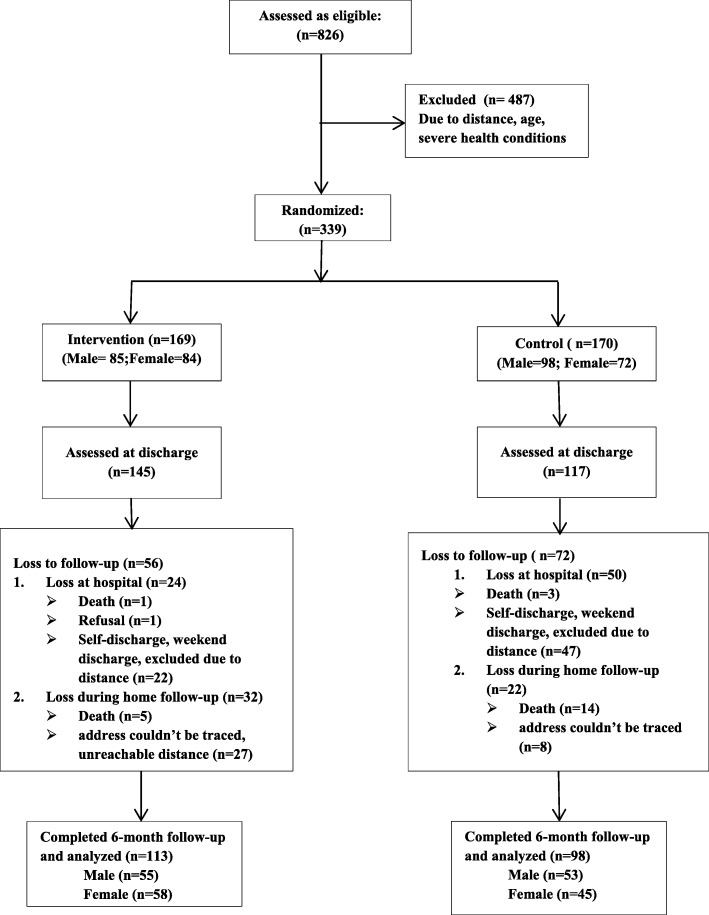
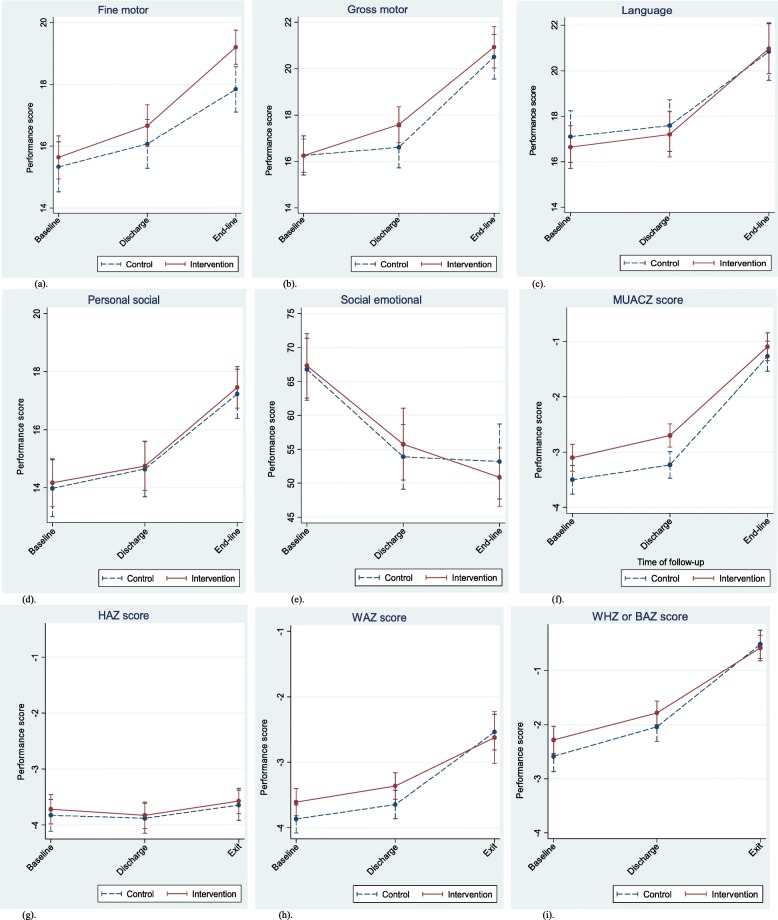
Method: Children with SAM (N = 339) admitted for treatment to the Jimma University Specialized Hospital, Ethiopia, were randomized to a control (n = 170) or intervention (n = 169) group. Both groups received routine medical care and nutritional treatment at the hospital. The intervention group additionally received play-based psychomotor/psychosocial stimulation during their hospital stay, and at home for 6 months after being discharged from hospital. The fine motor (FM) and gross motor (GM) functions, language (LA) and personal-social (PS) skills of the children were assessed using adapted Denver II, the social-emotional (SE) behavior was assessed using adapted Ages and Stages Questionnaires: Social-Emotional, and the linear growth and nutritional status were determined through anthropometric assessments. All outcomes were assessed before the intervention, upon discharge from hospital, and 6 months after discharge (as end-line). The overtime changes of these outcomes measured in both groups were compared using Generalized Estimating Equations.
Results: The intervention group improved significantly on GM during hospital follow-up by 0.88 points (p < 0.001, effect size = 0.26 SD), and on FM functions during the home follow-up by 1.09 points (p = 0.001, effect size = 0.22 SD). Both young and older children benefited similarly from the treatment. The intervention did not contribute significantly to linear growth and nutritional outcomes.
Conclusion: Psychomotor/psychosocial stimulation of SAM children enhances improvement in gross motor functions when combined with standard nutrient-rich diets, but it can enhance the fine motor functions even when such standard dietary care is not available.
Trial registration: The trial was retrospectively registered on 30 January 2017 at the US National Institute of Health (ClinicalTrials.gov) # NCT03036176 .
Conflict of interest statement
The authors declare that they have no competing interests.
Figures
References
-
- WHO. World Health Statistics 2016: monitoring health for the SDGs, sustainable development goals. World Health Organization; 2016. https://apps.who.int/iris/handle/10665/206498.
-
- Central Statistical Agency [Ethiopia] 2016 . ETHIOPIA Demographic and Health Survey 2016. Addis Ababa and Rockville: CSA and ICF; 2016.
-
- Martorell R. Early child development: investing in our children’s future. 1997. Undernutrition during pregnancy and early childhood and its consequences for cognitive and behavioral development; pp. 39–83.
-
- Heaver R. Strengthening country commitment to human development: lessons from nutrition. Washington DC: The World Bank; 2005.
-
- Martorell R, Nguyen P. Nestlé Nutrition workshop series Pediatric program. Vevey; Philadelphia: Nestec; Lippincott Williams & Wilkins, c1999; 2010. Interrelationship between growth and development in low and middle income countries; pp. 99–121. - PubMed
