


Determination of reliable lung function parameters in intubated mice
- PMID: 31521163
- PMCID: PMC6744631
- DOI: 10.1186/s12931-019-1177-9
Determination of reliable lung function parameters in intubated mice
Abstract
Background: Animal models and, in particular, mice models, are important tools to investigate the pathogenesis of respiratory diseases and to test potential new therapeutic drugs. Lung function measurement is a key step in such investigation. In mice, it is usually performed using forced oscillation technique (FOT), negative pressure-driven forced expiratory (NPFE) and pressure-volume (PV) curve maneuvers. However, these techniques require a tracheostomy, which therefore only allows end-point measurements. Orotracheal intubation has been reported to be feasible and to give reproducible lung function measurements, but the agreement between intubation and tracheostomy generated-data remains to be tested.
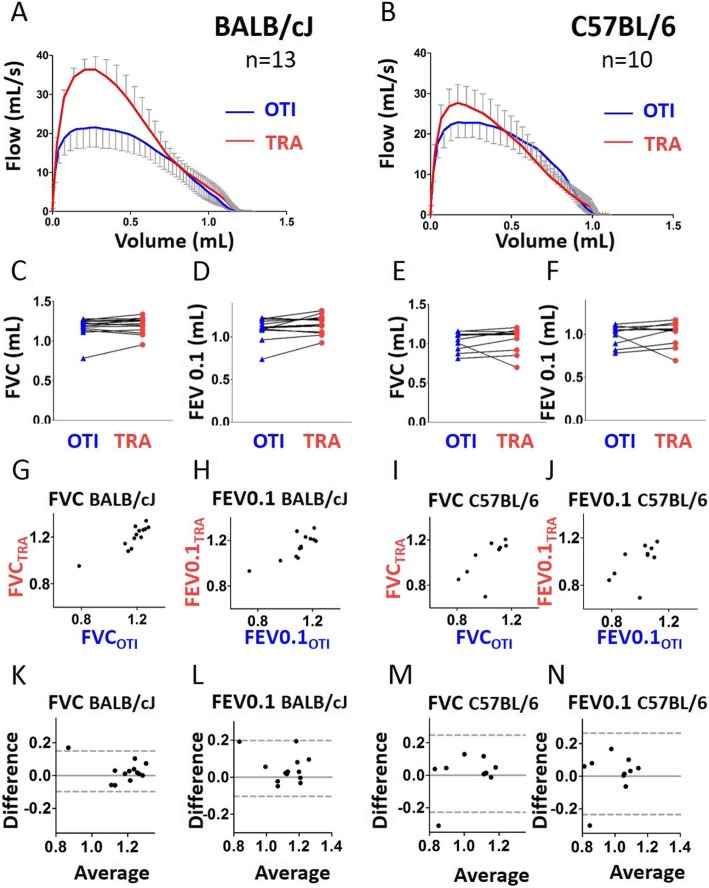
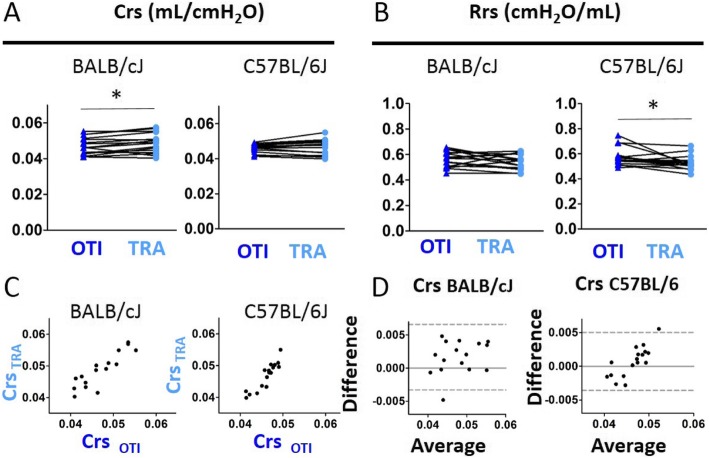
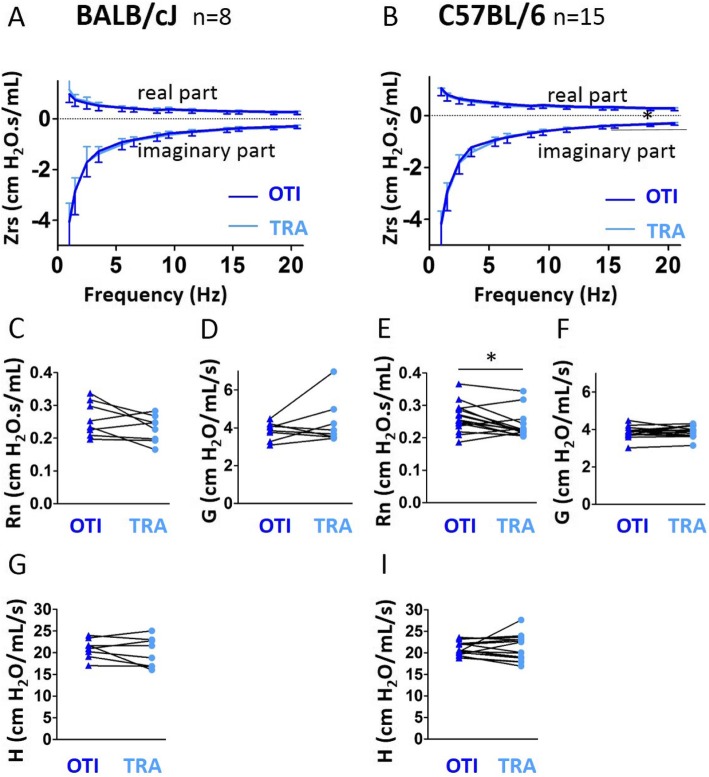
Methods: Using the Flexivent system, we measured lung function parameters (in particular, forced vital capacity (FVC), forced expiratory volume in the first 0.1 s (FEV0.1), compliance (Crs) of the respiratory system, compliance (C) measured using PV loop and an estimate of inspiratory capacity (A)) in healthy intubated BALB/cJ mice and C57BL/6 J mice and compared the results with similar measurements performed in the same mice subsequently tracheostomized after intubation, by means of paired comparison method, correlation and Bland-Altman analysis. The feasibility of repetitive lung function measurements by intubation was also tested.
Results: We identified parameters that are accurately evaluated in intubated animals (i.e., FVC, FEV0.1, Crs, C and A in BALB/cJ and FVC, FEV0.1, and A in C57BL/6 J). Repetitive lung function measurements were obtained in C57BL/6 J mice.
Conclusion: This subset of lung function parameters in orotracheally intubated mice is reliable, thereby allowing relevant longitudinal studies.
Keywords: Asthma; COPD; Lung function; Mice model; Orotracheal intubation.
Conflict of interest statement
Dr. Berger reports grants from Nycomed, grants from Takeda, grants from Fondation du Souffle–Fonds de dotation Recherche en Santé Respiratoire, during the conduct of the study; grants and personal fees from Novartis, personal fees and non-financial support from Chiesi, grants, personal fees and non-financial support from Boehringer Ingelheim, personal fees and non-financial support from AstraZeneca, personal fees and non-financial support from Sanofi, personal fees from Menarinni, personal fees from TEVA, outside the submitted work. In addition, Dr. Berger and Dr. Dupin have a patent (EP N°15152886.6 i.e. New compositions and methods of treating and/or preventing Chronic Obstructive Pulmonary Disease) pending.
Figures




References
-
- From the Global Strategy for the Diagnosis, Management and Prevention of COPD, Global Initiative for Chronic Obstructive Lung Disease (GOLD) 2019. Available from: https://goldcopd.org
MeSH terms
Grants and funding
LinkOut - more resources
Full Text Sources
