


Use of Imaging and Diagnostic Procedures After Low-Dose CT Screening for Lung Cancer
- PMID: 31521671
- PMCID: PMC7005377
- DOI: 10.1016/j.chest.2019.08.2187
Use of Imaging and Diagnostic Procedures After Low-Dose CT Screening for Lung Cancer
Abstract
Background: Clinical trials have demonstrated a mortality benefit from lung cancer screening by low-dose CT (LDCT) in current or past tobacco smokers who meet criteria. Potential harms of screening mostly relate to downstream evaluation of abnormal screens. Few data exist on the rates outside of clinical trials of imaging and diagnostic procedures following screening LDCT. We describe rates in the community setting of follow-up imaging and diagnostic procedures after screening LDCT.
Methods: We used Clinformatics Data Mart national database to identify enrollees age 55 to 80 year who underwent screening LDCT from January 1, 2016, to December 31, 2016. We assessed rates of follow-up imaging (diagnostic chest CT scan, MRI, and PET) and follow-up procedures (bronchoscopy, percutaneous biopsy, thoracotomy, mediastinoscopy, and thoracoscopy) in the 12 months following LDCT for lung cancer screening. We also assessed these rates in an age-, sex-, and number of comorbidities-matched population that did not undergo LDCT to estimate rates unrelated to the screening LDCT. We then reported the adjusted rate of follow-up testing as the observed rate in the screening LDCT population minus the rate in the non-LDCT population.
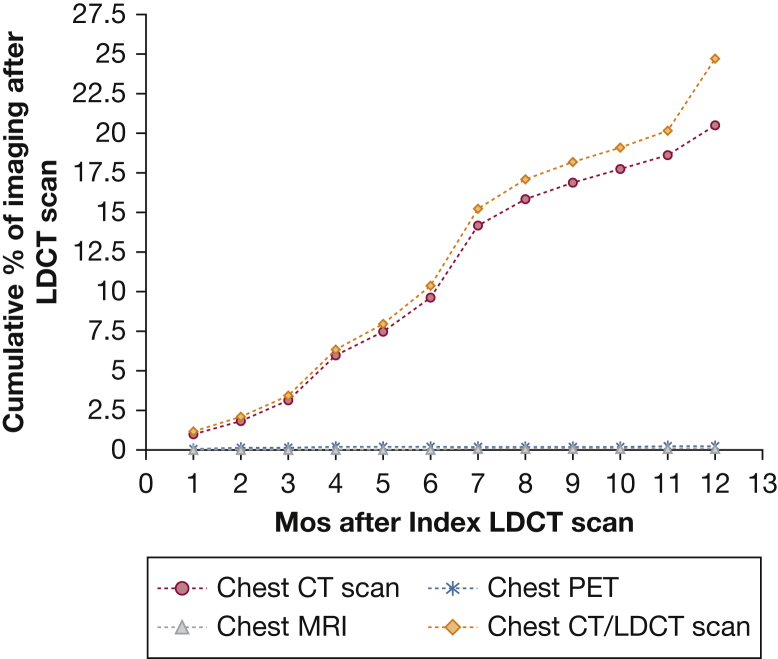
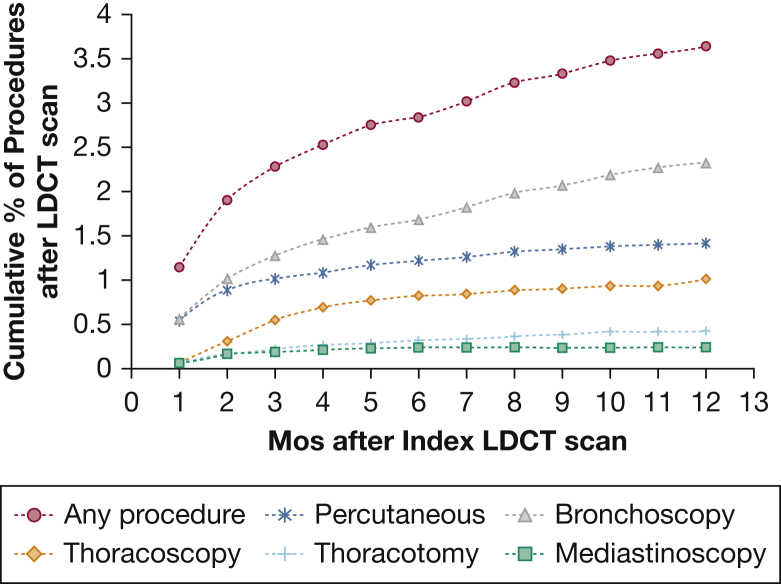
Results: Among 11,520 enrollees aged 55 to 80 years who underwent LDCT in 2016, the adjusted rates of follow up 12 months after LDCT examinations were low (17.7% for imaging and 3.1% for procedures). Among procedures, the adjusted rates were 2.0% for bronchoscopy, 1.3% for percutaneous biopsy, 0.9% for thoracoscopy, 0.2% for mediastinoscopy, and 0.4% for thoracotomy. Adjusted rates of follow-up procedures were higher in enrollees undergoing an initial screening LDCT (3.3%) than in those after a second screening examination (2.2%).
Conclusions: In general, imaging and rates of procedures after screening LDCT was low in this commercially insured population.
Keywords: LDCT; NLST; chest imaging; computed tomography; follow up; health-care utilization; imaging; lung cancer screening; procedures.
Copyright © 2019 American College of Chest Physicians. Published by Elsevier Inc. All rights reserved.
Figures
Comment in
-
Diagnostic Evaluation After Lung Cancer Screening in Real-World Practice: More Questions Than Answers.Chest. 2020 Feb;157(2):247-248. doi: 10.1016/j.chest.2019.10.028. Chest. 2020. PMID: 32033643 No abstract available.
-
Novelties in Lung Cancer Screening.Am J Respir Crit Care Med. 2021 Sep 1;204(5):596-598. doi: 10.1164/rccm.202012-4505RR. Am J Respir Crit Care Med. 2021. PMID: 34213386 No abstract available.
References
-
- Siegel R.L., Miller K.D., Jemal A. Cancer statistics, 2018. CA Cancer J Clin. 2018;68(1):7–30. - PubMed
-
- Moyer V.A., US Preventive Services Task Force Screening for lung cancer: U.S. Preventive Services Task Force recommendation statement. Ann Intern Med. 2014;160(5):330–338. - PubMed
-
- NELSON study shows CT screening for nodule volume management reduces lung cancer mortality by 26 percent in men [press release]. IASLC 19th World Conference on Lung Cancer (WCLC). September 25, 2018.
Publication types
MeSH terms
Grants and funding
LinkOut - more resources
Full Text Sources
Medical
Miscellaneous
