


Association Between Sacubitril/Valsartan Initiation and Health Status Outcomes in Heart Failure With Reduced Ejection Fraction
- PMID: 31521679
- PMCID: PMC7122134
- DOI: 10.1016/j.jchf.2019.05.016
Association Between Sacubitril/Valsartan Initiation and Health Status Outcomes in Heart Failure With Reduced Ejection Fraction
Abstract
Objectives: This study sought to describe the short-term health status benefits of angiotensin-neprilysin inhibitor (ARNI) therapy in patients with heart failure and reduced ejection fraction (HFrEF).
Background: Although therapy with sacubitril/valsartan, a neprilysin inhibitor, improved patients' health status (compared with enalapril) at 8 months in the PARADIGM-HF (Prospective Comparison of ARNI with ACE inhibitor to Determine Impact on Global Mortality and Morbidity in Heart Failure) study, the early impact of ARNI on patients' symptoms, functions, and quality of life is unknown.
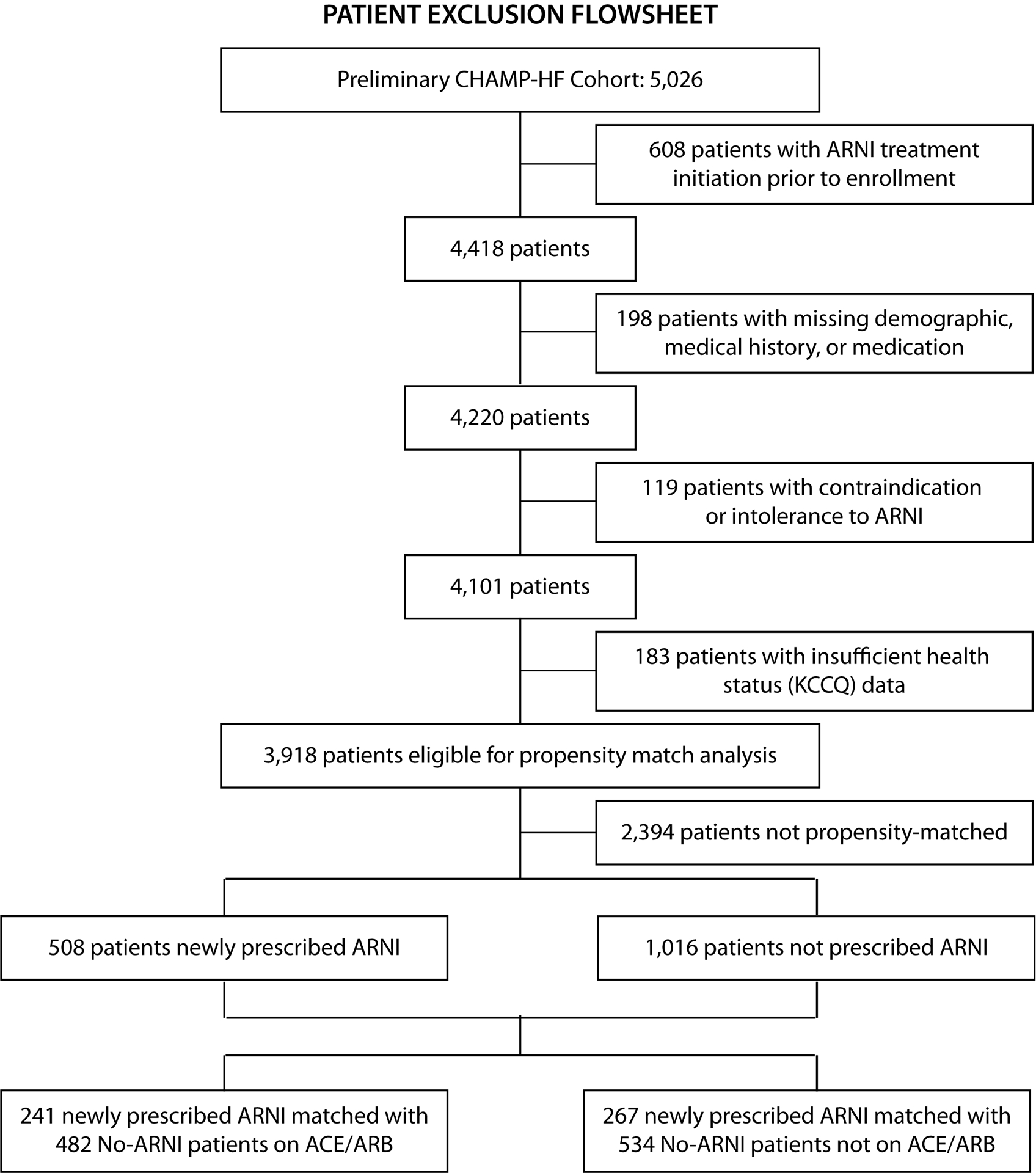
Methods: Health status was assessed by using the 12-item Kansas City Cardiomyopathy Questionnaire (KCCQ) in 3,918 outpatients with HFrEF and left ventricular ejection fraction ≤40% across 140 U.S. centers in the CHAMP-HF (Change the Management of Patients with Heart Failure) registry. ARNI therapy was initiated in 508 patients who were matched 1:2 to 1,016 patients who were not initiated on ARNI (no-ARNI), using a nonparsimonious time-dependent propensity score (6 sociodemographic factors, 23 clinical characteristics), prior KCCQ overall summary (KCCQ-OS) score, and angiotensin-converting enzyme inhibitor/angiotensin receptor blocker status.
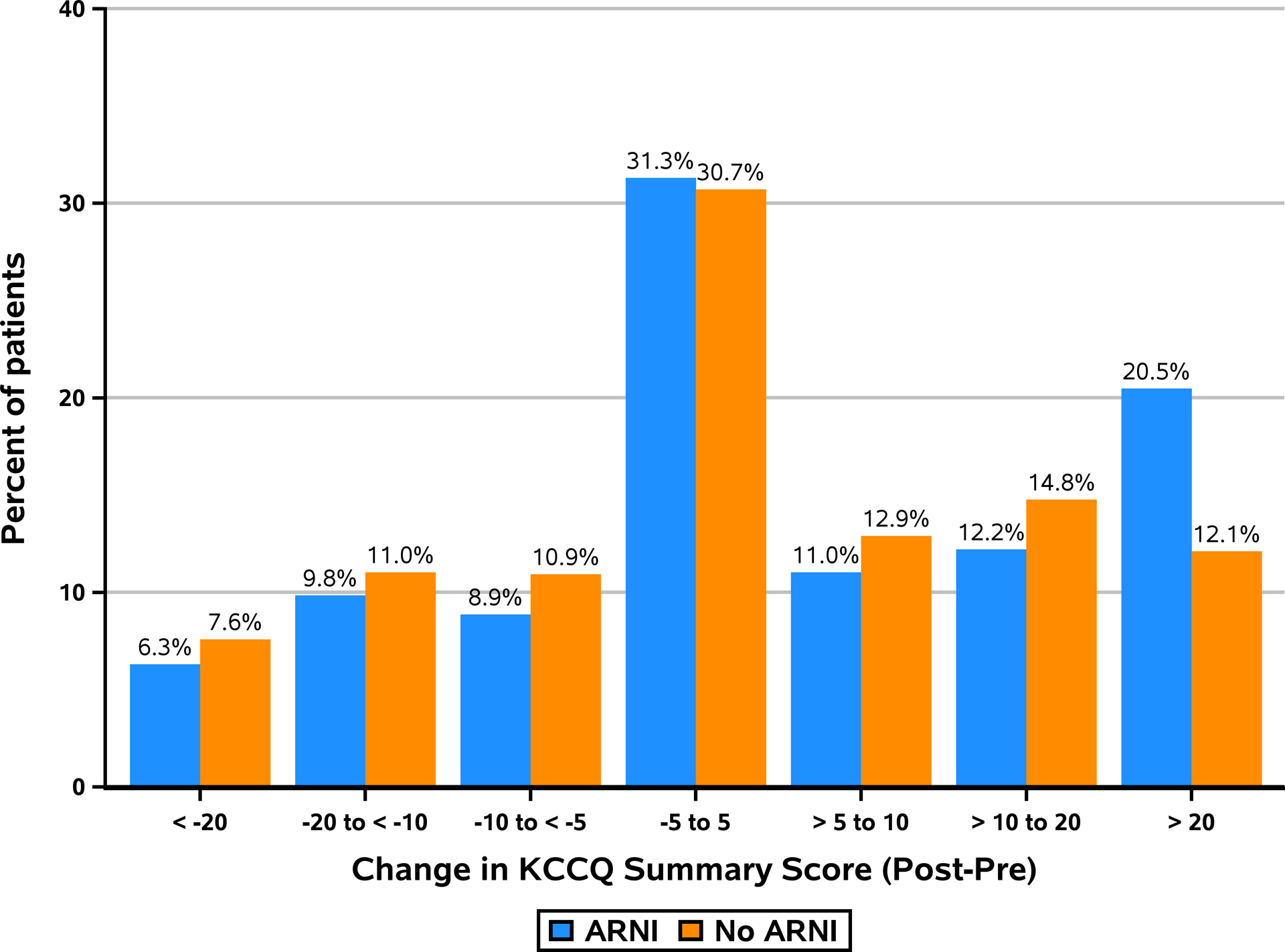
Results: Multivariate linear regression demonstrated a greater mean improvement in KCCQ-OS in patients initiated on ARNI therapy (5.3 ± 19 vs. 2.5 ± 17.4, respectively; p < 0.001) over a median (interquartile range [IQR]) of 57 (32 to 104) days. The proportions of ARNI versus no-ARNI groups with ≥10-point (large) and ≥20-point (very large) improvements in KCCQ-OS were 32.7% versus 26.9%, respectively, and 20.5% versus 12.1%, respectively, consistent with numbers needed to treat of 18 and 12, respectively.
Conclusions: In routine clinical care, ARNI therapy was associated with early improvements in health status, with 20% experiencing a very large health status benefit compared with 12% who were not started on ARNI therapy. These findings support the use of ARNI to improve patients' symptoms, functions, and quality of life.
Keywords: health status; heart failure; sacubitril/valsartan.
Published by Elsevier Inc.
Figures
Comment in
-
Choices in Heart Failure Treatment Goals: The Role of Patient-Reported Health Status.JACC Heart Fail. 2019 Nov;7(11):942-944. doi: 10.1016/j.jchf.2019.06.012. Epub 2019 Sep 11. JACC Heart Fail. 2019. PMID: 31521677 No abstract available.
References
-
- Yancy CW, Jessup M, Bozkurt B, et al. 2013 ACCF/AHA guideline for the management of heart failure: a report of the American College of Cardiology Foundation/American Heart Association Task Force on Practice Guidelines. J Am Coll Cardiol. 2013;62(16):e147–239. - PubMed
-
- Rumsfeld JS, Alexander KP, Goff DC Jr., et al. Cardiovascular health: the importance of measuring patient-reported health status: a scientific statement from the American Heart Association. Circulation. 2013;127(22):2233–2249. - PubMed
-
- Pokharel Y, Khariton Y, Tang Y, et al. Association of Serial Kansas City Cardiomyopathy Questionnaire Assessments With Death and Hospitalization in Patients With Heart Failure With Preserved and Reduced Ejection Fraction: A Secondary Analysis of 2 Randomized Clinical Trials. JAMA Cardiol. 2017;2(12):1315–1321. - PMC - PubMed
-
- Kosiborod M, Soto GE, Jones PG, et al. Identifying heart failure patients at high risk for near-term cardiovascular events with serial health status assessments. Circulation. 2007;115(15):1975–1981. - PubMed
-
- Soto GE, Jones P, Weintraub WS, Krumholz HM, Spertus JA. Prognostic value of health status in patients with heart failure after acute myocardial infarction. Circulation. 2004;110(5):546–551. - PubMed
Publication types
MeSH terms
Substances
Grants and funding
LinkOut - more resources
Full Text Sources
Medical
Research Materials
Miscellaneous
