


Touchpoints - Opportunities to predict and prevent opioid overdose: A cohort study
- PMID: 31521956
- PMCID: PMC7020606
- DOI: 10.1016/j.drugalcdep.2019.06.039
Touchpoints - Opportunities to predict and prevent opioid overdose: A cohort study
Abstract
Background: Medical care, public health, and criminal justice systems encounters could serve as touchpoints to identify and intervene with individuals at high-risk of opioid overdose death. The relative risk of opioid overdose death and proportion of deaths that could be averted at such touchpoints are unknown.
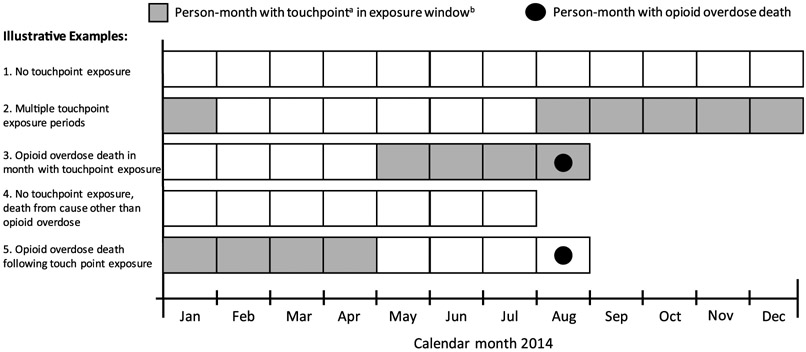
Methods: We used 8 individually linked data sets from Massachusetts government agencies to perform a retrospective cohort study of Massachusetts residents ages 11 and older. For each month in 2014, we identified past 12-month exposure to 4 opioid prescription touchpoints (high dosage, benzodiazepine co-prescribing, multiple prescribers, or multiple pharmacies) and 4 critical encounter touchpoints (opioid detoxification, nonfatal opioid overdose, injection-related infection, and release from incarceration). The outcome was opioid overdose death. We calculated Standardized Mortality Ratios (SMRs) and Population Attributable Fractions (PAFs) associated with touchpoint exposure.
Results: The cohort consisted of 6,717,390 person-years of follow-up with 1315 opioid overdose deaths. We identified past 12-month exposure to any touchpoint in 2.7% of person-months and for 51.8% of opioid overdose deaths. Opioid overdose SMRs were 12.6 (95% CI: 11.1, 14.1) for opioid prescription and 68.4 (95% CI: 62.4, 74.5) for critical encounter touchpoints. Fatal opioid overdose PAFs were 0.19 (95% CI: 0.17, 0.21) for opioid prescription and 0.37 (95% CI: 0.34, 0.39) for critical encounter touchpoints.
Conclusions: Using public health data, we found eight candidate touchpoints were associated with increased risk of fatal opioid overdose, and collectively identified more than half of opioid overdose decedents. These touchpoints are potential targets for development of overdose prevention interventions.
Keywords: Opioid overdose; Opioid prescribing; Population attributable fraction; Standardized mortality ratio.
Copyright © 2019 Elsevier B.V. All rights reserved.
Conflict of interest statement
Declaration of Competing Interest
Dr. Larochelle reports a research grant from Optum Labs. The authors have no other conflicts of interest or financial disclosures to report.
Figures
References
-
- Ball LJ, Sherazi A, Laczko D, Gupta K, Koivu S, M AW, Mele T, Tirona R, McCormick JK, Silverman M, 2017. Validation of an algorithm to identify infective endocarditis in people who inject drugs. Med. Care - PubMed
-
- Baumblatt J, Wiedeman C, Dunn JR, Schaffner W, Paulozzi LJ, Jones TF, 2014. High-risk use by patients prescribed opioids for pain and its role in overdose deaths. JAMA Intern. Med 174, 796–801. - PubMed
Publication types
MeSH terms
Substances
Grants and funding
LinkOut - more resources
Full Text Sources
Medical
Miscellaneous
