


Human population movement can impede the elimination of soil-transmitted helminth transmission in regions with heterogeneity in mass drug administration coverage and transmission potential between villages: a metapopulation analysis
- PMID: 31522681
- PMCID: PMC6745807
- DOI: 10.1186/s13071-019-3612-7
Human population movement can impede the elimination of soil-transmitted helminth transmission in regions with heterogeneity in mass drug administration coverage and transmission potential between villages: a metapopulation analysis
Abstract
Background: Soil-transmitted helminth (STH) infections affect predominantly socio-economically disadvantaged populations in sub-Saharan Africa, East Asia and the Americas. Previous mathematical modelling studies have evaluated optimal intervention strategies to break STH transmission in clusters of villages. These studies assumed that villages are closed independent units with no movement of people in or out of communities. Here we examine how human population movement, for example, of seasonal migrant labourers, affect the outcome of mass drug administration (MDA) programmes.
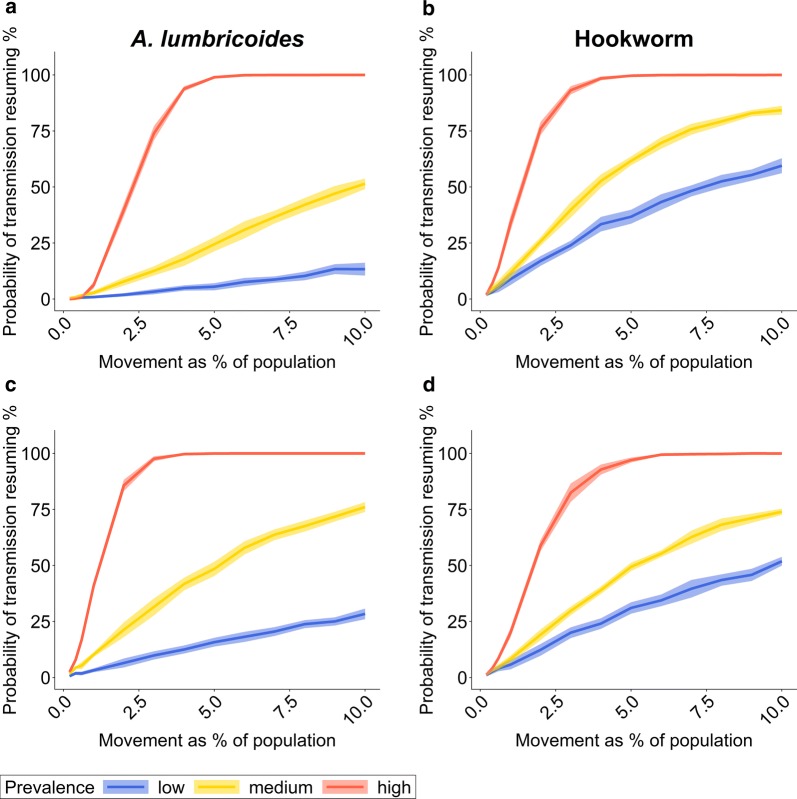
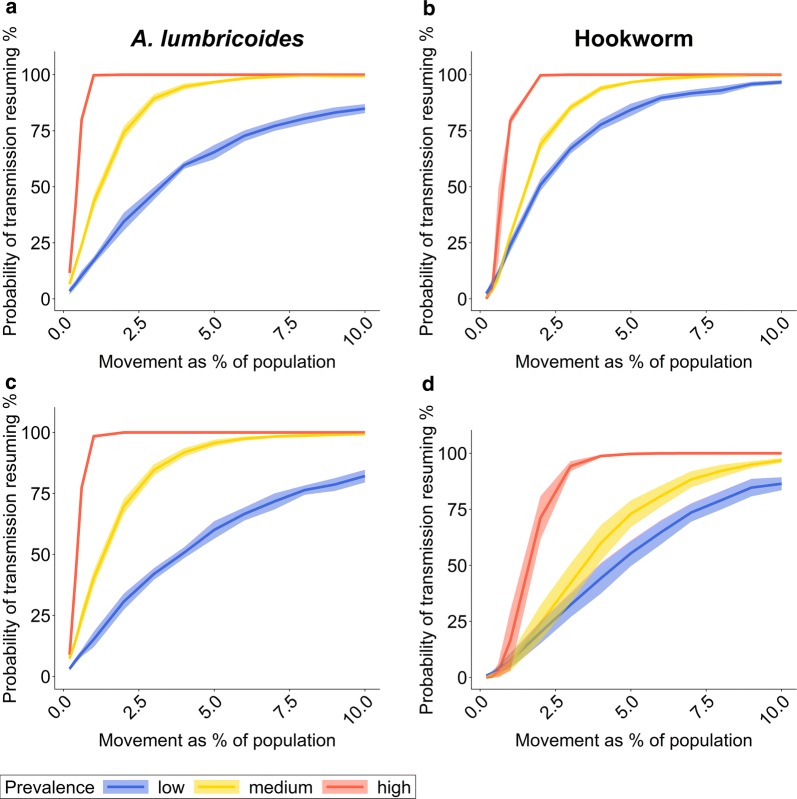
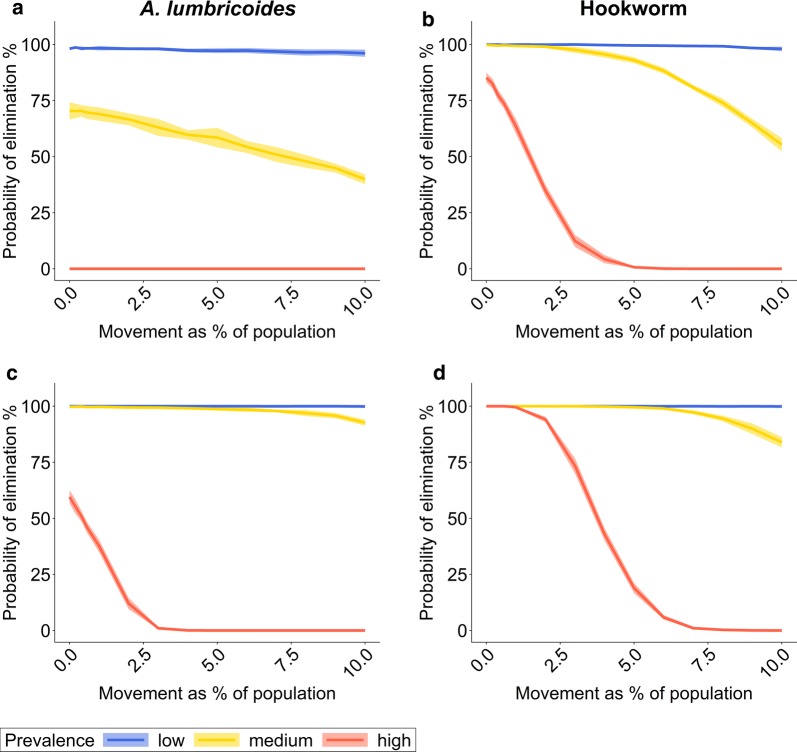
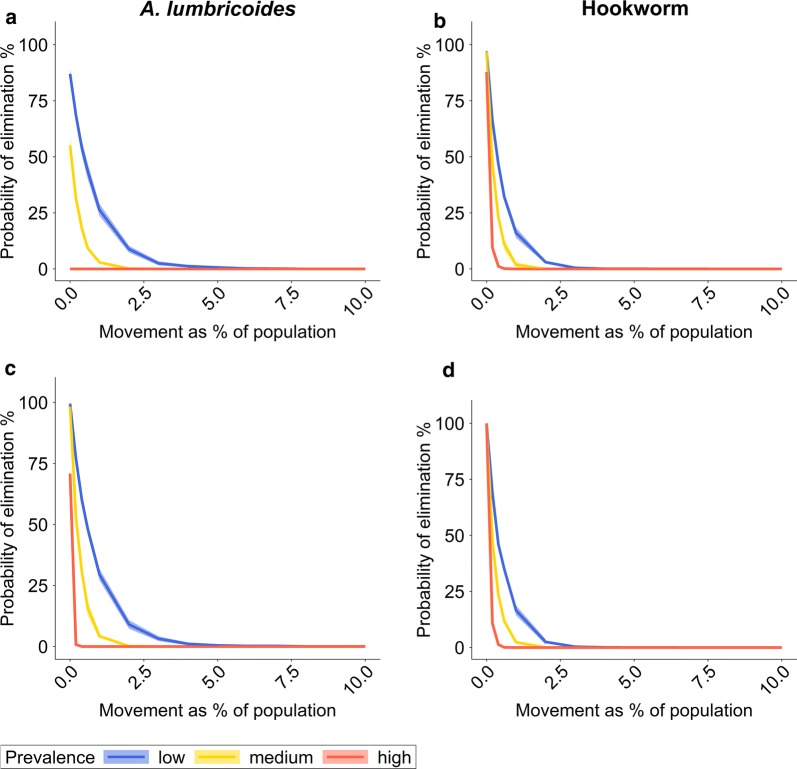
Results: We used a stochastic individual-based metapopulation model to analyse the impact of human population movement at varying rates on STH elimination efforts. Specifically, we looked at seasonal clumped movement events of infected individuals into a village. We showed that even if on average 75% of the entire resident population within a village are treated, an annual rate of 2-3% of the population arriving from an untreated source village can reduce the probability of STH elimination to less than 50% in high-prevalence settings. If a village is infection-free, an annual movement rate of 2-3% from an infected source village imposes a risk of re-introduction of STH of 75% or higher, unless the prevalence in the source village is less than 20%. Even a single arrival of 2-3% of the population can impose a risk of re-introducing STH of 50% or greater depending on the prevalence in the source village. The risk of re-introduction also depends on both the age group of moving individuals and STH species, since the pattern of cross-sectional age-prevalence and age-intensity profiles of infection in the human host are species-specific.
Conclusions: Planning for STH elimination programmes should account for human mobility patterns in defined regions. We recommend that individuals arriving from areas with ongoing STH transmission should receive preventive chemotherapy for STHs. This can most easily be implemented if migration is seasonal and overlaps with treatment rounds, e.g. seasonal migrant labour. Moreover, transmission hotspots in or near treatment clusters should be eliminated, for example, by implementing appropriate water, sanitation and hygiene (WASH) measures and targeting treatment to individuals living in hotspots.
Keywords: Elimination of transmission; Human population movement; Soil-transmitted helminths.
Conflict of interest statement
The authors declare that they have no competing interests.
Figures
References
-
- WHO . Guideline: preventive chemotherapy to control soil-transmitted helminth infections in at-risk population groups. Geneva: World Health Organization; 2017. - PubMed
-
- WHO . Soil-transmitted helminthiases: eliminating soil-transmitted helminthiases as a public health problem in children: progress report 2001–2010 and strategic plan 2011–2020. Geneva: World Health Organization; 2012.
-
- Asbjornsdottir KH, Ajjampur SSR, Anderson RM, Bailey R, Gardiner I, Halliday KE, et al. Assessing the feasibility of interrupting the transmission of soil-transmitted helminths through mass drug administration: the DeWorm3 cluster randomized trial protocol. PLoS Negl Trop Dis. 2018;12:e0006166. doi: 10.1371/journal.pntd.0006166. - DOI - PMC - PubMed
-
- Brooker SJ, Mwandawiro CS, Halliday KE, Njenga SM, Mcharo C, Gichuki PM, et al. Interrupting transmission of soil-transmitted helminths: a study protocol for cluster randomised trials evaluating alternative treatment strategies and delivery systems in Kenya. BMJ Open. 2015;5:e008950. doi: 10.1136/bmjopen-2015-008950. - DOI - PMC - PubMed
MeSH terms
Substances
Grants and funding
LinkOut - more resources
Full Text Sources
Molecular Biology Databases
