


Tumor grading of soft tissue sarcomas using MRI-based radiomics
- PMID: 31522983
- PMCID: PMC6838361
- DOI: 10.1016/j.ebiom.2019.08.059
Tumor grading of soft tissue sarcomas using MRI-based radiomics
Abstract
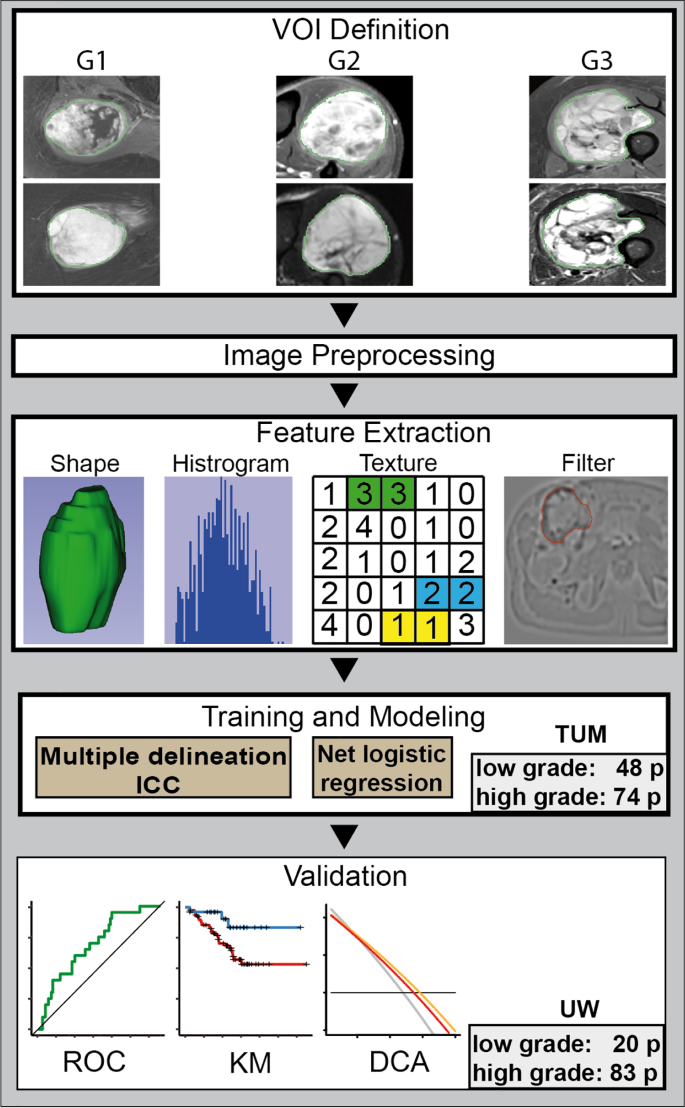
Background: Treatment decisions for multimodal therapy in soft tissue sarcoma (STS) patients greatly depend on the differentiation between low-grade and high-grade tumors. We developed MRI-based radiomics grading models for the differentiation between low-grade (G1) and high-grade (G2/G3) STS.
Methods: The study was registered at ClinicalTrials.gov (number NCT03798795). Contrast-enhanced T1-weighted fat saturated (T1FSGd), fat-saturated T2-weighted (T2FS) MRI sequences, and tumor grading following the French Federation of Cancer Centers Sarcoma Group obtained from pre-therapeutic biopsies were gathered from two independent retrospective patient cohorts. Volumes of interest were manually segmented. After preprocessing, 1394 radiomics features were extracted from each sequence. Features unstable in 21 independent multiple-segmentations were excluded. Least absolute shrinkage and selection operator models were developed using nested cross-validation on a training patient cohort (122 patients). The influence of ComBatHarmonization was assessed for correction of batch effects.
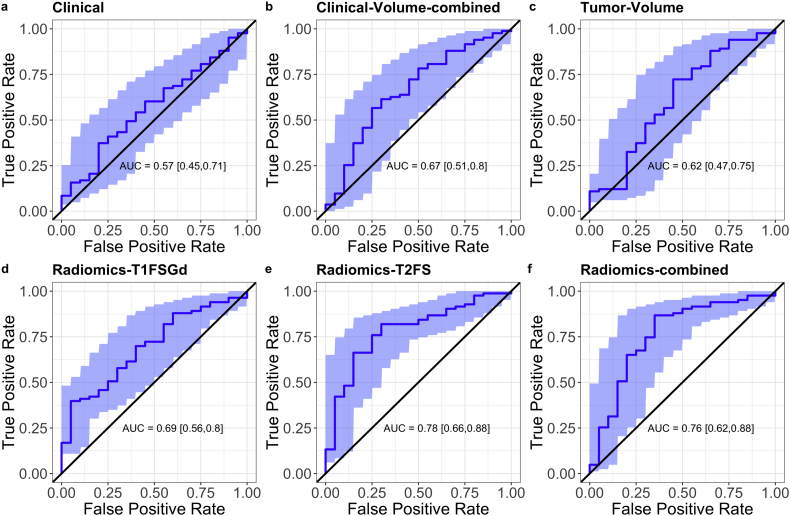
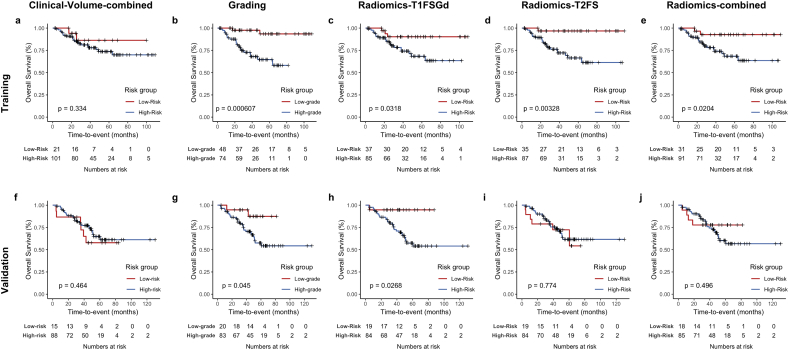
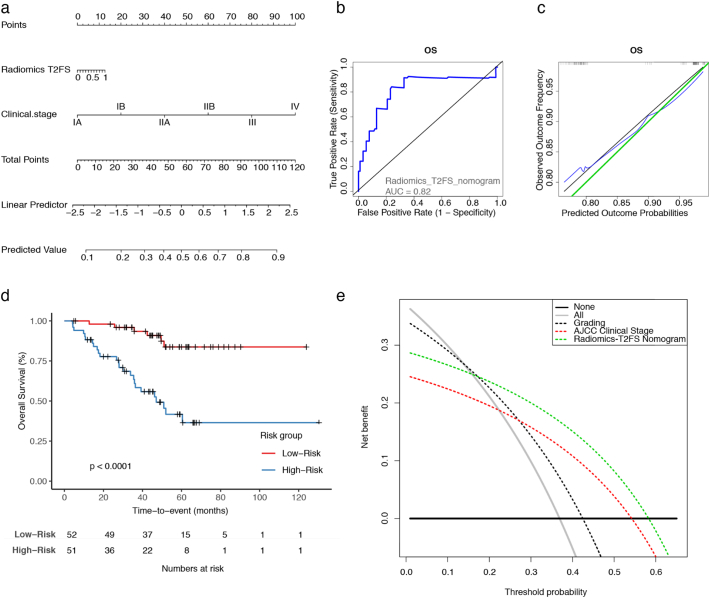
Findings: Three radiomic models based on T2FS, T1FSGd and a combined model achieved predictive performances with an area under the receiver operator characteristic curve (AUC) of 0.78, 0.69, and 0.76 on the independent validation set (103 patients), respectively. The T2FS-based model showed the best reproducibility. The radiomics model involving T1FSGd-based features achieved significant patient stratification. Combining the T2FS radiomic model into a nomogram with clinical staging improved prognostic performance and the clinical net benefit above clinical staging alone.
Interpretation: MRI-based radiomics tumor grading models effectively classify low-grade and high-grade soft tissue sarcomas. FUND: The authors received support by the medical faculty of the Technical University of Munich and the German Cancer Consortium.
Keywords: Biomarker; MRI; Radiomics; Risk stratification; Soft tissue sarcoma; Tumor grading.
Copyright © 2019 The Authors. Published by Elsevier B.V. All rights reserved.
Figures
References
-
- Gutierrez J.C., Perez E.A., Franceschi D., Moffat F.L., Livingstone A.S., Koniaris L.G. Outcomes for soft-tissue sarcoma in 8249 cases from a large state cancer registry. J Surg Res. 2007;141:105–114. - PubMed
-
- Amin M.B., Edge S., Greene F., editors. AJCC cancer staging manual. 8th ed. Springer International Publishing; 2017.
-
- Trojani M., Contesso G., Coindre J.M. Soft-tissue sarcomas of adults; study of pathological prognostic variables and definition of a histopathological grading system. Int J Cancer. 1984;33:37–42. - PubMed
-
- Costa J., Wesley R.A., Glatstein E., Rosenberg S.A. The grading of soft tissue sarcomas. Results of a clinicohistopathologic correlation in a series of 163 cases. Cancer. 1984;53:530–541. - PubMed
-
- Guillou L., Coindre J.M., Bonichon F. Comparative study of the National Cancer Institute and French Federation of Cancer Centers Sarcoma Group grading systems in a population of 410 adult patients with soft tissue sarcoma. J Clin Oncol. 1997;15:350–362. - PubMed
MeSH terms
Associated data
LinkOut - more resources
Full Text Sources
Medical
