


Hospital-Based Quality Improvement Interventions for Patients With Acute Coronary Syndrome: A Systematic Review
- PMID: 31525081
- PMCID: PMC6760859
- DOI: 10.1161/CIRCOUTCOMES.118.005513
Hospital-Based Quality Improvement Interventions for Patients With Acute Coronary Syndrome: A Systematic Review
Abstract
Background: Quality improvement initiatives have been developed to improve acute coronary syndrome care largely in high-income country settings. We sought to synthesize the effect size and quality of evidence from randomized controlled trials (RCTs) and nonrandomized studies for hospital-based acute coronary syndrome quality improvement interventions on clinical outcomes and process of care measures for their potential implementation in low- and middle-income country settings.
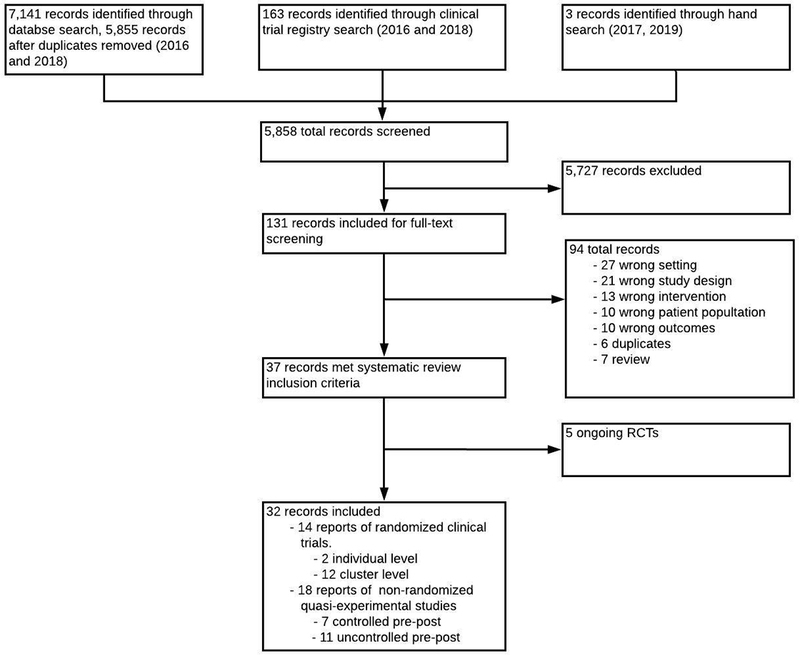
Methods and results: We conducted a bibliometric search of databases and trial registers and a hand search in 2016 and performed an updated search in May 2018 and May 2019. We performed data extraction, risk of bias assessment, and quality of evidence assessments in duplicate. We assessed differences in outcomes by study design comparing RCTs to nonrandomized quasi-experimental studies and by country income status. A meta-analysis was not feasible due to substantial, unexplained heterogeneity among the included studies, and thus, we present a qualitative synthesis. We screened 5858 records and included 32 studies (14 RCTs [n=109 763] and 18 nonrandomized quasi-experimental studies [n=54-423]). In-hospital mortality ranged from 2.1% to 4.8% in the intervention groups versus 3.3% to 5.1% in the control groups in 5 RCTs (n=55 942). Five RCTs (n=64 313) reported 3.0% to 31.0% higher rates of reperfusion for patients with ST-segment-elevation myocardial infarction in the intervention groups. The effect sizes for in-hospital and discharge medical therapies in a majority of RCTs were 3.0% to 10.0% higher in the intervention groups. There was no significant difference in 30-day mortality evaluated by 4 RCTs (n=42 384), which reported 2.5% to 15.0% versus 5.9% to 22% 30-day mortality rates in the intervention versus control groups. In contrast, nonrandomized quasi-experimental studies reported larger effect sizes compared to RCTs. There were no significant consistent differences in outcomes between high-income and middle-income countries. Low-income countries were not represented in any of the included studies.
Conclusions: Hospital-based acute coronary syndrome quality improvement interventions have a modest effect on process of care measures but not on clinical outcomes with expected differences by study design. Although quality improvement programs have an ongoing and important role for acute coronary syndrome quality of care in high-income country settings, further research will help to identify key components for contextualizing and implementing such interventions to new settings to achieve their desired effects. Systematic Review Registration: URL: https://www.crd.york.ac.uk/PROSPERO/. Unique identifier: CRD42016047604.
Keywords: acute coronary syndrome; income; quality improvement.
Figures
References
-
- Benjamin EJ, Virani SS, Callaway CW, Chamberlain AM, Chang AR, Cheng S, Chiuve SE, Cushman M, Delling FN, Deo R, de Ferranti SD, Ferguson JF, Fornage M, Gillespie C, Isasi CR, Jimenez MC, Jordan LC, Judd SE, Lackland D, Lichtman JH, Lisabeth L, Liu S, Longenecker CT, Lutsey PL, Mackey JS, Matchar DB, Matsushita K, Mussolino ME, Nasir K, Flaherty M, Palaniappan LP, Pandey A, Pandey DK, Reeves MJ, Ritchey MD, Rodriguez CJ, Roth GA, Rosamond WD, Sampson UKA, Satou GM, Shah SH, Spartano NL, Tirschwell DL, Tsao CW, Voeks JH, Willey JZ, Wilkins JT, Wu JHY, Alger HM, Wong SS, Muntner P. Heart Disease and Stroke Statistics‚ 2018 Update: A Report From the American Heart Association. Circulation. 2018;137:1–426. - PubMed
-
- Masoudi FA, Ponirakis AP, De Lemos JA, Jollis JG, Kremers M, Messenger JC, Moore JW, Moussa I, Oetgen WJ, Varosy PD, Vincent RN, Wei J, Curtis JP, Roe MT, Spertus JA. Trends in U.S. cardiovascular care: 2016 Report from 4 ACC National Cardiovascular Data Registries. J Am Coll Cardiol 2017;69:1427–1450. - PubMed
-
- PROSPERO International Prospective Register of Systematic Reviews. Hospital-based quality improvement interventions for patients with acute coronary syndrome: a systematic review. CRD42016047604. Available at: www.crd.york.ac.uk/PROSPERO/DisplayPDF.php?ID=CRD42016047604 Accessed on November 23 2018.
-
- World Bank Country and Lending Groups. Available at: https://datahelpdesk.worldbank.org/knowledgebase/articles/906519-world-b... Accessed on June 24 2018.
Publication types
MeSH terms
Grants and funding
LinkOut - more resources
Full Text Sources
