


Spatial distribution of breast cancer in Sudan 2010-2016
- PMID: 31525202
- PMCID: PMC6746353
- DOI: 10.1371/journal.pone.0211085
Spatial distribution of breast cancer in Sudan 2010-2016
Abstract
Background: Breast cancer is the most prevalent cancer among females worldwide including Sudan. The aim of this study was to determine the spatial distribution of breast cancer in Sudan.
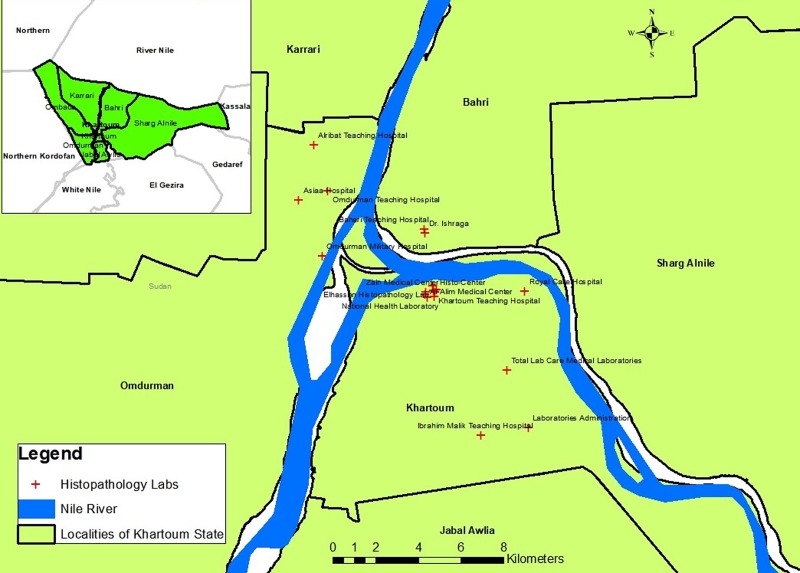
Materials and methods: A facility based cross-sectional study was implemented in eighteen histopathology laboratories distributed in the three localities of Khartoum State on a sample of 4630 Breast Cancer cases diagnosed during the period 2010-2016. A master database was developed through Epi InfoTM 7.1.5.2 for computerizing the data collected: the facility name, type (public or private), and its geo-location (latitude and longitude). Personal data on patients were extracted from their respective medical records (name, age, marital status, ethnic group, state, locality, administrative unit, permanent address and phone number, histopathology diagnosis). The data was summarized through SPSS to generate frequency tables for estimating prevalence and the geographical information system (ArcGIS 10.3) was used to generate the epidemiological distribution maps. ArcGIS 10.3 spatial analysis features were used to develop risk maps based on the kriging method.
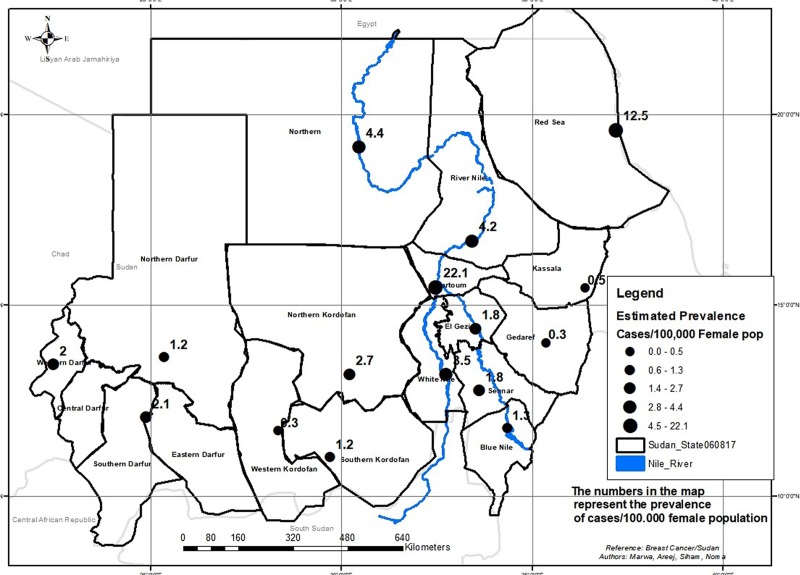
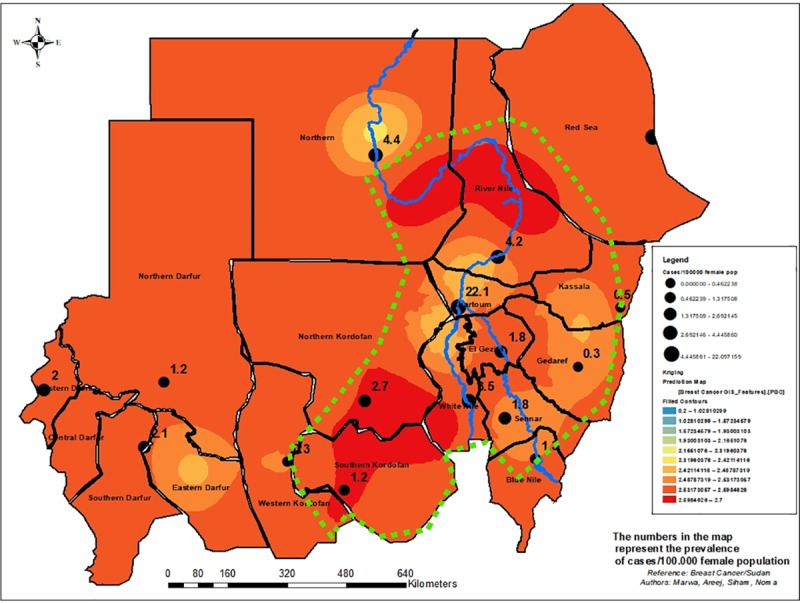
Results: Breast cancer prevalence was 3.9 cases per 100,000 female populations. Of the 4423 cases of breast cancer, invasive breast carcinoma of no special type (NST) was the most frequent (79.5%, 3517/4423) histopathological diagnosis. The spatial analysis indicated as high risk areas for breast cancer in Sudan the States of Nile River, Northern, Red Sea, White Nile, Northern and Southern Kordofan.
Conclusions: The attempt to develop a predictive map of breast cancer in Sudan revealed three levels of risk areas (risk, intermediate and high risk areas); regardless the risk level, appropriate preventive and curative health interventions with full support from decision makers are urgently needed.
Conflict of interest statement
The authors have declared that no competing interests exist.
Figures
References
-
- World Health Organization. Cancer Fact Sheet 2018. Accessed March 13, 2018. http://www.who.int/cancer/world-cancer-day/2018/en/
-
- Bray Freddie, Ferlay Jacques, Soerjomataram Isabelle, Siegel Rebecca L., Torre Lindsey A. and Jemal Ahmedin. Global Cancer Statistics 2018: GLOBOCAN Estimates of Incidence and Mortality Worldwide for 36 Cancers in 185 Countries. CA: Cancer J Clin. 2018;68:394–424. 10.3322/caac.21492 Available online at cacancerjournal.com. - DOI - PubMed
-
- Ferlay J, Soerjomataram I, Ervik M, Dikshit R, Eser S, Mathers C, et.al. GLOBOCAN 2012 v1.0, Cancer Incidence and Mortality Worldwide: IARC CancerBase No. 11 [Internet]. Lyon, France: International Agency for Research on Cancer; 2013. Available from: http://globocan.iarc.fr, accessed on 31/3/2018.
MeSH terms
LinkOut - more resources
Full Text Sources
Medical
