


Immunosenescence and human vaccine immune responses
- PMID: 31528180
- PMCID: PMC6743147
- DOI: 10.1186/s12979-019-0164-9
Immunosenescence and human vaccine immune responses
Abstract
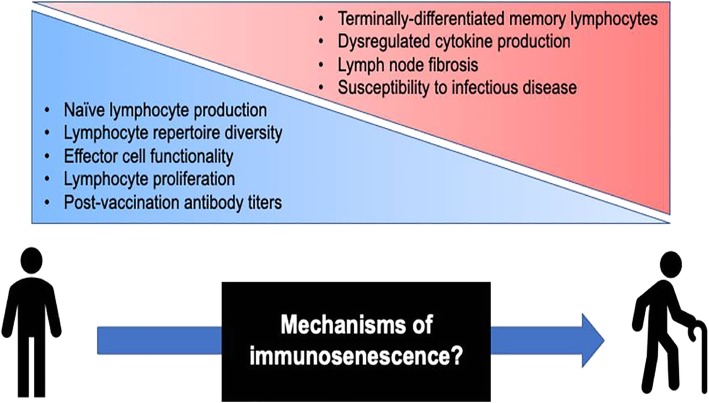
The age-related dysregulation and decline of the immune system-collectively termed "immunosenescence"-has been generally associated with an increased susceptibility to infectious pathogens and poor vaccine responses in older adults. While numerous studies have reported on the clinical outcomes of infected or vaccinated individuals, our understanding of the mechanisms governing the onset of immunosenescence and its effects on adaptive immunity remains incomplete. Age-dependent differences in T and B lymphocyte populations and functions have been well-defined, yet studies that demonstrate direct associations between immune cell function and clinical outcomes in older individuals are lacking. Despite these knowledge gaps, research has progressed in the development of vaccine and adjuvant formulations tailored for older adults in order to boost protective immunity and overcome immunosenescence. In this review, we will discuss the development of vaccines for older adults in light of our current understanding-or lack thereof-of the aging immune system. We highlight the functional changes that are known to occur in the adaptive immune system with age, followed by a discussion of current, clinically relevant pathogens that disproportionately affect older adults and are the central focus of vaccine research efforts for the aging population. We conclude with an outlook on personalized vaccine development for older adults and areas in need of further study in order to improve our fundamental understanding of adaptive immunosenescence.
Keywords: Adaptive immunity; Aging; B cell; Immune response; Immunosenescence; T cell; Vaccination.
Conflict of interest statement
Competing interestsDr. Poland is the chair of a Safety Evaluation Committee for novel investigational vaccine trials being conducted by Merck Research Laboratories. Dr. Poland offers consultative advice on vaccine development to Merck & Co. Inc., Avianax, Adjuvance, Valneva, Medicago, Sanofi Pasteur, GlaxoSmithKline, Dynavax, and Emergent Biosolutions. Drs. Poland and Ovsyannikova hold three patents related to vaccinia and measles peptide vaccines. Dr. Kennedy holds a patent related to vaccinia peptide vaccines. Dr. Kennedy has received research funding from Merck Research Laboratories to study waning immune responses to mumps vaccine. These activities have been reviewed by the Mayo Clinic Conflict of Interest Review Board and are conducted in compliance with Mayo Clinic Conflict of Interest policies. All other authors declare no competing interests.
Figures
References
-
- Fulop T, Dupuis G, Witkowski JM, Larbi A. The role of Immunosenescence in the development of age-related diseases. Rev Investig Clin. 2016;68(2):84–91. - PubMed
Publication types
Grants and funding
LinkOut - more resources
Full Text Sources
Other Literature Sources
