Review
. 2020;13(1):22-30.
doi: 10.2174/1567205016666190809161115.

Skin Ageing: Pathophysiology and Current Market Treatment Approaches

Affiliations
Review

Skin Ageing: Pathophysiology and Current Market Treatment Approaches

Manupriya Chaudhary et al. Curr Aging Sci. 2020.

Abstract

Ageing is a natural phenomenon which is a fold, ridge and crease in the skin that occurs due to loss of body mass, poor hydration, disintegration of dermis and epidermis junction. The Skin ageing process involves many changes that occur due to the combination of both endogenous factors (gene mutation, cellular metabolism, and hormonal factor) and exogenous factors (U.V, pollutants, chemical, and toxins). In 1950, the number of older people were found to be almost 205 million across the globe. But this number almost got 4 times by the year 2012 and the number of older persons increased to a massive amount of 810 million. The ageing of the skin occurs due to various mechanisms like glycation, free radical, cell cycle, and cellular and molecular mechanism of skin ageing. In this review article, we have discussed the treatment, worldwide newer therapies and marketed formulation that are currently available for the reduction of skin ageing. The most promising and revolutionizing field of nanotechnology is mostly applied in the field of dermatology, cosmetics, and biomedical applications. Nanotechnology also plays a vital role in increasing the efficacy of the product.

Keywords: Treatment; body mass; dermatology; nanocarriers; nanotechnology; skin ageing..


Figures

Fig. (1)
Fig. (1)
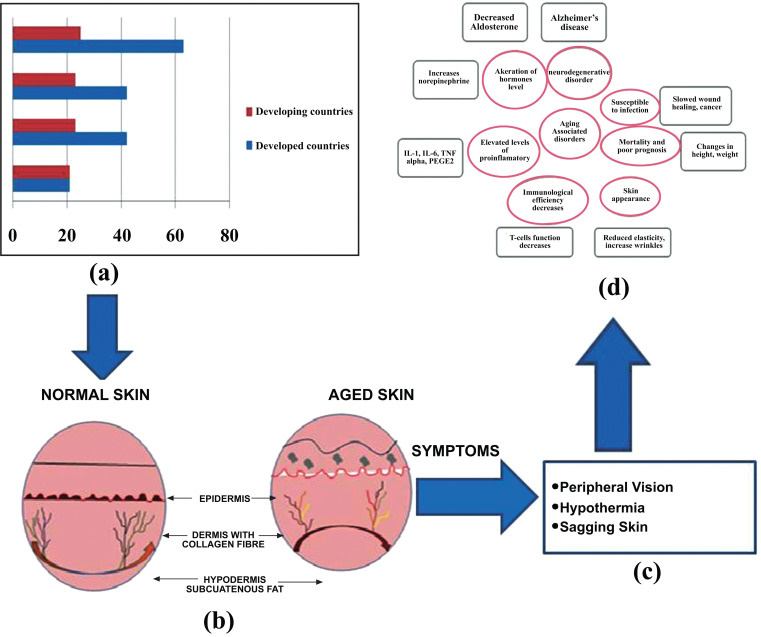
Schematic representation of skin ageing (a) Graphical representation of skin ageing (b) Difference between normal and aged skin (c) Symptoms of skin ageing (d) Disorders associated with skin ageing. (A higher resolution / colour version of this figure is available in the electronic copy of the article).
Fig. (2)
Fig. (2)
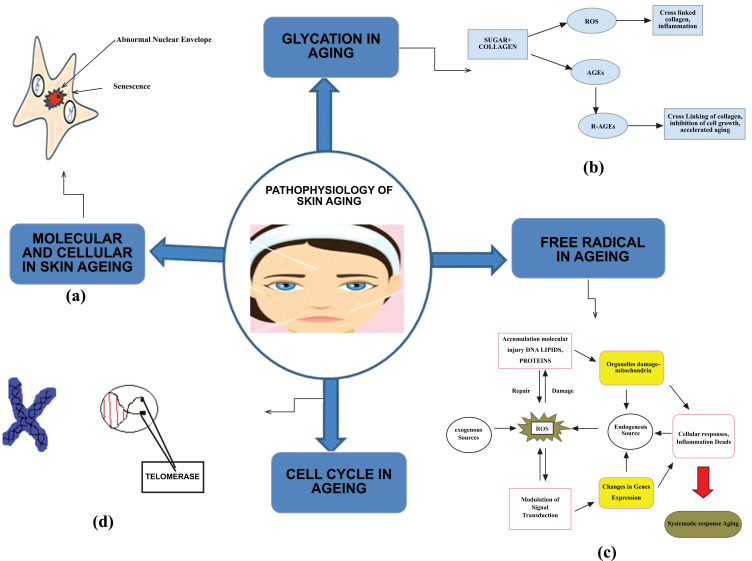
Schematic representations of various mechanism that associated for pathophysiology of Skin ageing (a) Molecular and cellular mechanism of skin ageing (b) Glycation in skin ageing (c) Free radical in skin ageing (d) Cell cycle in skin ageing. (A higher resolution / colour version of this figure is available in the electronic copy of the article).
Fig. (3)
Fig. (3)
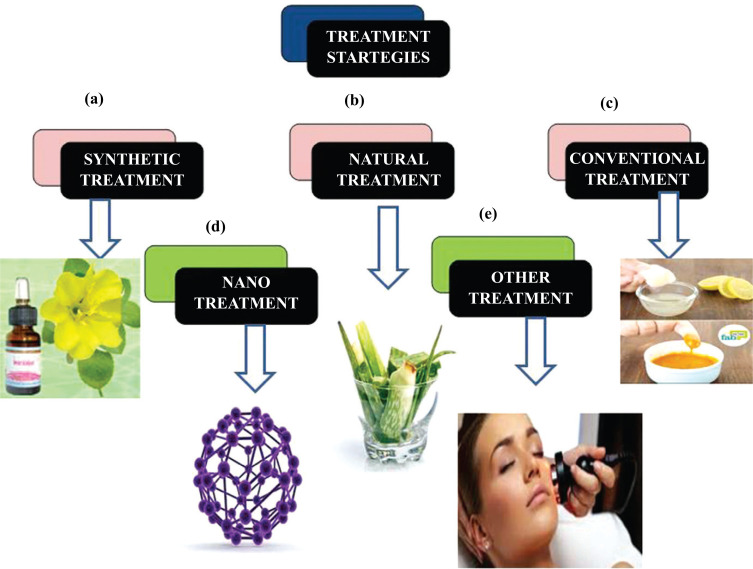
Schematic representations types of treatments for skin ageing (a) Synthetic treatment for skin ageing (b) Natural treatment for skin ageing (c) Conventional treatment for skin ageing (d) Nano treatment for skin ageing (d) Other treatment for skin ageing. (A higher resolution / colour version of this figure is available in the electronic copy of the article).

References

    1. Miguel J.D., Carlos H.M., David M.M. Ageing and the epidemiology of multimorbidity. Eur. Respir. J. 2014;44(4):1055–1068. - PMC - PubMed
    1. Gutiérrez A.M., Nöbauer K., Soler L., et al. Detection of potential markers for systemic disease in saliva of pigs by proteomics: A pilot study. Vet. Immunol. Immunopathol. 2013;151(1-2):73–82. doi: 10.1016/j.vetimm.2012.10.007. - DOI - PubMed
    1. Bolognia J.L., Braverman I.M., Rousseau M.E., Sarrel P.M. Skin changes in menopause. Maturitas. 1989;11(4):295–304. doi: 10.1016/0378-5122(89)90026-1. - DOI - PubMed
    1. Castelo-Branco C., Duran M., González-Merlo J. Skin collagen changes related to age and hormone replacement therapy. Maturitas. 1992;15(2):113–119. doi: 10.1016/0378-5122(92)90245-Y. - DOI - PubMed
    1. Curtis R., Geesaman B.J., DiStefano P.S. Ageing and metabolism: Drug discovery opportunities. Nat. Rev. Drug Discov. 2005;4(7):569–580. doi: 10.1038/nrd1777. - DOI - PubMed

Substances