


Postactivation Potentiation of Bench Press Throw Performance Using Velocity-Based Conditioning Protocols with Low and Moderate Loads
- PMID: 31531135
- PMCID: PMC6724597
- DOI: 10.2478/hukin-2019-0058
Postactivation Potentiation of Bench Press Throw Performance Using Velocity-Based Conditioning Protocols with Low and Moderate Loads
Abstract
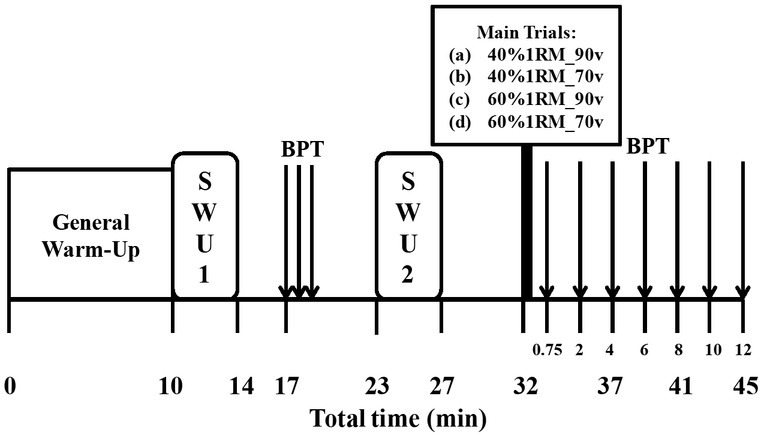
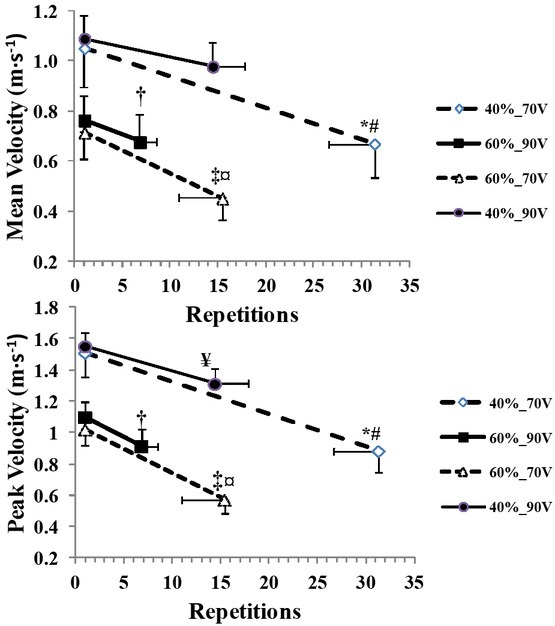
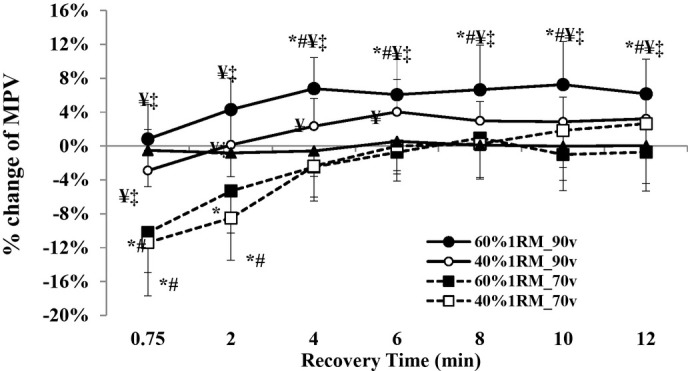
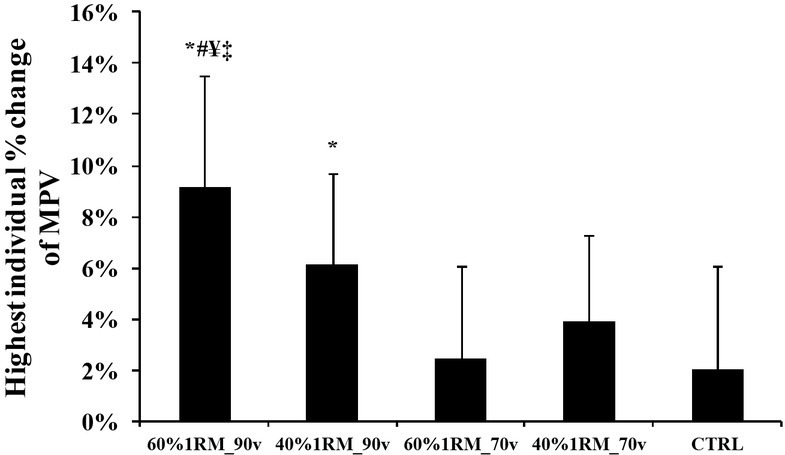
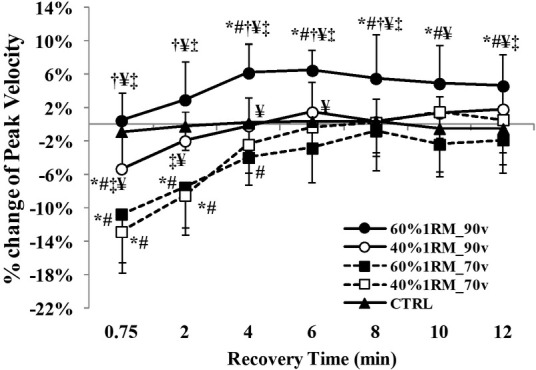
This study examined the acute effects of the bench press exercise with low and moderate loads as well as with two predetermined movement velocity loss percentages on bench press throw performance and surface electromyographic (sEMG) activity. Ten trained men completed 5 main trials in randomized and counterbalanced order one week apart. Mean propulsive velocity (MPV), peak velocity (PV) and sEMG activity of prime movers were evaluated before and periodically for 12 minutes of recovery under five conditions: using loads of 40 or 60% of 1 RM, until mean velocity dropped to 90 or 70%, as well as a control condition (CTRL). MPV and PV were increased 4-12 min into recovery by 4.5-6.8% only after the 60%1RM condition during which velocity dropped to 90% and total exercise volume was the lowest of all conditions (p < 0.01, Hedges' g = 0.8-1.7). When peak individual responses were calculated irrespective of time, MPV was increased by 9.2 ± 4.4 (p < 0.001, Hedges' g = 1.0) and 6.1 ± 3.6% (p < 0.001, Hedges' g = 0.7) under the two conditions with the lowest total exercise volume irrespective of the load, i.e. under the conditions of 40 and 60% 1RM where velocity was allowed to drop to 90%. sEMG activity of the triceps was significantly greater when peak individual responses were taken into account only under the 60%1RM condition when velocity dropped to 90% (p < 0.05, Hedges' g = 0.4). This study showed that potentiation may be maximized by taking into account individual fatigue profiles using velocity-based training.
Keywords: EMG activity; mean propulsive velocity; peak velocity; velocity loss.
Figures

References
-
- Balsalobre-Fernández C, Kuzdub M, Poveda-Ortiz P, Campo-Vecino J Del. Validity and Reliability of the PUSH Wearable Device to Measure Movement Velocity During the Back Squat Exercise. J Strength Cond Res. 2016;30:1968–1974. - PubMed
-
- Bauer P, Uebellacker F, Mitter B, Aigner AJ, Hasenoehrl T, Ristl R, Tschan H, Seitz LB. Combining higher-load and lower-load resistance training exercises: A systematic review and meta-analysis of findings from complex training studies. J Sci Med Sport. 2019;22:838–851. - PubMed
-
- Bevan HR, Owen NJ, Cunningham DJ, Kingsley MIC, Kilduff LP. Complex training in professional rugby players: influence of recovery time on upper-body power output. J Strength Cond Res. 2009;23:1780–1785. - PubMed
-
- Bogdanis GC, Tsoukos A, Veligekas P. Improvement of long-jump performance during competition using a plyometric exercise. Int J Sports Physiol Perform. 2017;12:235–240. - PubMed
-
- Bogdanis GC, Tsoukos A, Veligekas P, Tsolakis C, Terzis G. Effects of muscle action type with equal impulse of conditioning activity on postactivation potentiation. J Strength Cond Res. 2014;28:2521–2528. - PubMed
LinkOut - more resources
Full Text Sources