


Obesity is associated with significantly increased risk for diarrhoea after controlling for demographic, dietary and medical factors: a cross-sectional analysis of the 2009-2010 National Health and Nutrition Examination Survey
- PMID: 31532005
- PMCID: PMC6800600
- DOI: 10.1111/apt.15500
Obesity is associated with significantly increased risk for diarrhoea after controlling for demographic, dietary and medical factors: a cross-sectional analysis of the 2009-2010 National Health and Nutrition Examination Survey
Abstract
Background: Obesity is associated with increased risk for various gastrointestinal and liver diseases. However, the relationship between obesity and abnormal bowel habits is poorly understood.
Aim: To investigate the relationship between body mass index (BMI) and bowel habit, controlling for clinical, demographic and dietary factors, in a representative sample of the United States adult population METHODS: Data were extracted from the 2009-2010 National Health and Nutrition Examination Survey. Survey responses were included in this study if respondents completed the bowel health questionnaire (BHQ), were ≥20 years of age, and did not report history of IBD, celiac disease or colon cancer. BMI was divided into the following categories: underweight, normal weight, overweight, obese and severely obese. Stepwise logistic regression provided risk ratios of constipation and diarrhoea controlling for confounding factors (dietary, life-style, psychological and medical).
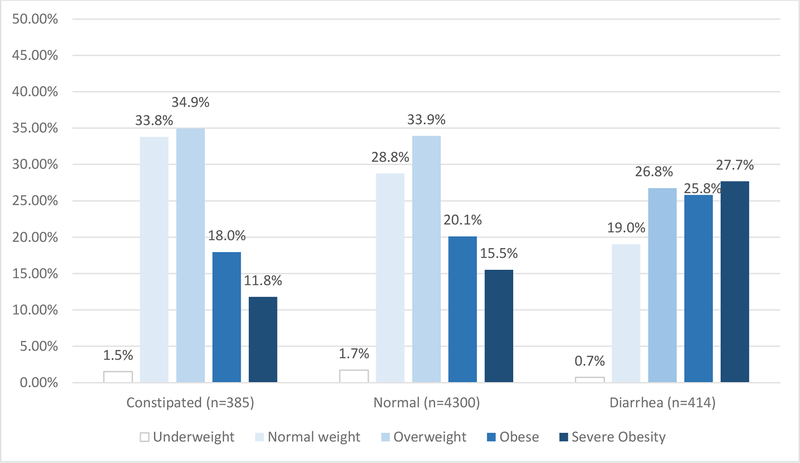
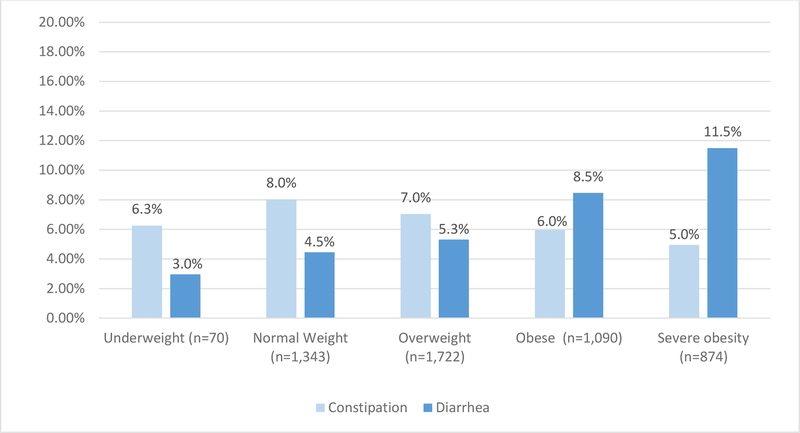
Results: A total of 5126 respondents completed the BHQ, had BMI data available, and met eligibility criteria. Of these, 70 (1.40%) were underweight, 1350 (26.34%) were normal weight, 1731 (33.77%) were overweight, 1097 (21.40%) were obese and 878 (17.13%) were severely obese. Up to 8.5% of obese and 11.5% of severely obese individuals had chronic diarrhoea, compared to 4.5% of normal weight individuals. Stepwise regression revealed that severe obesity was independently associated with increased risk of diarrhoea.
Conclusion: Obesity is positively associated with chronic diarrhoea in a nationally representative US adult population after adjusting for several known confounding factors.
© 2019 John Wiley & Sons Ltd.
Figures
Comment in
-
Editorial: obesity and chronic diarrhoea-A Hill of evidence for causation?Aliment Pharmacol Ther. 2019 Nov;50(10):1137-1138. doi: 10.1111/apt.15530. Aliment Pharmacol Ther. 2019. PMID: 31657475 No abstract available.
-
Letter: diarrhoea in obese patients-a new nosographic entity?Aliment Pharmacol Ther. 2020 Feb;51(3):405. doi: 10.1111/apt.15613. Aliment Pharmacol Ther. 2020. PMID: 31943273 No abstract available.
References
-
- Center for Disease Control and Prevention. Adult Obesity Facts. https://www.cdc.gov/obesity/data/adult.html. Accessed July 1, 2019.
-
- Poirier P, Giles TD, Bray GA, et al. Obesity and cardiovascular disease: pathophysiology, evaluation, and effect of weight loss: an update of the 1997 American Heart Association Scientific Statement on Obesity and Heart Disease from the Obesity Committee of the Council on Nutrition, Physical Activity, and Metabolism. Circulation. 2006;113(6):898–918. doi:10.1161/CIRCULATIONAHA.106.171016 - DOI - PubMed
Publication types
MeSH terms
Grants and funding
LinkOut - more resources
Full Text Sources
Medical
Miscellaneous