


Effect of Psychological Intervention on Fear of Cancer Recurrence: A Systematic Review and Meta-Analysis
- PMID: 31532725
- PMCID: PMC6823887
- DOI: 10.1200/JCO.19.00572
Effect of Psychological Intervention on Fear of Cancer Recurrence: A Systematic Review and Meta-Analysis
Abstract
Purpose: Fear of cancer recurrence (FCR) is a significantly distressing problem that affects a substantial number of patients with and survivors of cancer; however, the overall efficacy of available psychological interventions on FCR remains unknown. We therefore evaluated this in the present systematic review and meta-analysis.
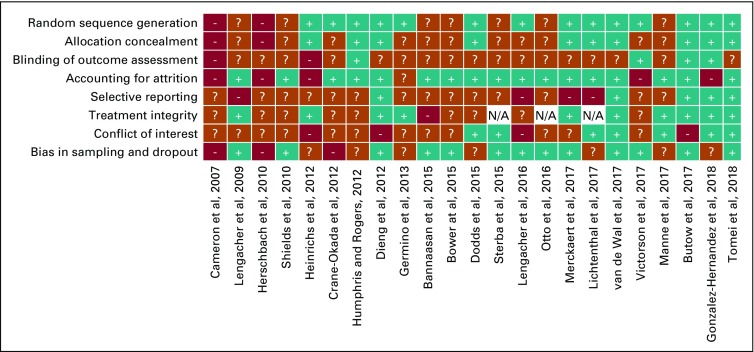
Methods: We searched key electronic databases to identify trials that evaluated the effect of psychological interventions on FCR among patients with and survivors of cancer. Controlled trials were subjected to meta-analysis, and the moderating influence of study characteristics on the effect were examined. Overall quality of evidence was evaluated using the GRADE system. Open trials were narratively reviewed to explore ongoing developments in the field (PROSPERO registration no.: CRD42017076514).
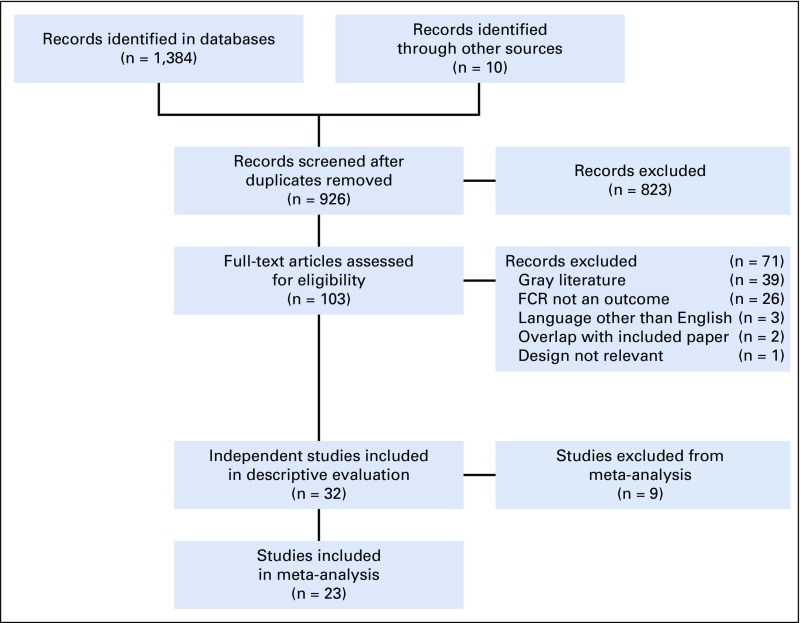
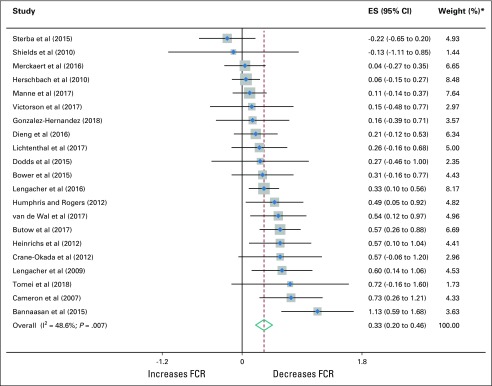
Results: A total of 23 controlled trials (21 randomized controlled trials) and nine open trials were included. Small effects (Hedges's g) were found both at postintervention (g = 0.33; 95% CI, 0.20 to 0.46; P < .001) and at follow-up (g = 0.28; 95% CI, 0.17 to 0.40; P < .001). Effects at postintervention of contemporary cognitive behavioral therapies (CBTs; g = 0.42) were larger than those of traditional CBTs (g = 0.24; β = .22; 95% CI, .04 to .41; P = .018). At follow-up, larger effects were associated with shorter time to follow-up (β = -.01; 95% CI, -.01 to -.00; P = .027) and group-based formats (β = .18; 95% CI, .01 to .36; P = .041). A GRADE evaluation indicated evidence of moderate strength for effects of psychological intervention for FCR.
Conclusion: Psychological interventions for FCR revealed a small but robust effect at postintervention, which was largely maintained at follow-up. Larger postintervention effects were found for contemporary CBTs that were focused on processes of cognition-for example, worry, rumination, and attentional bias-rather than the content, and aimed to change the way in which the individual relates to his or her inner experiences. Future trials could investigate how to further optimize and tailor interventions to individual patients' FCR presentation.
Figures
References
-
- Lebel S, Ozakinci G, Humphris G, et al. Current state and future prospects of research on fear of cancer recurrence. Psychooncology. 2017;26:424–427. - PubMed
-
- Simard S, Thewes B, Humphris G, et al. Fear of cancer recurrence in adult cancer survivors: A systematic review of quantitative studies. J Cancer Surviv. 2013;7:300–322. - PubMed
-
- Goerling U.(ed)Fear of progressioninPsycho-oncology New York, NY: Springer-Verlag Publishing; 2014. pp11–29.
-
- Lee-Jones C, Humphris G, Dixon R, et al. Fear of cancer recurrence: A literature review and proposed cognitive formulation to explain exacerbation of recurrence fears. Psychooncology. 1997;6:95–105. - PubMed
-
- Lebel S, Ozakinci G, Humphris G, et al. From normal response to clinical problem: Definition and clinical features of fear of cancer recurrence. Support Care Cancer. 2016;24:3265–3268. - PubMed
Publication types
MeSH terms
Supplementary concepts
LinkOut - more resources
Full Text Sources
Medical
