


A single session of hyperbaric oxygen therapy demonstrates acute and long-lasting neuroplasticity effects in humans: a replicated, randomized controlled clinical trial
- PMID: 31534358
- PMCID: PMC6682324
- DOI: 10.2147/JPR.S198359
A single session of hyperbaric oxygen therapy demonstrates acute and long-lasting neuroplasticity effects in humans: a replicated, randomized controlled clinical trial
Abstract
Purpose: Animal studies have demonstrated anti-inflammatory, and anti-nociceptive properties of hyperbaric oxygen therapy (HBOT). However, physiological data are scarce in humans. In a recent experimental study, the authors used the burn injury (BI) model observing a decrease in secondary hyperalgesia areas (SHA) in the HBOT-group compared to a control-group. Surprisingly, a long-lasting neuroplasticity effect mitigating the BI-induced SHA-response was seen in the HBOT-preconditioned group. The objective of the present study, therefore, was to confirm our previous findings using an examiner-blinded, block-randomized, controlled, crossover study design.
Patients and methods: Nineteen healthy subjects attended two BI-sessions with an inter-session interval of ≥28 days. The BIs were induced on the lower legs by a contact thermode (12.5 cm2, 47C°, 420 s). The subjects were block-randomized to receive HBOT (2.4 ATA, 100% O2, 90 min) or ambient conditions ([AC]; 1 ATA, 21% O2), dividing cohorts equally into two sequence allocations: HBOT-AC or AC-HBOT. All sensory assessments performed during baseline, BI, and post-intervention phases were at homologous time points irrespective of sequence allocation. The primary outcome was SHA, comparing interventions and sequence allocations.
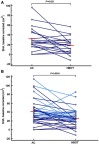
Results: Data are mean (95% CI). During HBOT-sessions a mitigating effect on SHA was demonstrated compared to AC-sessions, ie, 18.8 (10.5-27.0) cm2 vs 32.0 (20.1-43.9) cm2 (P=0.021), respectively. In subjects allocated to the sequence AC-HBOT a significantly larger mean difference in SHA in the AC-session vs the HBOT-session was seen 25.0 (5.4-44.7) cm2 (P=0.019). In subjects allocated to the reverse sequence, HBOT-AC, no difference in SHA between sessions was observed (P=0.55), confirming a preconditioning, long-lasting (≥28 days) effect of HBOT.
Conclusion: Our data demonstrate that a single HBOT-session compared to control is associated with both acute and long-lasting mitigating effects on BI-induced SHA, confirming central anti-inflammatory, neuroplasticity effects of hyperbaric oxygen therapy.
Keywords: burns; hyperbaric oxygenation; inflammation; pathophysiology; secondary hyperalgesia.
Conflict of interest statement
Mrs Anna M Wahl reports grants from P. Carl Petersens Fond and grants from C.C. Klestrup og hustru Henriette Klestrups Mindelegat, during the conduct of the study. The authors report no other conflicts of interest in this work.
Figures



References
-
- Weaver LK, Churchill SK, Bell J, Deru K, Snow GL. A blinded trial to investigate whether ‘pressure-familiar’ individuals can determine chamber pressure. Undersea Hyperb Med. 2012;39(4):801–805. - PubMed
Associated data
LinkOut - more resources
Full Text Sources
Other Literature Sources
Research Materials
Miscellaneous
