. 2019 Aug 28:58:1-26.
doi: 10.3897/mycokeys.58.36723. eCollection 2019.

Rubroshiraia gen. nov., a second hypocrellin-producing genus in Shiraiaceae (Pleosporales)

Affiliations

Rubroshiraia gen. nov., a second hypocrellin-producing genus in Shiraiaceae (Pleosporales)

Dong-Qin Dai et al. MycoKeys. .

Abstract

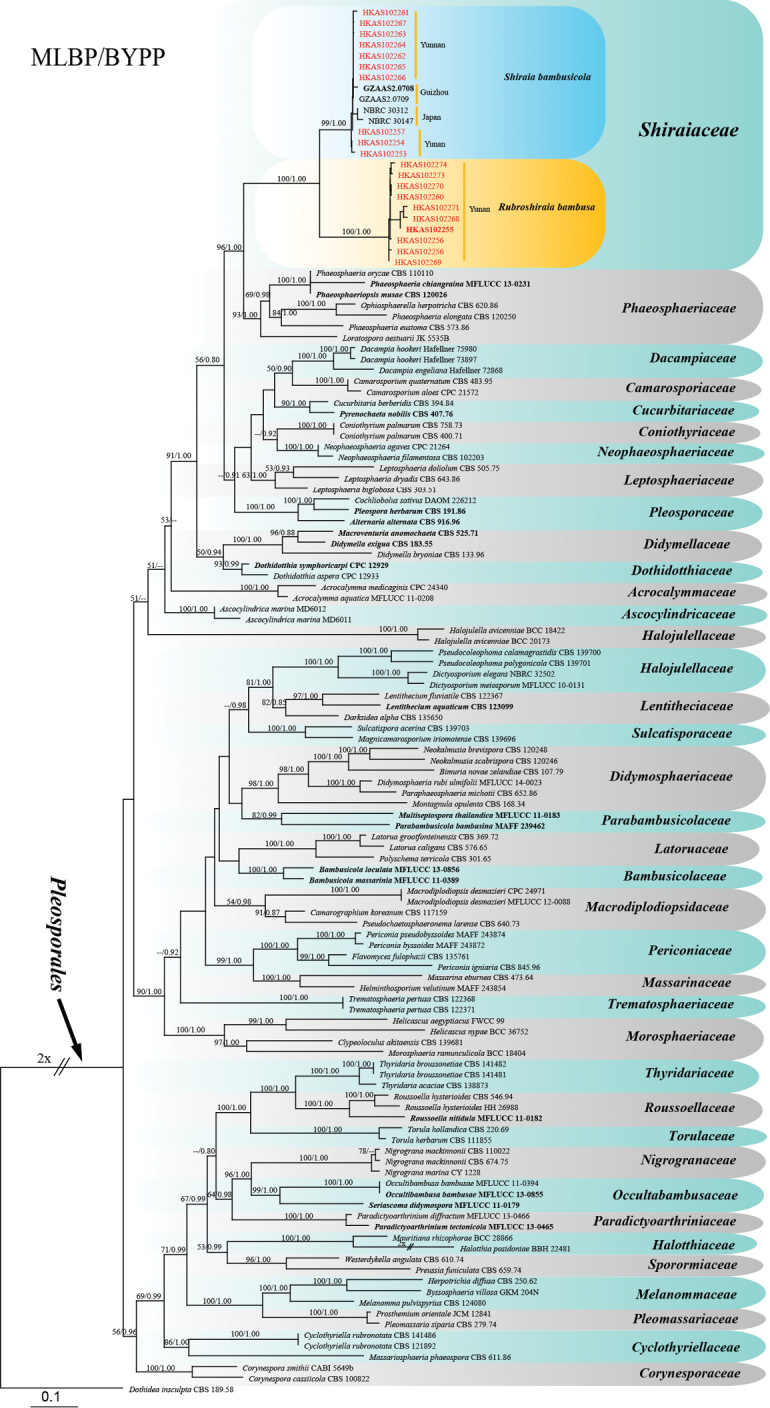
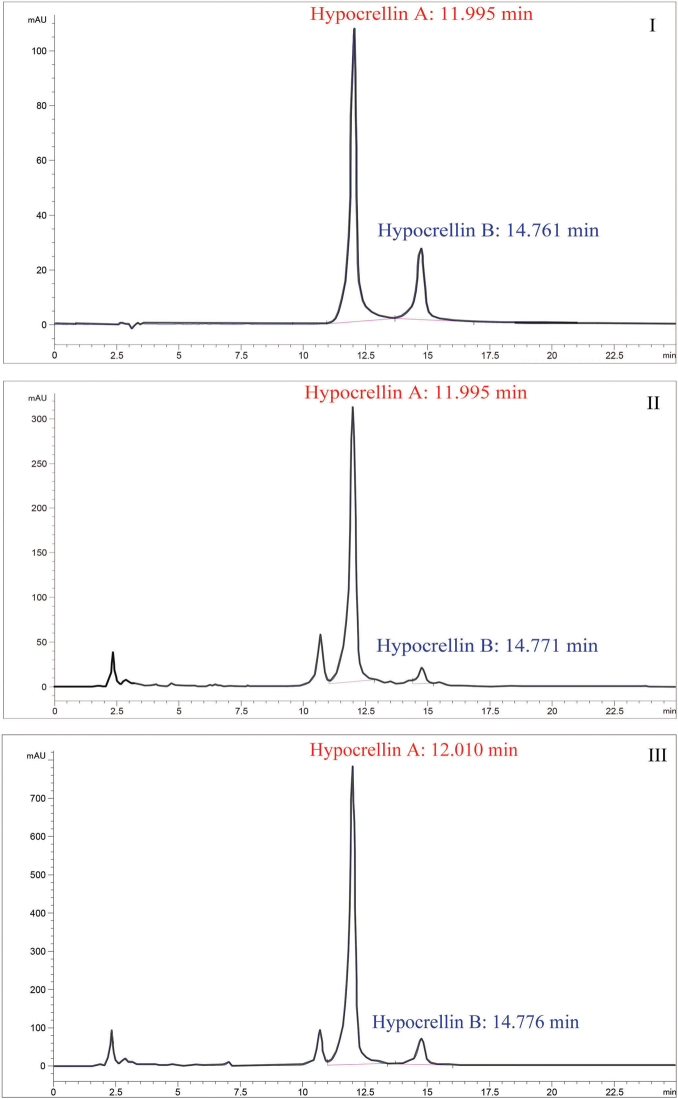
Shiraiaceae is an important family in Pleosporales (Dothideomycetes), which includes medical fungi and plant pathogens. Two hypocrellin-producing taxa, Shiraia bambusicola and a novel genus Rubroshiraia gen. nov., typified by Rubroshiraia bambusae are treated in this article. Maximum likelihood analysis, generated via RAxML (GTR+G model), using a combined SSU, LSU, TEF1 and RPB2 sequence dataset, shows that Rubroshiraia is close to Shiraia and belongs to the family Shiraiaceae. Descriptions, illustrations and a taxonomic key are provided for the genera in Shiraiaceae. Rubroshiraia morphologically differs from Shiraia in having small and dark ascostromata and filiform ascospores. Production of the ascostromatal metabolites, hypocrellin A and B, were examined by HPLC and spectrophotometer. The content of hypocrellin A and B of specimen HKAS 102255 (R. bambusae) is twice that produced by HKAS 102253 (S. bambusicola). To clarify the relationship between R. bambusae and Hypocrella bambusae, type material of the latter was examined and provided the illustration.

Keywords: HPLC; metabolite; new genus; phylogeny; taxonomy.


Figures
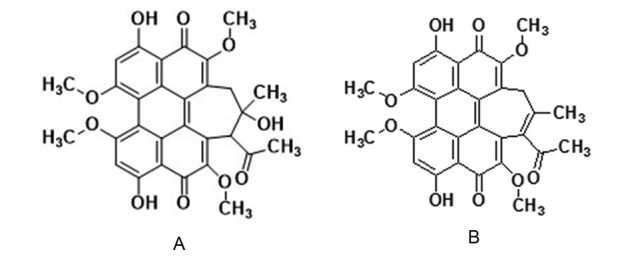
Figure 1.
Figure 1.
Chemical structures of hypocrellin A and hypocrellin B. A hypocrellin A B hypocrellin B.
Figure 2.
Figure 2.
Maximum likelihood phylogenetic tree generated from RAxML (GTR+G model), based on combined LSU, SSU, TEF1 and RPB2 sequences data. ML values (MLBP) (> 50%), resulting from 1000 bootstrap replicates and Bayesian posterior probabilities (BYPP) greater than 0.90, are given at the nodes. The original isolate numbers’ codes are noted after the species names. The tree is rooted to Dothidea insculpta (CBS 189.58). Ex-type or ex-epitype strains are in bold. Newly generated strains are in red and the new genus is in yellow background.
Figure 3.
Figure 3.
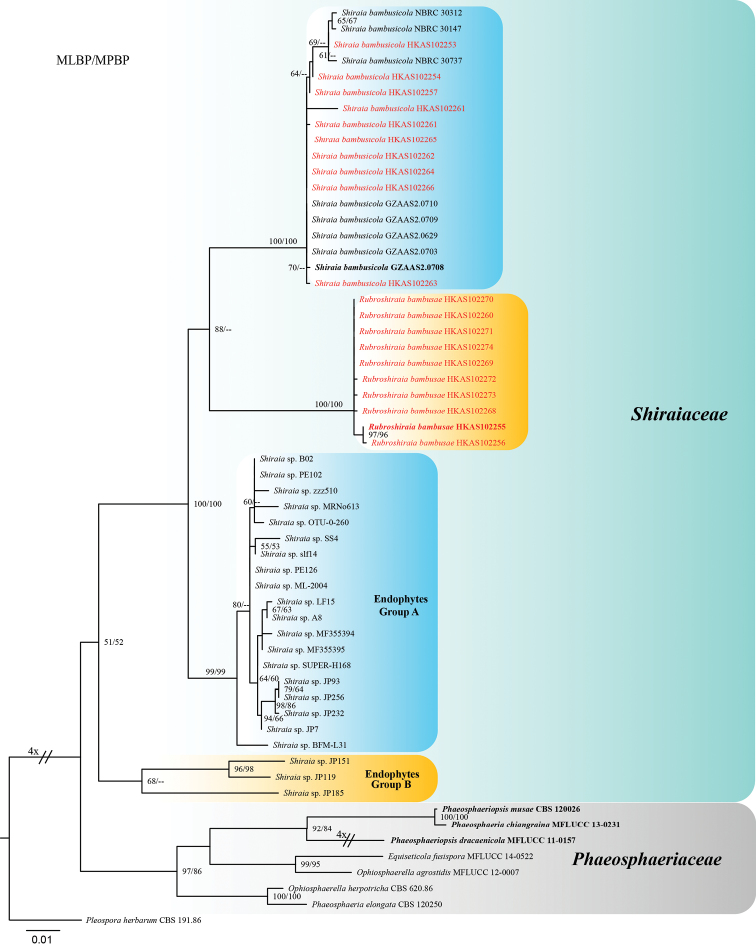
Maximum likelihood phylogenetic tree generated from RAxML (GTR+G model), based on combined LSU and ITS sequences data. ML and MP values (MLBP/MPBP) (> 50%), resulting from 1000 bootstrap replicates, are given at the nodes. The original isolate numbers’ codes are noted after the species names. The tree is rooted to Pleospora herbarum (CBS 191.86). Ex-type or ex-epitype strains are in bold. Newly generated strains are in red.
Figure 4.
Figure 4.
Hypocrellin A and hypocrellin B HPLC-UV profiles (265 nm) of standards and stromatal HPLC-UV profiles (265 nm) of specimens of Shiraia bambusicola (HKAS 102253) (II) and Rubroshiraia bambusae (HKAS 102255) (III) and DAD spectra of major metabolites.
Figure 5.
Figure 5.
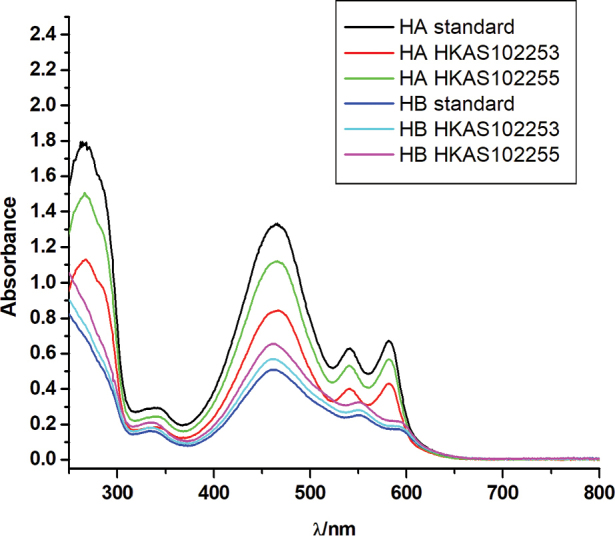
The UV spectrum of the standards and of hypocrellin A and B from the samples (Shiraia bambusicolaHKAS 102253 and Rubroshiraia bambusaeHKAS 102255) were recorded in alcohol at room temperature. HA: hypocrellin A, HB: hypocrellin B.
Figure 6.
Figure 6.
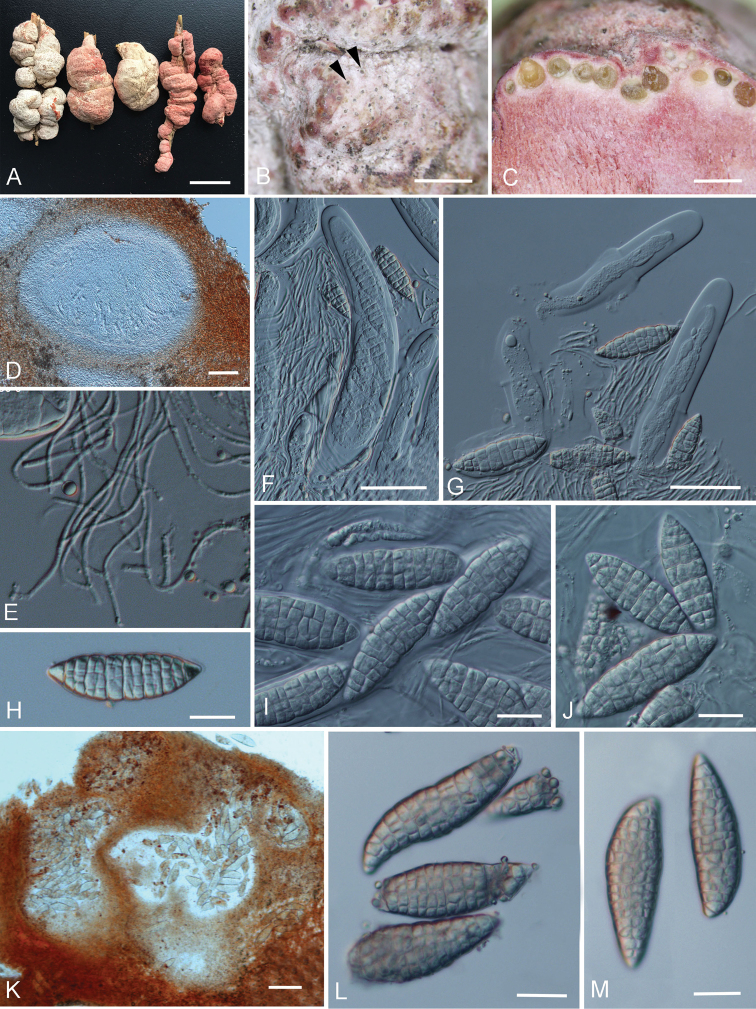
Shiraia bambusicolaA–J sexual morph A fruiting bodies (HKAS102253, HKAS102254, HKAS102257, HKAS102261, HKAS102262) B–J photographs from material HKAS102253 B Surface of ascostromata showing the dark openings of ostiole C vertical section of ascostromata D vertical section of locule E pseudoparaphyses F, G asci (G Showing the fissitunicate asci) H–J ascospores K–M asexual morph K vertical section of asexual locules L–M conidia. Scale bars: 2 cm (A), 5 mm (B), 1 mm (C), 100 μm (D, K), 50 μm (F, G), 20 μm (H–J, L, M).
Figure 7.
Figure 7.
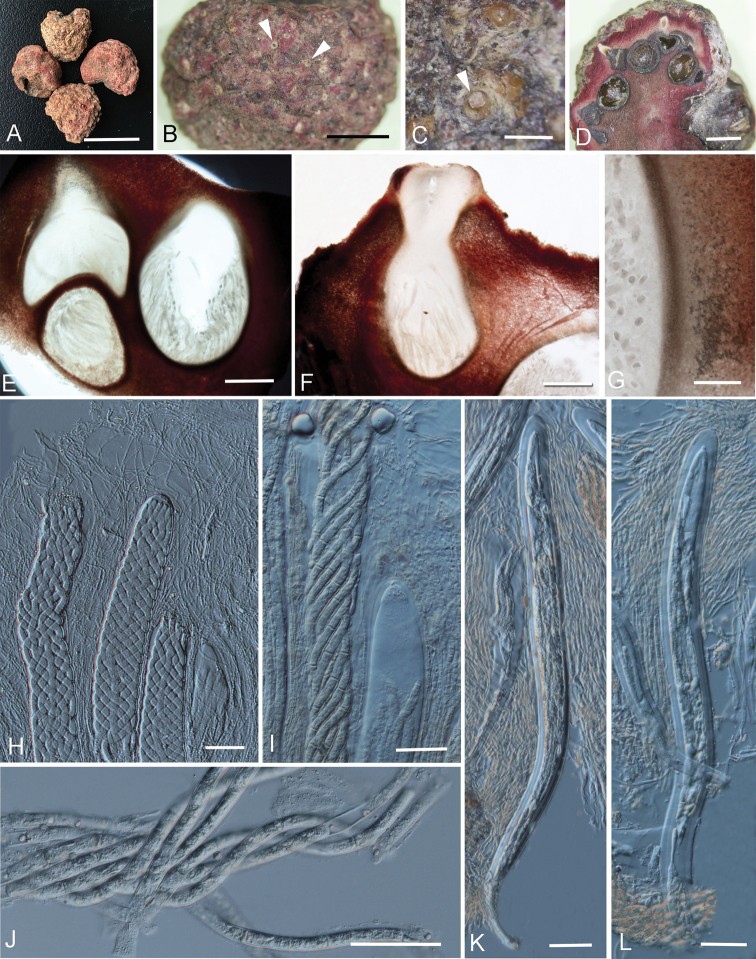
Rubroshiraia bambusae (HKAS102255, holotype) A fruiting bodies B, C surface of ascostromata showing the openings of ostiole D vertical section of ascostromata E, F vertical section of locule G peridium of locule H asci and pseudoparaphyses I asci and asci ocular chamber J ascospores K, L immature asci. Scale bars: 1 cm (A), 25 mm (B), 2 mm (C, D), 500 μm (E, F), 200 μm (G), 50 μm (H–L).
Figure 8.
Figure 8.
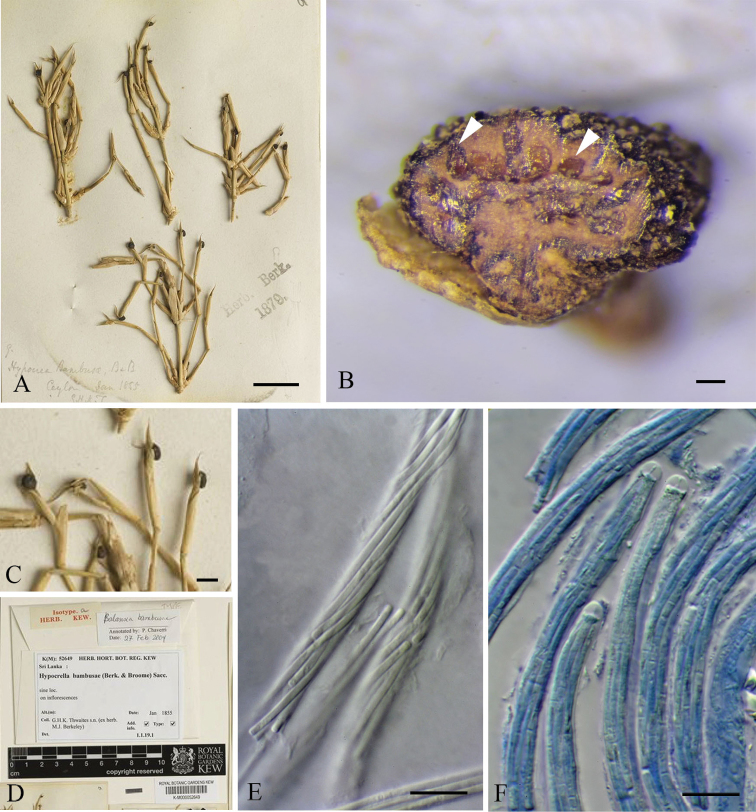
Hypocrella bambusae (K(M)52469, isotype, images are accredited to the Royal Botanic Gardens, Kew) A, C fruiting bodies on inflorescence of bamboo B vertical section of stromata showing the perithecia locating D herbarium envelope E filiform ascospores F asci with caps (Staining by cotton blue). Scale bars: 5 mm (A), 200 μm (B), 2 mm (C), 20 μm (E, F).

References

    1. Amano N. (1980) Studies on the Japanese Loculoascomycetes. II. Taxonomic position of the genus Shiraia. Bulletin of the National Science Museum 6: 55–60.
    1. Ariyawansa HA, Kang JC, Alias SA, Chukeatirote E, Hyde KD. (2013) Towards a natural classification of Dothideomycetes: The genera Dermatodothella, Dothideopsella, Grandigallia, Hysteropeltella and Gloeodiscus (Dothideomycetesincertae sedis). Phytotaxa 147: 35–47. 10.11646/phytotaxa.147.2.1 - DOI
    1. Barr ME, Boise JR, Hanlin RT. (1987) A spectacular Loculoascomycete from Venezuela. Mycotaxon 29: 195–198.
    1. Berkeley MJ, Broome CE. (1875) Enumeration of the fungi of Ceylon. Part II. Botanical Journal of the Linnean Society 14: 29–141. 10.1111/j.1095-8339.1873.tb00301.x - DOI
    1. Cai Y, Liao X, Liang X, Ding Y, Sun J, Zhang D. (2011) Induction of hypocrellin production by Triton X-100 under submerged fermentation with Shiraia sp. SUPER-H168. New Biotechnology 28: 588–592. 10.1016/j.nbt.2011.02.001 - DOI - PubMed

LinkOut - more resources