. 2019 Sep 10;5(8):FSO413.
doi: 10.2144/fsoa-2019-0065.

Autologous induced pluripotent stem cell-derived four-organ-chip

Affiliations

Autologous induced pluripotent stem cell-derived four-organ-chip

Anja Patricia Ramme et al. Future Sci OA. .

Abstract

Microphysiological systems play a pivotal role in progressing toward a global paradigm shift in drug development. Here, we designed a four-organ-chip interconnecting miniaturized human intestine, liver, brain and kidney equivalents. All four organ models were predifferentiated from induced pluripotent stem cells from the same healthy donor and integrated into the microphysiological system. The coculture of the four autologous tissue models in one common medium deprived of tissue specific growth factors was successful over 14-days. Although there were no added growth factors present in the coculture medium, the intestine, liver and neuronal model maintained defined marker expression. Only the renal model was overgrown by coexisting cells and did not further differentiate. This model platform will pave the way for autologous coculture cross-talk assays, disease induction and subsequent drug testing.

Keywords: differentiation; four-organ-chip; induced pluripotent stem cells; microphysiological system; multi-organ-chip.


Conflict of interest statement

Financial & competing interests disclosure U Marx is a founder of TissUse GmbH, which commercializes MPS platforms. This project has received funding from the European Union’s Horizon 2020 research and innovation programme under grant agreement No 681002 (EU-ToxRisk) and the German Federal Ministry for Education and Research, GO-Bio 3B No: 031B0062. The authors have no other relevant affiliations or financial involvement with any organization or entity with a financial interest in or financial conflict with the subject matter or materials discussed in the manuscript apart from those disclosed. No writing assistance was utilized in the production of this manuscript.

Figures

Figure 1.
Figure 1.. The microfluidic four-organ-chip at a glance.
3D view of the four-organ-chip (A), physiologically inspired model of the four-organ-chip (B). Pink: surrogate blood circuit, yellow: excretory circuit. Calculated velocity distribution (mm/s) at a flow rate of 16.9 μl/min in the surrogate blood circuit (C). Distribution of the wall shear stress (Pa) in the tubular compartment of the excretory circuit at a mean shear stress of 0.1 Pa (D).
Figure 2.
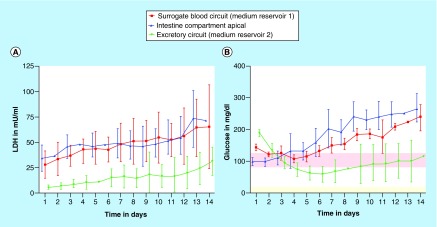
Figure 2.. Systemic tissue viability in the four-organ-chip over 14 days of coculture.
Measured by LDH activity (A) and glucose balance (B). Means with standard deviation are plotted. n = 10. The physiological glucose concentration range in the human blood [38] (red area) and urine [39] (light yellow area) of healthy people is drawn for comparison.
Figure 3.
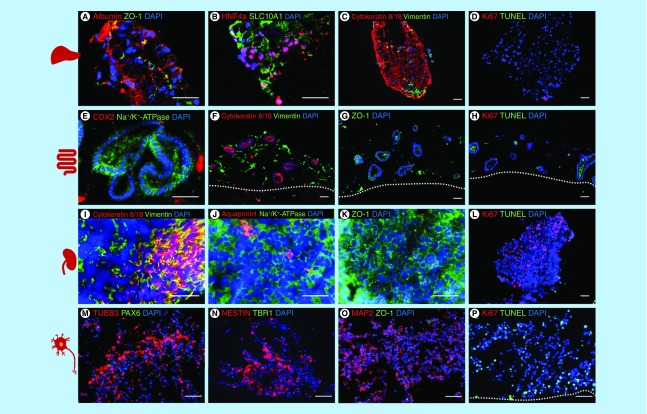
Figure 3.. Characterization of the induced pluripotent stem cell-derived liver, intestinal, renal and neuronal model cocultivated in the four-organ-chip for 14 days.
Immunostaining A–P: A–D liver spheroids: (A) albumin and ZO-1, (B) Hepatocyte nuclear factor 4 alpha and SLC10A1, (C) cytokeratin 8/18 and vimentin, (D) Ki67 and TUNEL. (E–H) intestinal model: (E) CDX2 and Na+/K+-ATPase, (F) cytokeratin 8/18 and vimentin, (G) ZO-1, H: Ki67 and TUNEL. (I–L) renal model: (I) cytokeratin 8/18 and vimentin, (J) aquaporin 1 and Na+/K+-ATPase, (K) ZO-1, (L) Ki67 and TUNEL. (M–P) neuronal model; (M) TUBB3 and PAX6, (N) nestin and TBR1, (O) MAP2 and ZO-1, (P) Ki67 and TUNEL. Scale 50 μm.
Figure 4.
Figure 4.. Principle component analysis on RNA sequencing data of the liver, intestine, brain and kidney model cultivated over 0, 7 and 14 days in the four-organ-chip.
Five different human iPSC lines were analyzed for comparison. iPSC: Induced pluripotent stem cell.
Figure 5.
Figure 5.. KeyGenes prediction on RNA sequencing data from the four-organ-chip experiment.
KeyGenes prediction with the human adult training set (A) and the human fetal training set (B). The identity scores range from 0 (black – no match) to 1 (green – high match). The rows represent the 11 (A) or 22 (B) organs from the human training set and the columns depict the four-organ-chip cocultured RNA samples. Light grey and green boxes show the predicted tissues for the given samples by KeyGenes.

References

    1. Sung JH, Wang Y, Sriram NN. et al. Recent advances in body-on-a-chip systems. Anal. Chem. 91(1), 330–351 (2019). - PMC - PubMed
    1. Dehne E-M, Hickman JJ, Shuler ml. Biologically-inspired microphysiological systems. :The History of Alternative Test Methods in Toxicology. Balls M, Combes R, Worth A (). Elsevier, London, UK, 279–284 (2019).
    1. Marx U, Andersson TB, Bahinski A. et al. Biology-inspired microphysiological system approaches to solve the prediction dilemma of substance testing. ALTEX 33(3), 272–321 (2016). - PMC - PubMed
    1. Zhang B, Radisic M. Organ-on-a-chip devices advance to market. Lab Chip 17(14), 2395–2420 (2017). - PubMed
    1. Zhang J, Wei X, Zeng R, Xu F, Li X. Stem cell culture and differentiation in microfluidic devices toward organ-on-a-chip. Future Sci. OA 3(2), FSO187 (2017). - PMC - PubMed

LinkOut - more resources