


The effectiveness of general practice-based health checks on health behaviour and incidence on non-communicable diseases in individuals with low socioeconomic position: a randomised controlled trial in Denmark
- PMID: 31537563
- PMCID: PMC6756442
- DOI: 10.1136/bmjopen-2019-029180
The effectiveness of general practice-based health checks on health behaviour and incidence on non-communicable diseases in individuals with low socioeconomic position: a randomised controlled trial in Denmark
Abstract
Background: The effectiveness of health checks aimed at the general population is disputable. However, it is not clear whether health checks aimed at certain groups at high risk may reduce adverse health behaviour and identify persons with metabolic risk factors and non-communicable diseases (NCDs).
Objectives: To assess the effect of general practice-based health checks on health behaviour and incidence on NCDs in individuals with low socioeconomic position.
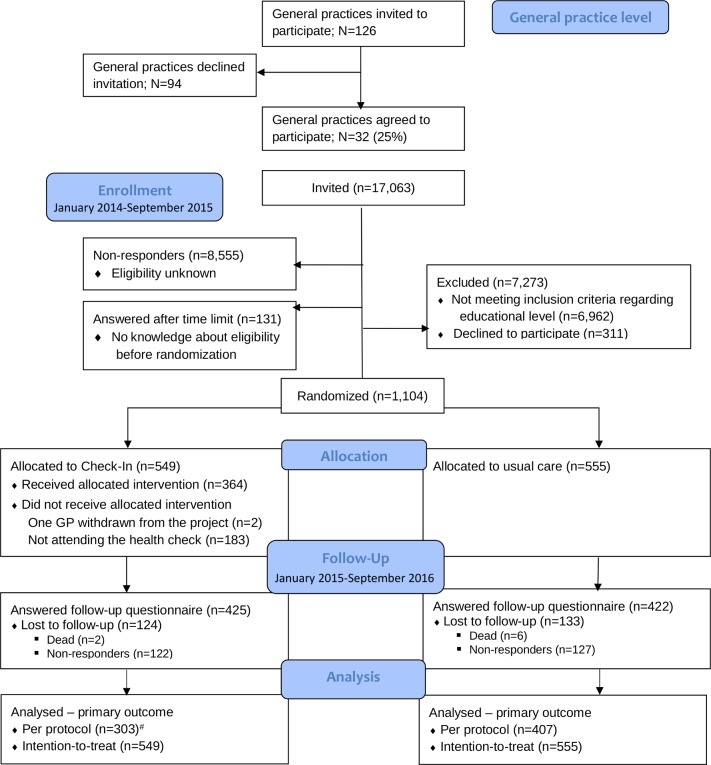
Methods: Individuals with no formal education beyond lower secondary school and aged 45-64 years were randomly assigned to the intervention group of a preventive health check or to control group of usual care in a 1:1 allocation. Randomisation was stratified by gender and 5-year age group. Due to the real-life setting, blinding of participants was only possible in the control group. Effects were analysed as intention to treat (ITT) and per protocol. The trial was undertaken in 32 general practice units in Copenhagen, Denmark.
Intervention: Invitation to a prescheduled preventive health check from the general practitioner (GP) followed by a health consultation and an offer of follow-up with health risk behaviour change or preventive medical treatment, if necessary.
Primary outcome measures: Smoking status at 12-month follow-up. Secondary outcomes included status in other health behaviours such as alcohol consumption, physical activity and body mass index (measured by self-administered questionnaire), as well as incidence of metabolic risk factors and NCDs such as hypertension, hypercholesterolaemia, chronic obstructive pulmonary disease, diabetes mellitus, hypothyroidism, hyperthyroidism and depression (drawn from national healthcare registries).
Results: 1104 participants were included in the study. For the primary outcome, 710 participants were included in the per protocol analysis, excluding individuals who did not attend the health check, and 1104 participants were included in the ITT analysis. At 12-month follow-up, 37% were daily smokers in the intervention group and 37% in the control group (ORs=0.99, 95% CI: 0.76 to 1.30). No difference in health behaviour nor in the incidence of metabolic risk factors and NCDs between the intervention and control group were found. Side effects were comparable across the two groups.
Conclusion: The lack of effectiveness may be due to low intensity of intervention, a high prevalence of metabolic risk factors and NCDs among the participants at baseline as well as a high number of contacts with the GPs in general or to the fact that general practices are not an effective setting for prevention.
Trial registration number: NCT01979107.
Keywords: general practitioner; health check; preventive medicine; randomised controlled trial; social medicine.
© Author(s) (or their employer(s)) 2019. Re-use permitted under CC BY-NC. No commercial re-use. See rights and permissions. Published by BMJ.
Conflict of interest statement
Competing interests: None declared.
Figures
References
-
- World Health Organization Global status report on noncommunicable diseases 2014. World Health Organization, 2014.
-
- Wilson JM, Jungner YG. [Principles and practice of mass screening for disease]. Bol Oficina Sanit Panam 1968;65:281–393. - PubMed
Publication types
MeSH terms
Associated data
LinkOut - more resources
Full Text Sources
Medical
