


Olaparib: A Novel Therapy for Metastatic Breast Cancer in Patients With a BRCA 1/2 Mutation
- PMID: 31538027
- PMCID: PMC6750920
Olaparib: A Novel Therapy for Metastatic Breast Cancer in Patients With a BRCA 1/2 Mutation
Abstract
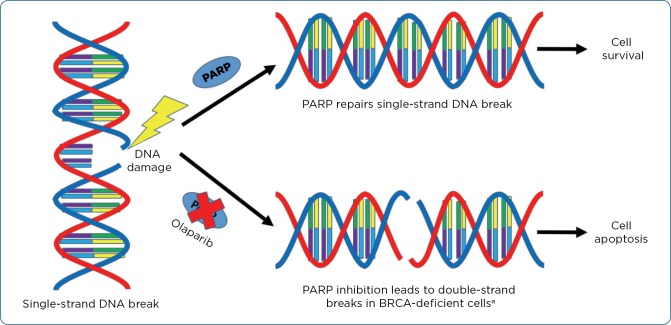
Breast cancer is the most frequently diagnosed cancer in women globally. Genetic mutations can increase the risk of developing breast cancer. Inherited germline mutations in BRCA1 and BRCA2 tumor suppressor genes (gBRCAm) account for 5% to 10% of breast cancer cases. The recent approval of olaparib, a poly (ADP-ribose) polymerase (PARP) inhibitor, in HER2-negative, metastatic breast cancer provides an additional treatment option for patients with a gBRCAm. Inhibition of PARP results in the trapping of the PARP-DNA complex at replication forks, causing single-strand breaks to become double-strand breaks (DSBs). PARP trapping and the accumulation of DSBs ultimately leads to cell apoptosis. Cells deficient in BRCA1/2 are particularly sensitive to the effects of PARP inhibition, as cells lacking these functional proteins are unable to repair DSBs, resulting in synthetic lethality. The phase III OlympiAD trial showed a progression-free survival benefit but no overall survival benefit, leading to the US Food and Drug Administration approval of olaparib. The purpose of this article is to describe current data regarding the use of olaparib in metastatic breast cancer, its role in the treatment of patients with a gBRCAm, and the clinical implications of its approval for oncology advanced practitioners.
Figures
References
-
- American Cancer Society. . Cancer Facts & Figures 2019. 2019 Retrieved from https://www.cancer.org/research/cancer-facts-statistics/all-cancer-facts....
-
- AstraZeneca Pharmaceuticals LP. Lynparza (olaparib) tablets package insert. 2018 Retrieved from https://www.azpicentral.com/lynparza_tb/pi_lynparza_tb.pdf#page=1.
-
- Balmaña J, Díez O, Castiglione M. BRCA in breast cancer: ESMO clinical recommendations. Annals of oncology : official journal of the European Society for Medical Oncology. 2009;20 Suppl 4:19–20. - PubMed
-
- ClinicalTrials.gov. ClinicalTrials.gov. 2019 Retrieved from https://www.clinicaltrials.gov.
Publication types
LinkOut - more resources
Full Text Sources
Other Literature Sources
Research Materials
Miscellaneous