


Altered Metabolomic Profile in Patients with Peripheral Artery Disease
- PMID: 31540015
- PMCID: PMC6780416
- DOI: 10.3390/jcm8091463
Altered Metabolomic Profile in Patients with Peripheral Artery Disease
Abstract
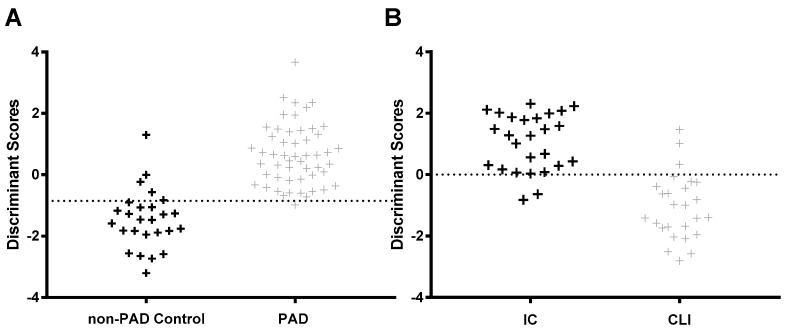
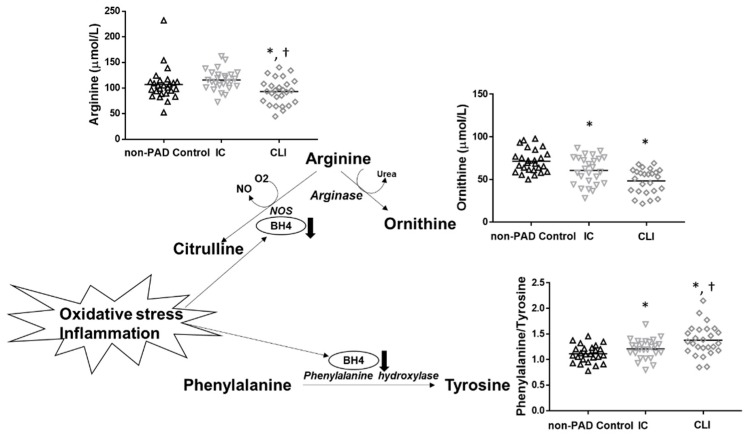
Peripheral artery disease (PAD) is a common atherosclerotic disease characterized by narrowed or blocked arteries in the lower extremities. Circulating serum biomarkers can provide significant insight regarding the disease progression. Here, we explore the metabolomics signatures associated with different stages of PAD and investigate potential mechanisms of the disease. We compared the serum metabolites of a cohort of 26 PAD patients presenting with claudication and 26 PAD patients presenting with critical limb ischemia (CLI) to those of 26 non-PAD controls. A difference between the metabolite profiles of PAD patients from non-PAD controls was observed for several amino acids, acylcarnitines, ceramides, and cholesteryl esters. Furthermore, our data demonstrate that patients with CLI possess an altered metabolomic signature different from that of both claudicants and non-PAD controls. These findings provide new insight into the pathophysiology of PAD and may help develop future diagnostic procedures and therapies for PAD patients.
Keywords: claudication; critical limb ischemia (CLI); metabolomics; peripheral artery disease (PAD).
Conflict of interest statement
The authors declare no conflict of interest.
Figures

References
-
- Gerhard-Herman M.D., Gornik H.L., Barrett C., Barshes N.R., Corriere M.A., Drachman D.E., Fleisher L.A., Fowkes F.G., Hamburg N.M., Kinlay S., et al. 2016 AHA/ACC Guideline on the Management of Patients With Lower Extremity Peripheral Artery Disease: Executive Summary: A Report of the American College of Cardiology/American Heart Association Task Force on Clinical Practice Guidelines. Circulation. 2017;135:e686–e725. doi: 10.1161/CIR.0000000000000470. - DOI - PMC - PubMed
-
- Pipinos I.I., Judge A.R., Selsby J.T., Zhu Z., Swanson S.A., Nella A.A., Dodd S.L. The myopathy of peripheral arterial occlusive disease: Part 1. Functional and histomorphological changes and evidence for mitochondrial dysfunction. Vasc. Endovascular Surg. 2007;41:481–489. doi: 10.1177/1538574407311106. - DOI - PubMed
Grants and funding
LinkOut - more resources
Full Text Sources
Medical
Research Materials
Miscellaneous
