Review
. 2019 Sep 18;24(18):3388.
doi: 10.3390/molecules24183388.

Yeast Models for Amyloids and Prions: Environmental Modulation and Drug Discovery

Affiliations
Review

Yeast Models for Amyloids and Prions: Environmental Modulation and Drug Discovery

Tatiana A Chernova et al. Molecules. .

Abstract

Amyloids are self-perpetuating protein aggregates causing neurodegenerative diseases in mammals. Prions are transmissible protein isoforms (usually of amyloid nature). Prion features were recently reported for various proteins involved in amyloid and neural inclusion disorders. Heritable yeast prions share molecular properties (and in the case of polyglutamines, amino acid composition) with human disease-related amyloids. Fundamental protein quality control pathways, including chaperones, the ubiquitin proteasome system and autophagy are highly conserved between yeast and human cells. Crucial cellular proteins and conditions influencing amyloids and prions were uncovered in the yeast model. The treatments available for neurodegenerative amyloid-associated diseases are few and their efficiency is limited. Yeast models of amyloid-related neurodegenerative diseases have become powerful tools for high-throughput screening for chemical compounds and FDA-approved drugs that reduce aggregation and toxicity of amyloids. Although some environmental agents have been linked to certain amyloid diseases, the molecular basis of their action remains unclear. Environmental stresses trigger amyloid formation and loss, acting either via influencing intracellular concentrations of the amyloidogenic proteins or via heterologous inducers of prions. Studies of environmental and physiological regulation of yeast prions open new possibilities for pharmacological intervention and/or prophylactic procedures aiming on common cellular systems rather than the properties of specific amyloids.

Keywords: amyloid; chaperone; drug discovery; environmental factors; heat shock; neurodegenerative disease; prion; ubiquitin.


Conflict of interest statement

The authors declare no conflict of interest.

Figures
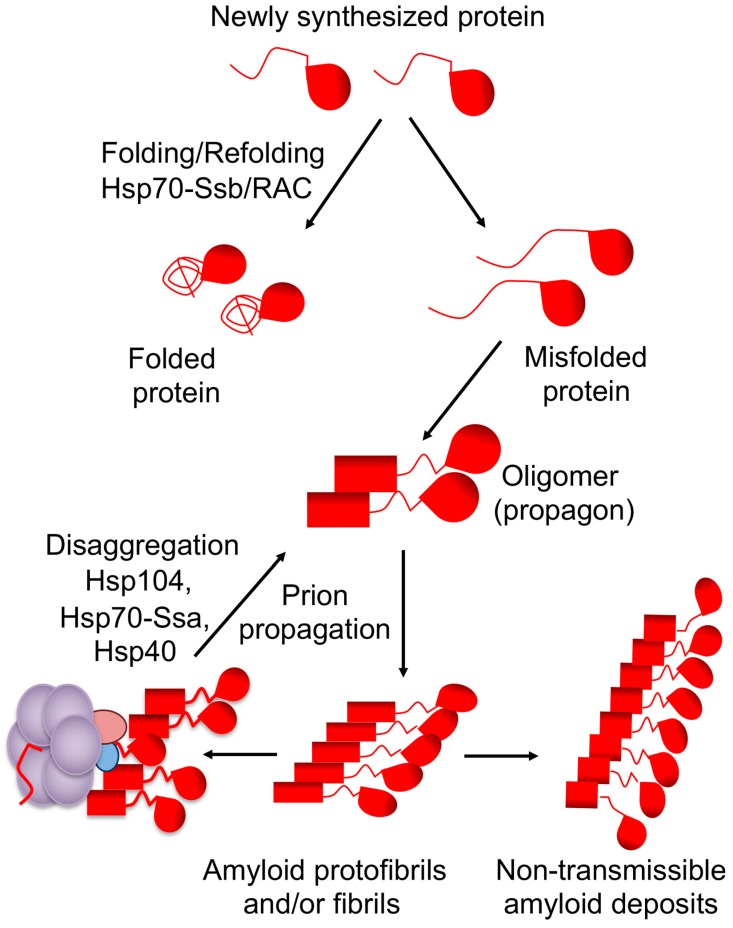
Figure 1
Figure 1
”Life cycle” of the [PSI+] prion and the role of chaperone machinery. Chaperone Hsp70-Ssb with the cochaperones of the ribosome-associated complex (RAC) assist in normal protein folding, thus counteracting misfolding. Misfolded proteins assemble into amyloidogenic oligomers, producing amyloid fibrils. In the case of a prion, amyloids are fragmented by chaperone complex Hsp104/Hsp70-Ssa/Hsp40 into oligomeric “propagons” (transmissible amyloids), continuing the propagation cycle after cell division. Non-fragmented fibrils generate large non-transmissible amyloid deposits, which do not re-enter the propagation cycle and/or are malpartitioned in cell divisions.
Figure 2
Figure 2
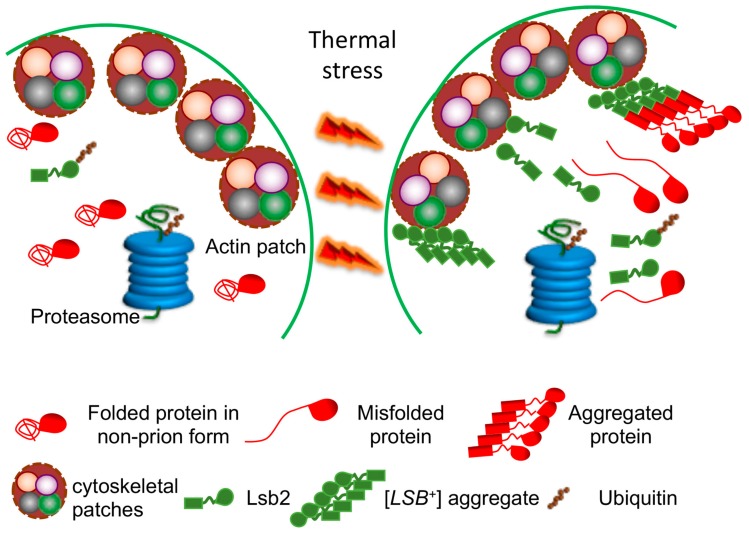
Lsb2 aggregation and prion formation during thermal stress. Thermal stress (39 °C) leads to an increased synthesis of the Lsb2 protein, as well as to misfolding of other proteins. When present at high concentration, Lsb2 forms prion-like aggregates ([LSB+]), which are associated with peripheral cytoskeletal patches and promote assembly of misfolded proteins into protective (but potentially amyloidogenic) aggregate deposits. [LSB+] aggregates are metastable and lost in cell divisions after stress, while the Lsb2 protein is ubiquitinated and degraded by a proteasome.
Figure 3
Figure 3
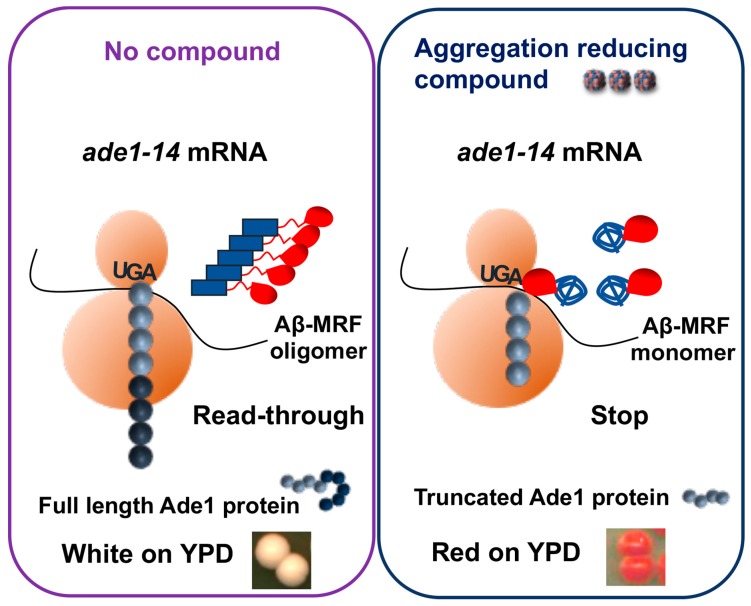
Yeast model to screen for inhibitors of Aβ oligomerization. In the ade1-14 reporter strain, the stop codon UGA, introduced into the ADE1 gene, is normally recognized by the translation termination complex, including release factor Sup35. Fusion of Aβ with functional domain (MRF) of Sup35 leads to its oligomerization. When Aβ-MRF is in an oligomeric for, translation termination is impaired. This results in synthesis of full-length Ade1 protein due to readthrough of the stop codon, inability of cells to grow on the medium lacking adenine (–Ade) and white color on the complete (YPD) medium (Left panel). If cells are treated with a compound able to counteract oligomerization of Aβ-MRF, translation termination is restored, leading to the production of truncated Ade1 protein, inability of cells to grow on -Ade medium and accumulation of red pigment (a polymerized intermediate of the adenine biosynthetic pathway) on YPD medium (right panel).

References

    1. Wilson C.J., Bommarius A.S., Champion J.A., Chernoff Y.O., Lynn D.G., Paravastu A.K., Liang C., Hsieh M.C., Heemstra J.M. Biomolecular Assemblies: Moving from Observation to Predictive Design. Chem. Rev. 2018;118:11519–11574. doi: 10.1021/acs.chemrev.8b00038. - DOI - PMC - PubMed
    1. Hebert L.E., Weuve J., Scherr P.A., Evans D.A. Alzheimer disease in the United States (2010-2050) estimated using the 2010 census. Neurology. 2013;80:1778–1783. doi: 10.1212/WNL.0b013e31828726f5. - DOI - PMC - PubMed
    1. Prusiner S.B. Cell biology. A unifying role for prions in neurodegenerative diseases. Science. 2012;336:1511–1513. doi: 10.1126/science.1222951. - DOI - PMC - PubMed
    1. Walker L.C., Jucker M. Neurodegenerative diseases: Expanding the prion concept. Annu. Rev. Neurosci. 2015;38:87–103. doi: 10.1146/annurev-neuro-071714-033828. - DOI - PMC - PubMed
    1. Masnata M., Cicchetti F. The Evidence for the Spread and Seeding Capacities of the Mutant Huntingtin Protein in in Vitro Systems and Their Therapeutic Implications. Front. Neurosci. 2017;11:647. doi: 10.3389/fnins.2017.00647. - DOI - PMC - PubMed

LinkOut - more resources