


Immune checkpoint inhibitor-induced inflammatory arthritis persists after immunotherapy cessation
- PMID: 31540935
- PMCID: PMC7031780
- DOI: 10.1136/annrheumdis-2019-216109
Immune checkpoint inhibitor-induced inflammatory arthritis persists after immunotherapy cessation
Abstract
Objective: We sought to investigate the long-term outcomes of patients who develop immune checkpoint inhibitor (ICI)-induced inflammatory arthritis (IA), to define factors associated with IA persistence after ICI cessation, the need for immunosuppressants and the impact of these medications on underlying malignancies.
Methods: We conducted a prospective observational study of patients referred for IA associated with ICIs. Patients were recruited from June 2015 to December 2018. Information was obtained at the baseline visit, and follow-up visits occurred at varying intervals for up to 24 months from ICI cessation. Kaplan-Meier curves were developed to characterise IA persistence. Cox proportional hazards models were used to assess the influence of various factors on IA persistence. Logistic regression was used to evaluate the impact of IA treatment on tumour response.
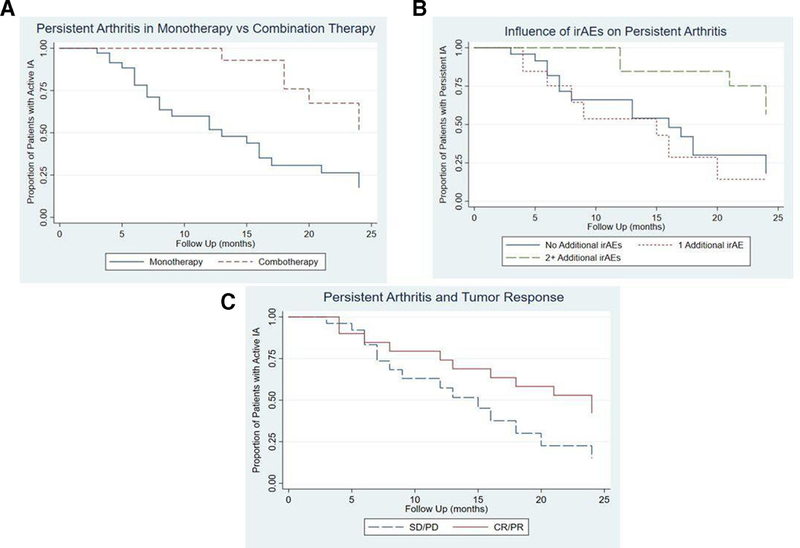
Results: Sixty patients were monitored with a median follow-up after ICI cessation of 9 months. A majority (53.3%) had active IA at their most recent follow-up. IA was less likely to improve in those with longer duration of ICI use, in those receiving combination ICI therapy, and in patients with multiple other immune-related adverse events. Tumour response did not appear to be impacted by immunosuppression. Although not statistically significant, persistent IA was correlated with a better tumour response (complete or partial response).
Conclusion: ICI-induced IA can become a long-term disease necessitating management by rheumatology for immunomodulatory treatment. Importantly, the use of immunomodulatory treatment has not been shown to impact cancer outcomes in this study.
Keywords: Arthritis; Autoimmune Diseases; Inflammation; Synovitis.
© Author(s) (or their employer(s)) 2020. No commercial re-use. See rights and permissions. Published by BMJ.
Conflict of interest statement
Competing interests: Individual sources of potential conflict are as follows: JRB: Consultant/Advisory Boards: Bristol-Myers Squibb, Celgene, Lily Merck, Genentech, Amgen, Janssen, Syndax. Grant/Research Funding: Bristol-Myers Squibb, Merck, MedImmune/AstraZeneca. PMF: Consultant/Advisory Board: Abbvie AstraZeneca, Boehringer, Bristol-Myers Squibb, Celgene, Eli Lilly, Novartis. Grant/Research Funding: AstraZeneca, BMS, Corvus, Kyowa, Novartis. DL: Consultant/Advisory Board: Bristol-Myers Squibb, Merck. Grant/Research Funding: Bristol-Myers Squibb, Merck, Aduro Biotech. Honoraria: Merck. EJL: Consultant/Advisory Board: Bristol-Myers Squibb, Novartis, EMD Serono, Array BioPharma, Macrogenics, Merck, Millennium. Grant/Research Funding: Bristol-Myers Squibb, Merck, Sysmex. Patent/Royalty/Intellectual Property: Method of prevent organ transplant rejection using agonist to the PD-1 checkpoint pathway. JN: Consulting/Advisory Board: AstraZeneca, Roche/Genentech, Bristol-Myers Squibb. Grant/Research Funding: Merck, AstraZeneca. Honoraria: Bristol-Myers Squibb, AstraZeneca. LZ: Consultant/Advisory Boards: Biosynergics, Alphamab, Mingrui, Foundation Medicine, NovaRock Biological, Datareve. Grant/Research Funding: Halozyme, iTeos, Bristol-Myers Squibb, Merck, Amgen, NovaRock. Licensing Agreement: Aduro Biotech (given up personal royalty). COB III: Consultant/Advisory Board: Bristol-Myers Squibb, Genentech/Roche, Regeneron/Sanofi. Grant/Research Funding: Bristol-Myers Squibb. AAS: Consultant/Advisory Board: Bristol-Myers Squibb. LCC: Consultant/Advisory Board: Regeneron/Sanofi. Grant/Research Funding: Bristol-Myers Squibb.
Figures
Comment in
-
Chronic inflammatory arthritis following checkpoint inhibitor therapy for cancer: game changing implications.Ann Rheum Dis. 2020 Mar;79(3):309-311. doi: 10.1136/annrheumdis-2019-216510. Epub 2020 Jan 3. Ann Rheum Dis. 2020. PMID: 31900302 No abstract available.
-
Correspondence on 'Immune checkpoint inhibitor-induced inflammatory arthritis persists after immunotherapy cessation' by Braaten et al.Ann Rheum Dis. 2022 Jan;81(1):e13. doi: 10.1136/annrheumdis-2019-216867. Epub 2020 Jan 6. Ann Rheum Dis. 2022. PMID: 31907163 No abstract available.
-
Response to: Correspondence on "Immune checkpoint inhibitor-induced inflammatory arthritis persists after immunotherapy cessation" by Braaten et al.Ann Rheum Dis. 2022 Jan;81(1):e14. doi: 10.1136/annrheumdis-2019-216892. Epub 2020 Jan 20. Ann Rheum Dis. 2022. PMID: 31959594 Free PMC article. No abstract available.
-
Features of polymyalgia rheumatica-like syndrome after immune checkpoint inhibitor therapy.Ann Rheum Dis. 2022 Mar;81(3):e52. doi: 10.1136/annrheumdis-2020-217225. Epub 2020 Mar 18. Ann Rheum Dis. 2022. PMID: 32188691 No abstract available.
-
Severe polymyalgia-like symptoms secondary to anti-PD1 therapy successfully managed without discontinuing checkpoint inhibitor.Ann Rheum Dis. 2022 Nov;81(11):e237. doi: 10.1136/annrheumdis-2020-217605. Epub 2020 May 6. Ann Rheum Dis. 2022. PMID: 32376598 No abstract available.
References
-
- Timeline of Progress in immunotherapy - Cancer Research institute. Available: https://www.cancerresearch.org/immunotherapy/timeline-of-progress
-
- EMA: European Medical Agency. Available: ema.europa.eu/en
-
- The Department of Health and Human services. Fda approves first treatment for advanced form of the second most common skin cancer, 2018. Available: https://www.fda.gov/news-events/press-announcements/fda-approves-first-t...
-
- Js Weber, Kähler KC, Hauschild A. Management of immune-related adverse events and kinetics of response with ipilimumab. JCO 2012;30:2691–7. - PubMed
Publication types
MeSH terms
Substances
Grants and funding
LinkOut - more resources
Full Text Sources
Medical
