


Agricultural land-uses consistently exacerbate infectious disease risks in Southeast Asia
- PMID: 31541099
- PMCID: PMC6754503
- DOI: 10.1038/s41467-019-12333-z
Agricultural land-uses consistently exacerbate infectious disease risks in Southeast Asia
Abstract
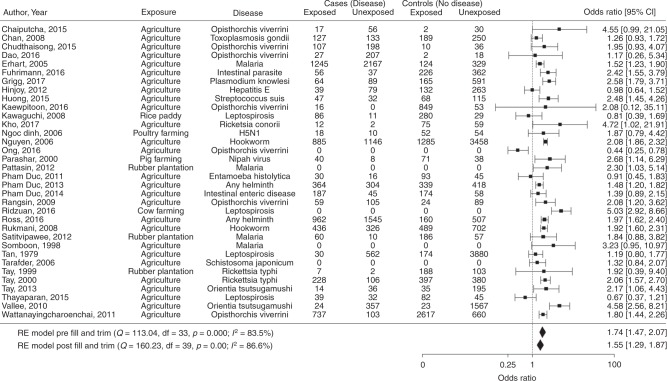
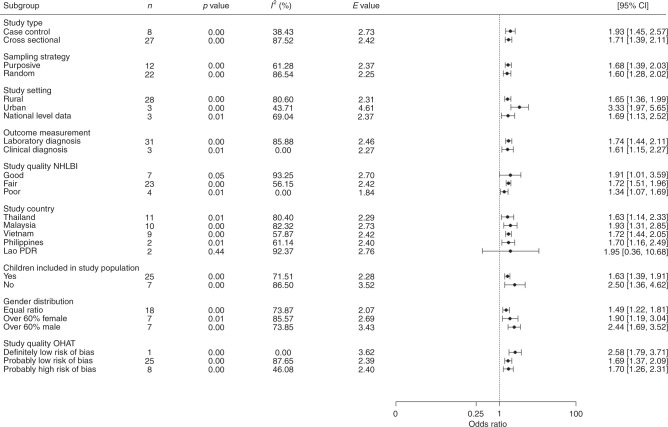
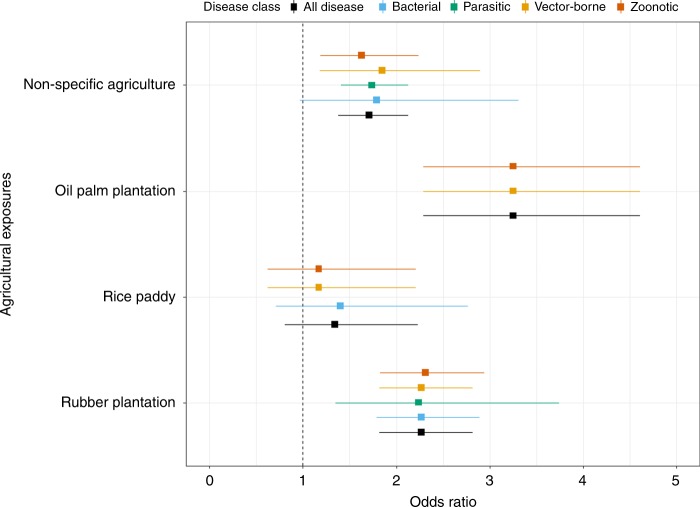
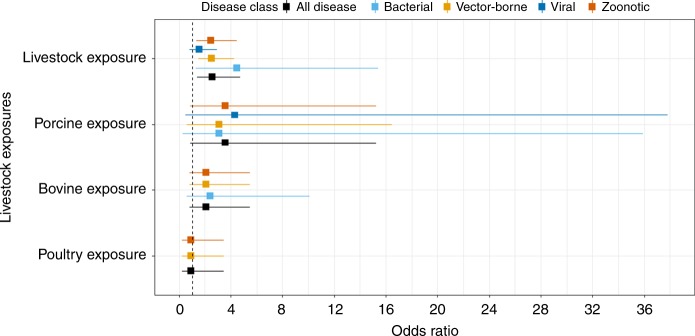
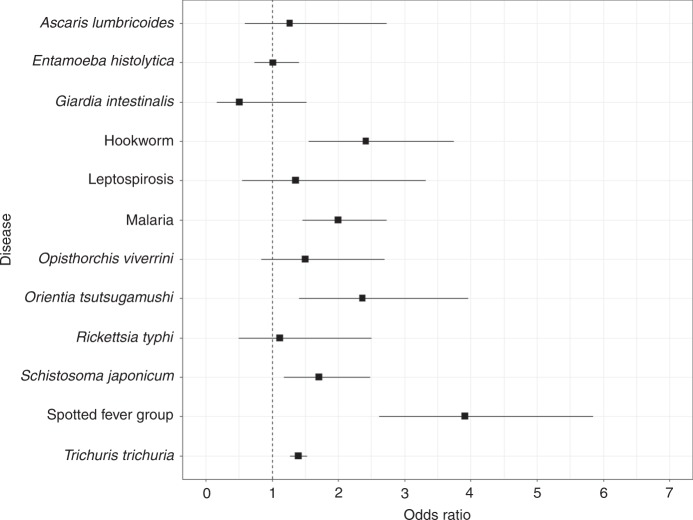
Agriculture has been implicated as a potential driver of human infectious diseases. However, the generality of disease-agriculture relationships has not been systematically assessed, hindering efforts to incorporate human health considerations into land-use and development policies. Here we perform a meta-analysis with 34 eligible studies and show that people who live or work in agricultural land in Southeast Asia are on average 1.74 (CI 1.47-2.07) times as likely to be infected with a pathogen than those unexposed. Effect sizes are greatest for exposure to oil palm, rubber, and non-poultry based livestock farming and for hookworm (OR 2.42, CI 1.56-3.75), malaria (OR 2.00, CI 1.46-2.73), scrub typhus (OR 2.37, CI 1.41-3.96) and spotted fever group diseases (OR 3.91, CI 2.61-5.85). In contrast, no change in infection risk is detected for faecal-oral route diseases. Although responses vary by land-use and disease types, results suggest that agricultural land-uses exacerbate many infectious diseases in Southeast Asia.
Conflict of interest statement
The authors declare no competing interests.
Figures
References
-
- Costanza R, et al. Changes in the global value of ecosystem services. Glob. Environ. Chang. 2014;26:152–158. doi: 10.1016/j.gloenvcha.2014.04.002. - DOI
-
- Costanza R, et al. The value of the world’s ecosystem services and natural capital. Nature. 1998;387:253–260. doi: 10.1038/387253a0. - DOI
-
- Houghton RA. Revised estimates of the annual net flux of carbon to the atmosphere from changes in land use and land management 1850-2000. Tellus, Ser. B Chem. Phys. Meteorol. 2003;55:378–390.
-
- Vermeulen S, Campbell B, Ingram J. Climate change and food systems. Annu. Rev. Environ. Resour. 2012;37:195–222. doi: 10.1146/annurev-environ-020411-130608. - DOI
