


Greater neurodegeneration and behavioral deficits after single closed head traumatic brain injury in adolescent versus adult male mice
- PMID: 31541497
- PMCID: PMC6980517
- DOI: 10.1002/jnr.24535
Greater neurodegeneration and behavioral deficits after single closed head traumatic brain injury in adolescent versus adult male mice
Abstract
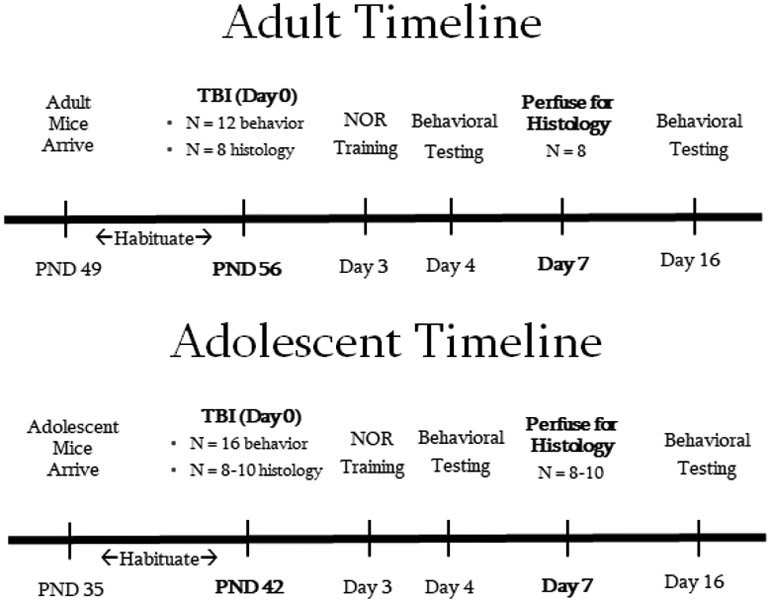
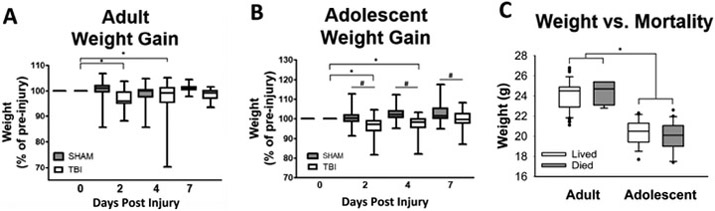
Traumatic brain injury (TBI) is a major public health concern affecting 2.8 million people per year in the United States, of whom about 1 million are children under 19 years old. Animal models of TBI have been developed and used in multiple ages of animals, but direct comparisons of adult and adolescent populations are rare. The current studies were undertaken to directly compare outcomes between adult and adolescent male mice, using a closed head, single-impact model of TBI. Six-week-old adolescent and 9-week-old adult male mice were subjected to mild-moderate TBI. Histological measures for neurodegeneration, gliosis, and microglial neuroinflammation, and behavioral tests of locomotion and memory were performed. Adolescent TBI mice have increased mortality (Χ2 = 20.72, p < 0.001) compared to adults. There is also evidence of hippocampal neurodegeneration in adolescents that is not present in adults. Hippocampal neurodegeneration correlates with histologic activation of microglia, but not with increased astrogliosis. Adults and adolescents have similar locomotion deficits after TBI that recover by 16 days postinjury. Adolescents have memory deficits as evidenced by impaired novel object recognition between 3-4 and 4-16 days postinjury (F1,26 = 5.23, p = 0.031) while adults do not. In conclusion, adults and adolescents within a close age range (6-9 weeks) respond to TBI differently. Adolescents are more severely affected by mortality, neurodegeneration, and inflammation in the hippocampus compared to adults. Adolescents, but not adults, have worse memory performance after TBI that lasts at least 16 days postinjury.
Keywords: RRID:AB_10013382; RRID:AB_10641962; RRID:AB_2307443; adolescent; memory; neurodegeneration; neuroinflammation; traumatic brain injury.
© 2019 Wiley Periodicals, Inc.
Conflict of interest statement
Conflict of Interest Statement
No competing financial interests exist.
Figures


References
-
- Baratz R, Tweedie D, Wang JY, Rubovitch V, Luo W, Hoffer BJ, … Pick CG (2015). Transiently lowering tumor necrosis factor-alpha synthesis ameliorates neuronal cell loss and cognitive impairments induced by minimal traumatic brain injury in mice. J Neuroinflammation, 12, 45. doi: 10.1186/s12974-015-0237-4 - DOI - PMC - PubMed
Publication types
MeSH terms
Grants and funding
LinkOut - more resources
Full Text Sources
Medical
