


Research-based PAM50 signature and long-term breast cancer survival
- PMID: 31542876
- PMCID: PMC6985186
- DOI: 10.1007/s10549-019-05446-y
Research-based PAM50 signature and long-term breast cancer survival
Abstract
Purpose: Multi-gene signatures provide biological insight and risk stratification in breast cancer. Intrinsic molecular subtypes defined by mRNA expression of 50 genes (PAM50) are prognostic in hormone-receptor positive postmenopausal breast cancer. Yet, for 25-40% in the PAM50 intermediate risk group, long-term risk remains uncertain. Our study aimed to (i) test the long-term prognostic value of the PAM50 signature in pre- and post-menopausal breast cancer; (ii) investigate if the PAM50 model could be improved by addition of other mRNAs implicated in oncogenesis.
Methods: We used archived FFPE samples from 1723 breast cancer survivors; high quality reads were obtained on 1253 samples. Transcript expression was quantified using a custom codeset with probes for > 100 targets. Cox models assessed gene signatures for breast cancer relapse and survival.
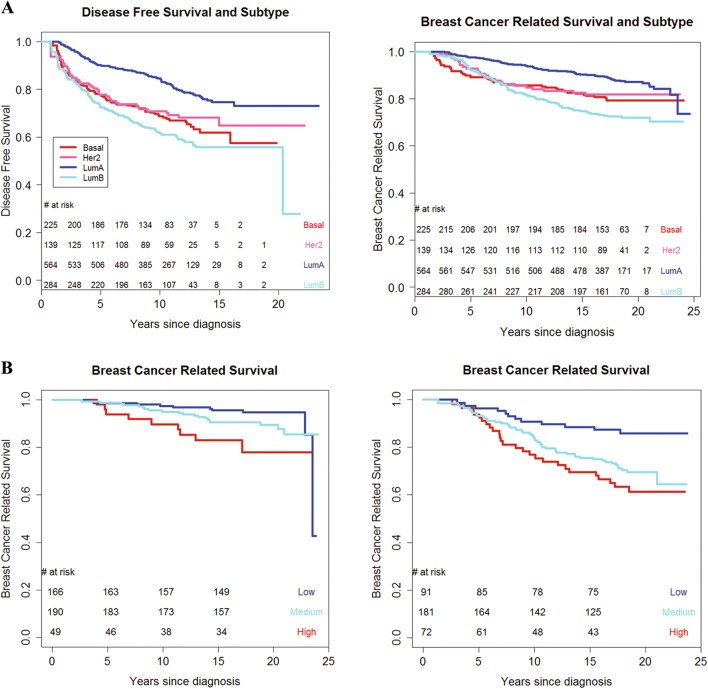
Results: Over 15 + years of follow-up, PAM50 subtypes were (P < 0.01) associated with breast cancer outcomes after accounting for tumor stage, grade and age at diagnosis. Results did not differ by menopausal status at diagnosis. Women with Luminal B (versus Luminal A) subtype had a > 60% higher hazard. Addition of a 13-gene hypoxia signature improved prognostication with > 40% higher hazard in the highest vs lowest hypoxia tertiles.
Conclusions: PAM50 intrinsic subtypes were independently prognostic for long-term breast cancer survival, irrespective of menopausal status. Addition of hypoxia signatures improved risk prediction. If replicated, incorporating the 13-gene hypoxia signature into the existing PAM50 risk assessment tool, may refine risk stratification and further clarify treatment for breast cancer.
Keywords: Breast cancer; Gene signatures; Hypoxia; Long-term survival; PAM50 subtypes; Prognostic modeling.
Conflict of interest statement
SD has stock or other ownership in NanoString Techologies. BAP has a consulting or advisory Role with Bioalta; Research Funding from Genetech, Glaxo Smith Kline, and Novartis; and Patents, Royalties, Other Intellectual Property with Salk Institute Licensed Technology. MJE has a leadership role, Employment of Immediate Family Member, and stock or other ownership, consulting or advisory role, and Honoraria with Bioclassifier, Prosigna, and NanoString Technologies. ERM has a leadership role and stock with Qiagen N.V., and a consulting or advisory role with Regeneron. The remaining authors declare no conflict of interest.
Figures
References
-
- Buyse M, Loi S, van’t Veer L, Viale G, Delorenzi M, Glas AM, d’Assignies MS, Bergh J, Lidereau R, Ellis P, Harris A, Bogaerts J, Therasse P, Floore A, Amakrane M, Piette F, Rutgers E, Sotiriou C, Cardoso F, Piccart MJ, Consortium T Validation and clinical utility of a 70-gene prognostic signature for women with node-negative breast cancer. J Natl Cancer Inst. 2006;98(17):1183–1192. doi: 10.1093/jnci/djj329. - DOI - PubMed
-
- Nielsen TO, Parker JS, Leung S, Voduc D, Ebbert M, Vickery T, Davies SR, Snider J, Stijleman IJ, Reed J, Cheang MCU, Mardis ER, Perou CM, Bernard PS, Ellis MJ. A comparison of PAM50 intrinsic subtyping with immunohistochemistry and clinical prognostic factors in tamoxifen-treated estrogen receptor-positive breast cancer. Clin Cancer Res. 2010;16(21):5222–5232. doi: 10.1158/1078-0432.ccr-10-1282. - DOI - PMC - PubMed
-
- Paik S, Shak S, Tang G, Kim C, Baker J, Cronin M, Baehner FL, Walker MG, Watson D, Park T, Hiller W, Fisher ER, Wickerham DL, Bryant J, Wolmark N. A multigene assay to predict recurrence of tamoxifen-treated, node-negative breast cancer. N Engl J Med. 2004;351(27):2817–2826. doi: 10.1056/NEJMoa041588. - DOI - PubMed
Publication types
MeSH terms
Substances
Grants and funding
LinkOut - more resources
Full Text Sources
Other Literature Sources
Medical
Molecular Biology Databases
