


Impact of a 10-Year Eye Care Program in Sokoto, Nigeria: Changing Pattern of Prevalence and Causes of Blindness and Visual Impairment
- PMID: 31543668
- PMCID: PMC6737780
- DOI: 10.4103/meajo.MEAJO_113_17
Impact of a 10-Year Eye Care Program in Sokoto, Nigeria: Changing Pattern of Prevalence and Causes of Blindness and Visual Impairment
Abstract
Background: This study was undertaken to ascertain the current magnitude and causes of blindness and visual impairment in persons aged 50 years and over and to assess the impact of a 10-year eye care program in Sokoto State, Nigeria.
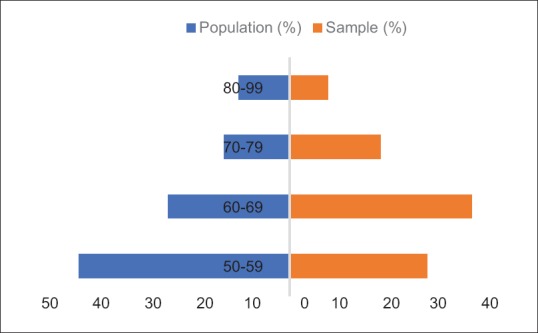
Methods: A rapid assessment of avoidable blindness (RAAB) survey (in persons 50 years and over) was conducted in 2016. Participants were selected in Wurno health zone using a two-stage cluster randomized sampling with probability proportional to size. Operational definitions were based on RAAB and World Health Organization eye examination record definitions. Eye care program documents were reviewed and data from a baseline survey undertaken in 2005 were reanalyzed.
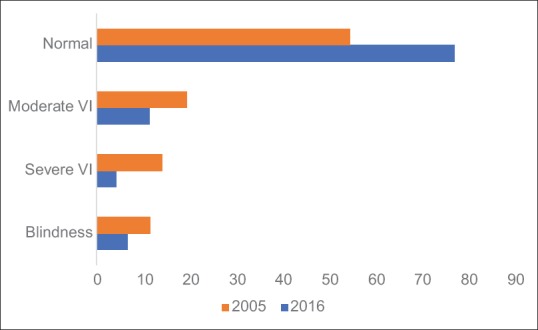
Results: A response of 89.1% (2405 of 2700 participants) was obtained in the 2016 survey. With available correction, the unadjusted prevalence of blindness was 7.7% (95% confidence interval [CI]: 6.4, 8.9). The odds of blindness were 1.8 times higher in females than males (95% CI: 1.3, 2.4; P < 0.001). Major causes of blindness were cataract (48.9%) corneal disease (20.1%), glaucoma (10.3%), and uncorrected refractive error/aphakia (8.7%). The age- and sex-adjusted prevalence of blindness has declined from 11.6% (95% CI: 7.4, 17.0) in 2005 to 6.8% (95% CI: 5.6, 8.0%) in 2016.
Conclusion: The blindness prevalence is high, and the major causes are avoidable in the health zone. The findings suggest that investments in the program over the last 10 years might have led to almost a halving in the prevalence of blindness in th e population. However, the small sample size of persons 50+ years from Wurno zone in the 2005 survey necessitate caution when comparing the 2005 and the 2016 surveys.
Keywords: Avoidable blindness; eye care; impact; rapid assessment of avoidable blindness.
Conflict of interest statement
There are no conflicts of interest.
Figures
References
-
- World Health Organization. Universal Eye Health – A Global Action Plan 2014-19. World Health Organization. 2014:28.
-
- Sightsavers International Kaduna Nigeria. Sokoto State Eye Care programme Project Document 2005 – 2009. Sightsavers International Kaduna Nigeria. 2005:48.
-
- 2006 National and State Population and Housing Tables – Priority Tables I. Abuja, Nigeria: National Population Commission; 2010. National Population Commission; p. 347.
MeSH terms
LinkOut - more resources
Full Text Sources
Medical
