Review
. 2019 Aug 30:10:592.
doi: 10.3389/fpsyt.2019.00592. eCollection 2019.

Craving in Opioid Use Disorder: From Neurobiology to Clinical Practice

Affiliations
Review

Craving in Opioid Use Disorder: From Neurobiology to Clinical Practice

Johan Kakko et al. Front Psychiatry. .

Abstract

Opioid use disorder (OUD) is a major public health issue that has reached epidemic levels in some parts of the world. It is a chronic and complex neurobiological disease associated with frequent relapse to drug taking. Craving, defined as an overwhelmingly strong desire or need to use a drug, is a central component of OUD and other substance use disorders. In this review, we describe the neurobiological and neuroendocrine pathways that underpin craving in OUD and also focus on the importance of assessing and treating craving in clinical practice. Craving is strongly associated with patients returning to opioid misuse and is therefore an important treatment target to reduce the risk of relapse and improve patients' quality of life. Opioid agonist therapies (OAT), such as buprenorphine and methadone, can significantly reduce craving and relapse risk, and it is essential that patients are treated optimally with these therapies. There is also evidence to support the benefits of non-pharmacological approaches, such as cognitive behavioral therapy and mindfulness-based interventions, as supplementary treatments to opioid agonist therapies. However, despite the positive impact of these treatments on craving, many OUD patients continue to suffer with negative affect and dysphoria. There is a clear need for further studies to progress our understanding of the neurobiological basis of craving and addiction and to identify novel therapeutic strategies as well as to optimize the use of existing treatments to improve outcomes for the growing numbers of patients affected by OUD.

Keywords: addiction; buprenorphine; craving; methadone; negative affect; opioid.


Figures
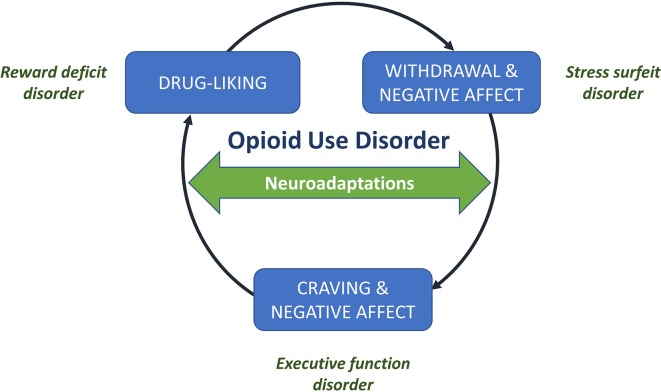
Figure 1
Figure 1
Drivers in the cycle of addiction. The addiction cycle involves three key drivers: (1) pleasurable drug-liking (associated with euphoria in the early stages of addiction), (2) withdrawal and negative affect (the stress and dysphoria associated with withdrawal from a drug), and (3) craving for the drug and ongoing negative affect. Underlying these key drivers are neuroadaptations associated with reward deficit, stress surfeit, and executive function disorders, respectively. Figure reproduced and adapted under the CC-BY license from the ACH Servier Research Group (22).
Figure 2
Figure 2
Interface between addiction and stress: Reward versus anti-reward. During acute drug use, the reward system becomes overactive and dopamine is upregulated, especially in the NAc, giving rise to positive reinforcing symptoms, such as drug-liking and euphoria. In the dependent state, the reward system becomes down-regulated and the anti-reward system becomes upregulated and CRF released from the hypothalamic neurons acts on the pituitary to release ACTH, which in turn results in the secretion of cortisol by the adrenal glands. The production of CRF is initially controlled by negative feedback of cortisol on the hippocampus and hypothalamus. However, this is eventually overcome by the production of extra-hypothalamic CRF from the amygdala in a feed-forward manner, which maintains the sympathetic nervous system stress response. This latter pathway produces a stress surfeit that contributes to the negative emotions associated with withdrawal and which goes unbuffered because of the hypodopaminergic tone in the mesolimbic pathway. ACTH, adrenocorticotropic hormone; BP, blood pressure; CRF, corticotropin-releasing factor; DA, dopamine; MFB, medial forebrain bundle; NA, noradrenaline; NAc, nucleus accumbens; PFC, prefrontal cortex; VTA, ventral tegmental area.
Figure 3
Figure 3
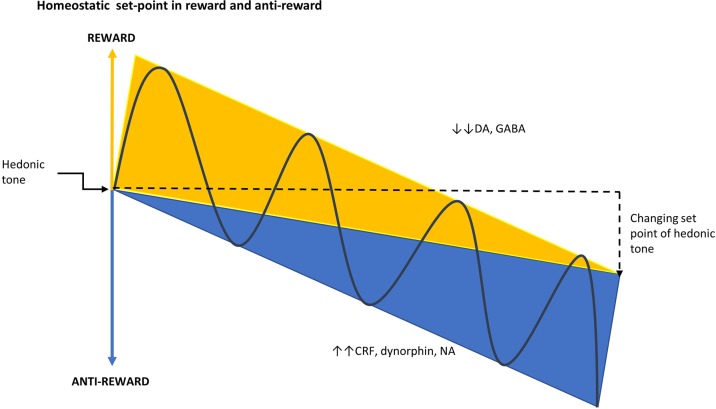
Homeostatic set-point in reward and anti-reward. The set-point of hedonic tone is determined by the balance between the opposing reward and anti-reward pathways. As addiction develops, there is a change in hedonic tone resulting from the deviation of the set-point that occurs when the reward system is down-regulated and the anti-reward system becomes dominant (25). CRF, corticotropin-releasing factor; DA, dopamine; GABA, γ-aminobutyric acid; NA, noradrenaline.
Figure 4
Figure 4
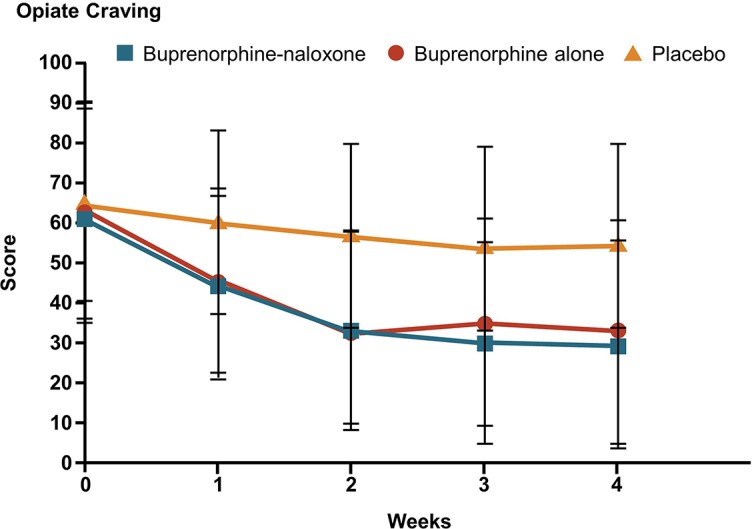
Impact of buprenorphine on self-reported opiate craving among OUD patients (111). Patients were randomized to double-blind treatment with sublingual tablets consisting of buprenorphine (16 mg), buprenorphine-naloxone (16 mg/4 mg), or placebo given daily for 4 weeks. Self-reported opiate craving was assessed as the peak craving during the prior 24 hours measured on a 0–100 mm visual analogue scale, with higher scores representing greater craving. Statistically significant reductions in craving (p < 0.001) were reported for comparisons between buprenorphine and buprenorphine-naloxone groups versus placebo at all post-baseline time points. OUD, opioid use disorder. Reproduced with permission from the Massachusetts Medical Society.

Comment in

References

    1. GBD 2016 Causes of Death Collaborators. Global, regional, and national age-sex specific mortality for 264 causes of death, 1980-2016: a systematic analysis for the Global Burden of Disease Study 2016 Lancet (2017) 390:1151–210. 10.1016/S0140-6736(17)32152-9 - DOI - PMC - PubMed
    1. United Nations Office on Drugs and Crime (2017). World Drug Report 2017.
    1. Kosten TR, George TP. The neurobiology of opioid dependence: implications for treatment. Sci Pract Perspect (2002) 1:13–20. 10.1151/spp021113 - DOI - PMC - PubMed
    1. American Academy of Pain Medicine, the American Pain Society, American Society of Addition Medicine Definitions related to the use of opioids for the treatment of pain. Wisconsin Med J (2001) 100:28–9. - PubMed
    1. Schuckit MA. Treatment of opioid-use disorders. N Engl J Med (2016) 375:357–68. 10.1056/NEJMra1604339 - DOI - PubMed

LinkOut - more resources