Review
. 2018 May 31;7(2):19.
doi: 10.3390/antib7020019.

Anti-Drug Antibodies: Emerging Approaches to Predict, Reduce or Reverse Biotherapeutic Immunogenicity

Affiliations
Review

Anti-Drug Antibodies: Emerging Approaches to Predict, Reduce or Reverse Biotherapeutic Immunogenicity

Kathleen P Pratt. Antibodies (Basel). .

Abstract

The development of anti-drug antibodies (ADAs) following administration of biotherapeutics to patients is a vexing problem that is attracting increasing attention from pharmaceutical and biotechnology companies. This serious clinical problem is also spawning creative research into novel approaches to predict, avoid, and in some cases even reverse such deleterious immune responses. CD4+ T cells are essential players in the development of most ADAs, while memory B-cell and long-lived plasma cells amplify and maintain these responses. This review summarizes methods to predict and experimentally identify T-cell and B-cell epitopes in therapeutic proteins, with a particular focus on blood coagulation factor VIII (FVIII), whose immunogenicity is clinically significant and is the subject of intensive current research. Methods to phenotype ADA responses in humans are described, including T-cell stimulation assays, and both established and novel approaches to determine the titers, epitopes and isotypes of the ADAs themselves. Although rational protein engineering can reduce the immunogenicity of many biotherapeutics, complementary, novel approaches to induce specific tolerance, especially during initial exposures, are expected to play significant roles in future efforts to reduce or reverse these unwanted immune responses.

Keywords: anti-drug antibodies; biotherapeutics; immunogenicity; tolerance.


Conflict of interest statement

The authors declare no conflict of interest.

Figures
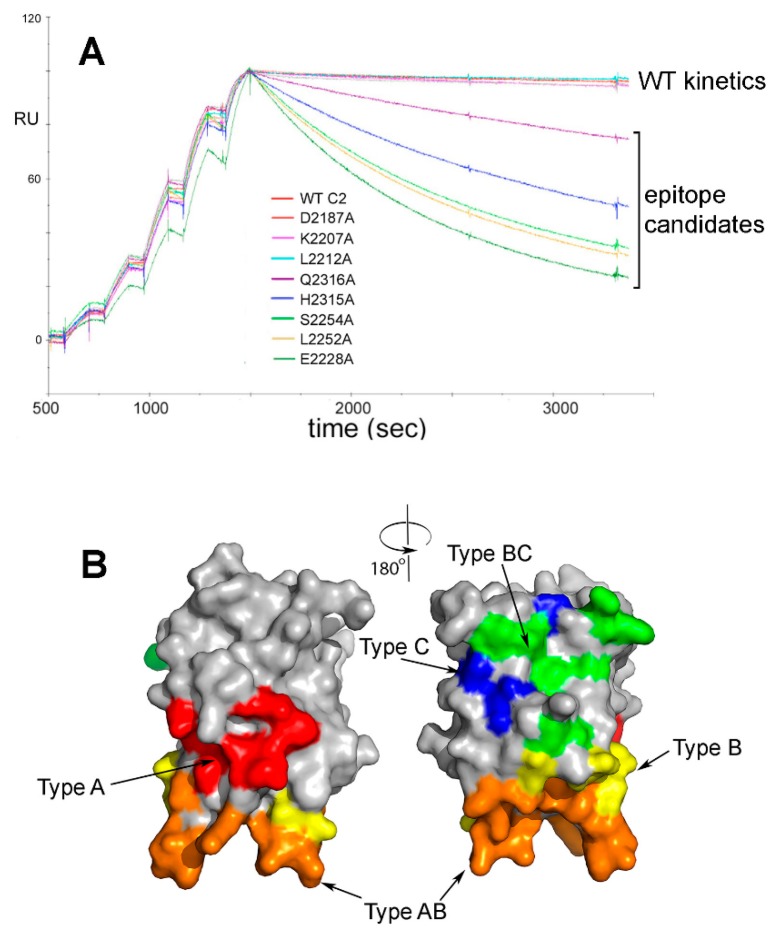
Figure 1
Figure 1
Surface plasmon resonance (SPR)-based epitope mapping. (A). Representative superimposed sensorgrams showing single-cycle kinetics experiments in which rFVIII-C2 protein and rFVIII-C2 variants with a single surface-exposed side chain mutated to alanine were injected at increasing concentrations over a FVIII-specific MAb captured on a biosensor [97]. Residues were flagged as potential contributors to the epitope if the kd for the FVIII-C2 mutein was >2.0X the kd for the wild-type rFVIII-C2 protein. Alanine substitutions at residues E2228, L2252, S2254, H2315 and Q2316 met this criterion in this set of experiments with MAb 1B5. Separate SPR runs (not shown here) identified residues F2196, T2197, N2198, F2200, T2202, R2220, Q2222, N2225 and K2239 as also possibly contributing to the epitope recognized by this MAb. (B). Front and back views (rotated 180°) of the FVIII C2 domain crystal structure [100], with surfaces colored to indicate the 5 partially-overlapping B-cell epitopes recognized by 11 neutralizing MAbs. The MAbs and their cognate epitopes were designated Types A, AB, B, BC and C on the basis of competition ELISA experiments. These MAbs inhibit distinct binding interactions and functions of FVIII, e.g., binding to negatively charged phospholipid surfaces, von Willebrand factor, and other proteins comprising the ‘intrinsic tenase’ complex [88]. Type A: red; Type AB: orange; Type B: yellow; Type BC: green; Type C: blue.
Figure 2
Figure 2
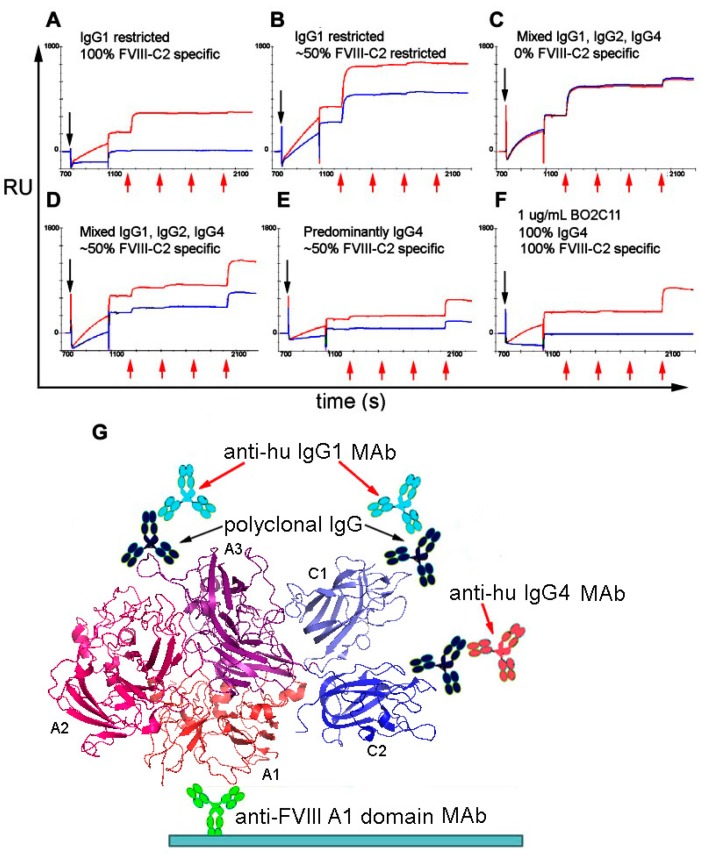
“Saturation SPR” method to characterize polyclonal anti-FVIII anti-drug antibodies (ADAs) in patient plasma samples [114]. First a high-affinity MAb specific for the FVIII A1 domain is covalently immobilized on the biosensor surface, and FVIII protein is then injected and captured by this MAb (0–700 s, not shown in figure). A plasma sample (pre-treated with caprylic acid to minimize biosensor fouling) is injected next (black arrows) followed by sequential injections of anti-hu IgG1, IgG2, IgG3 and IgG4 MAbs (red arrows), all at saturating concentrations. The vertical displacements (in RUs) may be converted to total mass at the biosensor surface following each injection, which is then converted to the total bound antibody concentration assuming an average molecular weight of 150 kDa. (AF): The red and blue sensorgram curves depict matched plasma samples pre-incubated with (red) and without (blue) saturating (1 µM) recombinant FVIII-C2 domain protein, which will compete with the polyclonal anti-FVIII-C2 antibodies in the plasma samples. Thus, these paired SPR experiments indicate the total anti-FVIII polyclonal antibody titer, the fractions of IgG1, IgG2, IgG3 and IgG4 in the samples, and the fraction of antibodies specific for the FVIII C2 domain. Panels A-E illustrate the diverse phenotypes of the anti-FVIII IgG response in patients with allo-or autoimmune anti-FVIII antibodies. Panel F is a control experiment in which a patient-derived IgG4 monoclonal antibody specific for the FVIII C2 domain is tested in the same assay. No patient samples contained FVIII-specific IgM or IgGA (not shown). (G) The biosensor assay format is shown schematically, with the FVIII crystal structure [116] in ribbon representation.

References

    1. World Health Organization . Guidelines on the Quality, Safety and Efficacy of Biotherapeutic Protein Products Prepared by Recombinant DNA Technology. World Health Organization; Geneva, Switzerland: 2013.
    1. Partridge M.A., Purushothama S., Elango C., Lu Y. Emerging technologies and generic assays for the detection of anti-drug antibodies. J. Immunol. Res. 2016;2016:6262383. doi: 10.1155/2016/6262383. - DOI - PMC - PubMed
    1. Rosenberg A.S., Sauna Z.E. Immunogenicity assessment during the development of protein therapeutics. J. Pharm. Pharmacol. 2018;70:584–594. doi: 10.1111/jphp.12810. - DOI - PubMed
    1. Lollar P., Healey J.F., Barrow R.T., Parker E.T. Factor VIII inhibitors. Adv. Exp. Med. Biol. 2001;489:65–73. - PubMed
    1. Franchini M., Santoro C., Coppola A. Inhibitor incidence in previously untreated patients with severe haemophilia B: A systematic literature review. Thromb. Haemost. 2016;116:201–203. - PubMed