


Associations between childhood maltreatment latent classes and eating disorder symptoms in a nationally representative sample of young adults in the United States
- PMID: 31546098
- PMCID: PMC6885127
- DOI: 10.1016/j.chiabu.2019.104171
Associations between childhood maltreatment latent classes and eating disorder symptoms in a nationally representative sample of young adults in the United States
Abstract
Background: Childhood maltreatment is associated with eating disorders, but types of childhood maltreatment often co-occur.
Objective: To examine associations between childhood maltreatment patterns and eating disorder symptoms in young adulthood.
Participants and setting: Data came from the National Longitudinal Study of Adolescent to Adult Health (N = 14,322).
Methods: Latent class analysis was conducted, using childhood physical neglect, physical abuse, and sexual abuse as model indicators. Logistic regression models adjusted for demographic covariates were conducted to examine associations between childhood maltreatment latent classes and eating disorder symptoms.
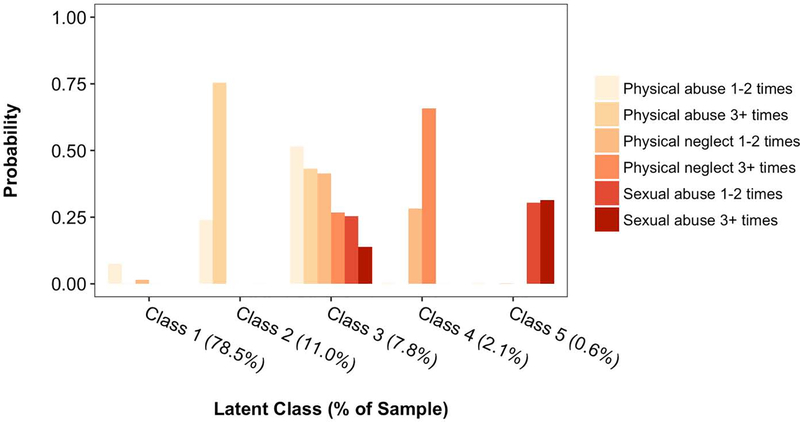
Results: In this nationally representative sample of U.S. young adults (mean age = 21.82 years), 7.3% of participants reported binge eating-related concerns, 3.8% reported compensatory behaviors, and 8.6% reported fasting/skipping meals. Five childhood maltreatment latent classes emerged: "no/low maltreatment" (78.5% of the sample), "physical abuse only" (11.0% of the sample), "multi-type maltreatment" (7.8% of the sample), "physical neglect only" (2.1% of the sample), and "sexual abuse only" (0.6% of the sample). Compared to participants assigned to the "no/low maltreatment" class, participants assigned to the "multi-type maltreatment" class were more likely to report binge eating-related concerns (odds ratio = 1.97; 95% confidence interval [CI]: 1.52, 2.56) and fasting/skipping meals (OR = 1.85; 95% CI: 1.46, 2.34), and participants assigned to the "physical abuse only" class were more likely to report fasting/skipping meals (OR = 1.35; 95% CI: 1.04, 1.76).
Conclusions: This study provides evidence that distinct childhood maltreatment profiles are differentially associated with eating disorder symptoms. Individuals exposed to multi-type childhood maltreatment may be at particularly high risk for eating disorders.
Keywords: Child abuse; Child neglect; Feeding and eating disorders; Young adult.
Copyright © 2019 Elsevier Ltd. All rights reserved.
Conflict of interest statement
Figures
References
-
- Afifi TO, Sareen J, Fortier J, Taillieu T, Turner S, Cheung K, & Henriksen CA (2017). Child maltreatment and eating disorders among men and women in adulthood: Results from a nationally representative United States sample. International Journal of Eating Disorders, 50(11), 1281–1296. 10.1002/eat.22783 - DOI - PMC - PubMed
-
- Akaike H (1987). Factor analysis and AIC. Psychometrika, 52(3), 317–332.
-
- American Psychiatric Association. (2013). Feeding and Eating Disorders In Diagnostic and Statistical Manual of Mental Disorders (DSM-5®). American Psychiatric Association;
Publication types
MeSH terms
Grants and funding
LinkOut - more resources
Full Text Sources
Medical
