Review
. 2019 Sep 21;20(19):4687.
doi: 10.3390/ijms20194687.

The Role of Exo-miRNAs in Cancer: A Focus on Therapeutic and Diagnostic Applications

Affiliations
Review

The Role of Exo-miRNAs in Cancer: A Focus on Therapeutic and Diagnostic Applications

Francesco Ingenito et al. Int J Mol Sci. .

Abstract

Exosomes are extracellular vesicles released into biological fluids where they act as carriers of various molecules, including proteins, lipids, and RNAs, between cells, modulating or perturbing specific physiological processes. Recently, it has been suggested that tumoral cells release excessive amounts of exosomes that, through their cargo, promote tumor progression, stimulating growth, angiogenesis, metastasis, insensitivity to chemotherapy, and immune evasion. Increasing evidence highlights exosomal microRNAs (exo-miRNAs) as important players in tumorigenesis. MicroRNA (miRNA) are a class of small non-coding RNA able to regulate gene expression, targeting multiple mRNAs and inducing translational repression and/or mRNA degradation. Exo-miRNAs are highly stable and easily detectable in biological fluids, and for these reasons, miRNAs are potential cancer biomarkers useful diagnostically and prognostically. Furthermore, since exosomes are natural delivery systems between cells, they can be appropriately modified to carry therapeutic miRNAs to specific recipient cells. Here we summarize the main functions of exo-miRNAs and their possible role for diagnostic and therapeutic applications.

Keywords: brain tumors; cancer diagnosis; cancer therapy; exosome; microRNA; tumor microenvironment.


Conflict of interest statement

The authors declare no conflict of interests.

Figures
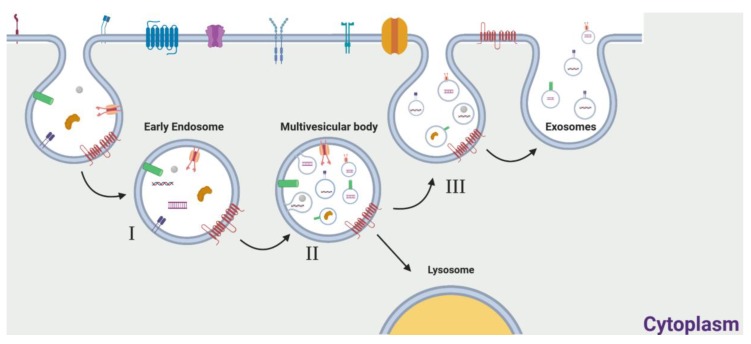
Figure 1
Figure 1
Schematic representation of exosome formation and release. Exosomal cargo from the extracellular and intracellular spaces is transported to early endosomes entering the endocytic pathway (I). During endosome maturation, the early endosomal membrane invaginates, leading to the formation of a late endosome, known as a multivesicular body (MVB), which is characterized by the presence of small, internal microvesicles. By this process, cargo is internalized into these microvesicles, now called exosomes (II). MVBs preferentially fuse with lysosomes, for the degradation of cellular components (III), or can fuse with the cytoplasmic membrane, allowing the release of the exosomes into the extracellular space (IV).
Figure 2
Figure 2
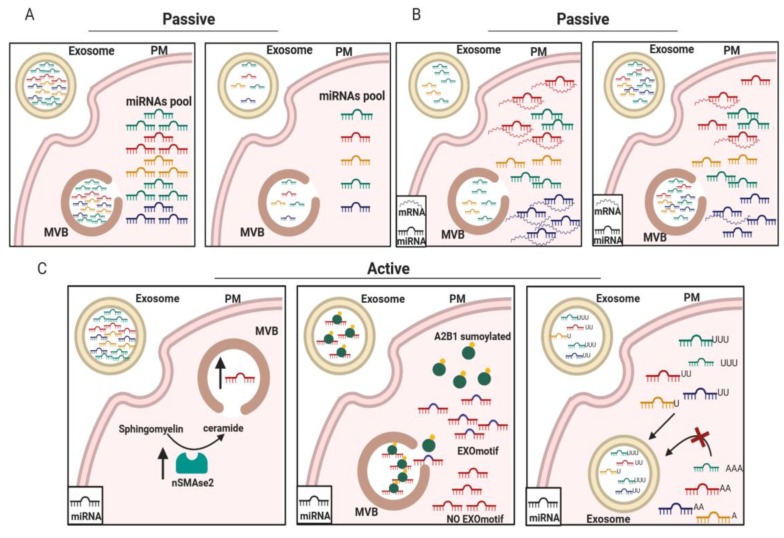
Active and passive mechanisms of miRNA loading in exosomes. miRNAs are more or less present in exosomes on the basis of either their relative abundance in cells (A) or the abundance of their target mRNAs (B). (C) Active mechanisms of miRNA loading are regulated by nSMAse2 (left panel) or by sumoylated A2B1, which recognizes an EXO motif present in the miRNA sequence (middle panel), or by a specific sequence containing uridine at the 3’UTR of the miRNA (right panel).
Figure 3
Figure 3
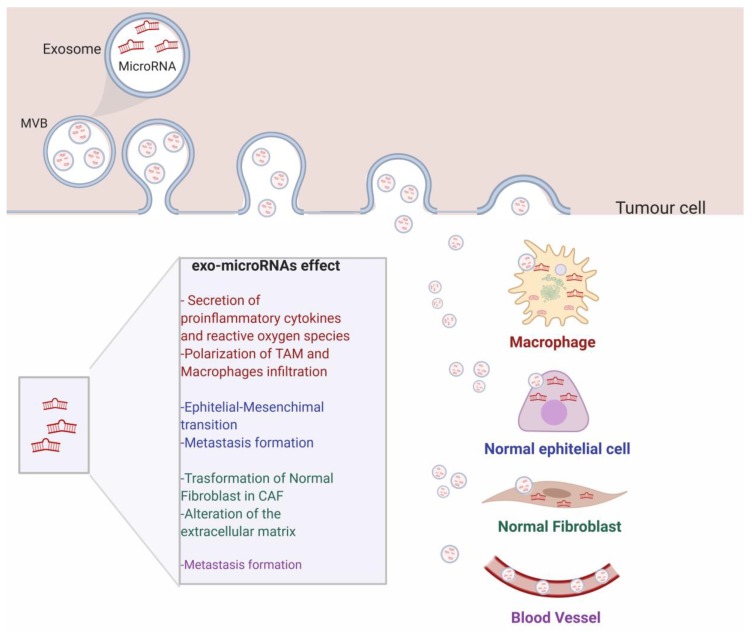
Schematic representation of the roles of exo-miRNAs on distant cells and in the cancer microenvironment. Exo-miRNAs released by tumor cells move to the extracellular space to reach near-by cells, such as macrophages, normal epithelial cells, and normal fibroblast. The exosomal cargo is responsible for cellular transformation and enhanced cancer progression. Exosomes can also reach distant cells, by moving along the blood stream.

References

    1. Rak J. Extracellular vesicles—Biomarkers and effectors of the cellular interactome in cancer. Front. Pharmacol. 2013;4:21. doi: 10.3389/fphar.2013.00021. - DOI - PMC - PubMed
    1. Van Niel G., D’Angelo G., Raposo G. Shedding light on the cell biology of extracellular vesicles. Nat. Rev. Mol. Cell Biol. 2018;19:213–228. doi: 10.1038/nrm.2017.125. - DOI - PubMed
    1. Colombo M., Raposo G., Thery C. Biogenesis, secretion, and intercellular interactions of exosomes and other extracellular vesicles. Annu. Rev. Cell Dev. Biol. 2014;30:255–289. doi: 10.1146/annurev-cellbio-101512-122326. - DOI - PubMed
    1. Kalra H., Drummen G.P., Mathivanan S. Focus on Extracellular Vesicles: Introducing the Next Small Big Thing. Int. J. Mol. Sci. 2016;17:170. doi: 10.3390/ijms17020170. - DOI - PMC - PubMed
    1. Yuana Y., Sturk A., Nieuwland R. Extracellular vesicles in physiological and pathological conditions. Blood Rev. 2013;27:31–39. doi: 10.1016/j.blre.2012.12.002. - DOI - PubMed

LinkOut - more resources