Review
. 2019 Sep 22;24(19):3439.
doi: 10.3390/molecules24193439.

Mechanisms of DNA Replication and Repair: Insights from the Study of G-Quadruplexes

Affiliations
Review

Mechanisms of DNA Replication and Repair: Insights from the Study of G-Quadruplexes

Tracy M Bryan. Molecules. .

Abstract

G-quadruplexes are four-stranded guanine-rich structures that have been demonstrated to occur across the genome in humans and other organisms. They provide regulatory functions during transcription, translation and immunoglobulin gene rearrangement, but there is also a large amount of evidence that they can present a potent barrier to the DNA replication machinery. This mini-review will summarize recent advances in understanding the many strategies nature has evolved to overcome G-quadruplex-mediated replication blockage, including removal of the structure by helicases or nucleases, or circumventing the deleterious effects on the genome through homologous recombination, alternative end-joining or synthesis re-priming. Paradoxically, G-quadruplexes have also recently been demonstrated to provide a positive role in stimulating the initiation of DNA replication. These recent studies have not only illuminated the many roles and consequences of G-quadruplexes, but have also provided fundamental insights into the general mechanisms of DNA replication and its links with genetic and epigenetic stability.

Keywords: DNA replication; DNA structure; G-quadruplex.


Conflict of interest statement

The author declares no conflict of interest.

Figures
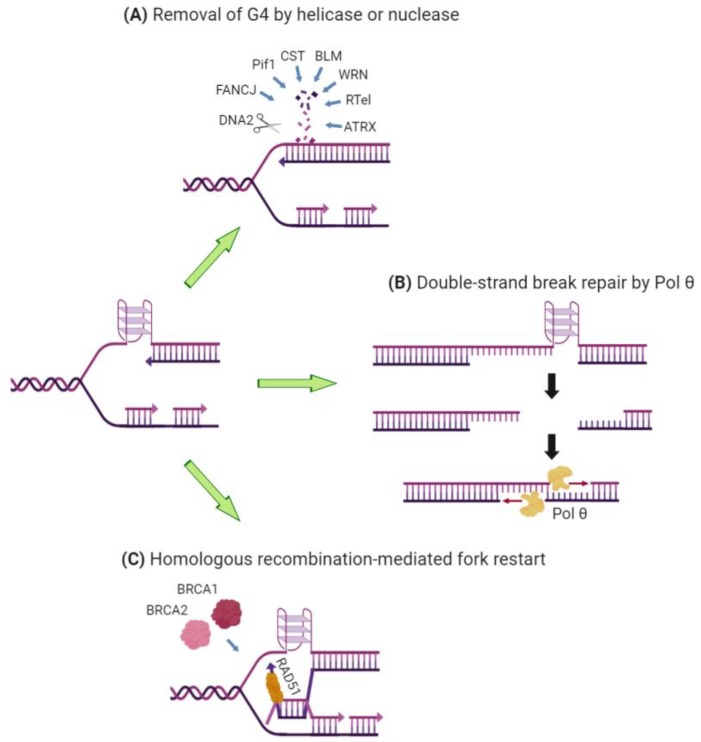
Figure 1
Figure 1
Cellular strategies to minimize genomic damage arising from G-quadruplex (G4)-mediated replication stalling. (A) A large number of helicases and nucleases exist to remove G-quadruplexes; it is not yet clear why so many proteins with this function are needed. (B) In the absence of FANCJ, deletions occur in the region surrounding G-quadruplexes. The size of these deletions is kept in check by the end-joining and gap-filling activity of polymerase θ [16]. (C) In the absence of Pif1, homologous recombination mediated by RAD51, BRCA1, and BRCA2 can lead to genomic rearrangements [20]. Figure created with BioRender.com.
Figure 2
Figure 2
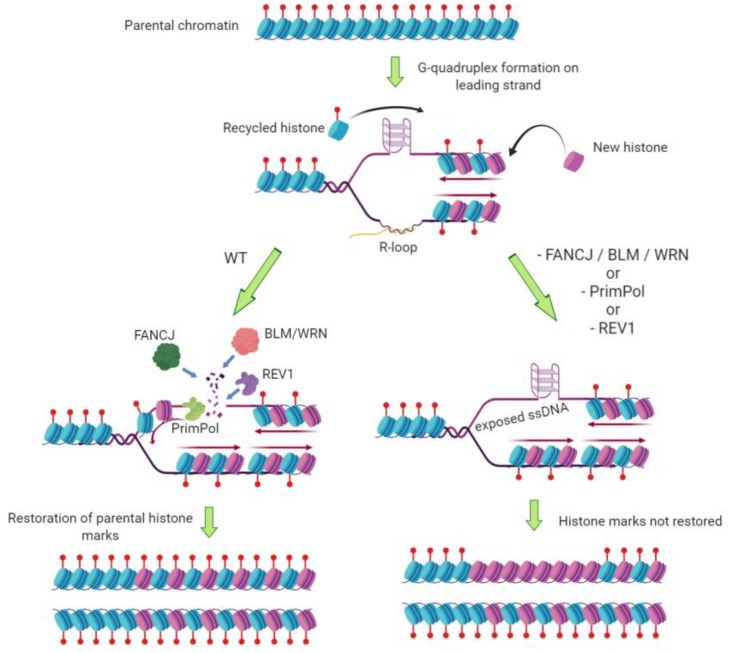
Model for the mechanism of G4-mediated changes to histone modifications and gene expression (adapted from [19,79]). G-quadruplex formation at the replication fork can block replication (here depicted with the G4 on the leading strand, but it may also block lagging strand synthesis). (Left panel): FANCJ, BLM or WRN helicases can remove the G-quadruplex, and DNA synthesis past the impediment can be promoted by REV1 or PrimPol. (Right panel): in the absence of any of these pathways, an extended region of single-stranded DNA template may accumulate. The subsequent DNA synthesis needed to fill this gap would be uncoupled from the incorporation of parental histones into the newly replicated DNA strand, resulting in a loss of the restoration of parental histone marks. Figure created with BioRender.com.
Figure 3
Figure 3
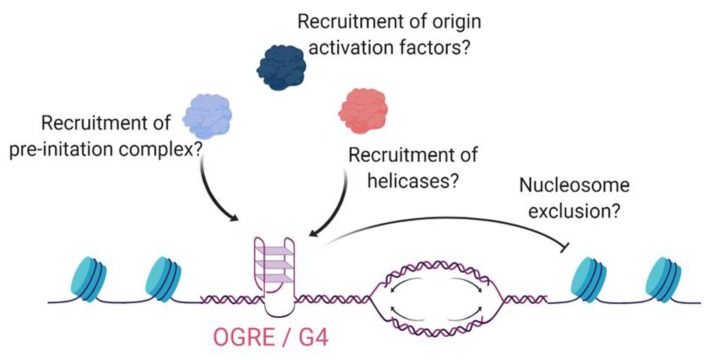
Promotion of replication origin firing by a G4-forming sequence. The Origin G-rich Repeated Element (OGRE) lies 250–300 bp upstream of the replication initiation site, in a nucleosome-free region, and is needed for optimal origin activity of a subset of vertebrate replication origins [90,92,94]. Figure created with BioRender.com.
Figure 4
Figure 4
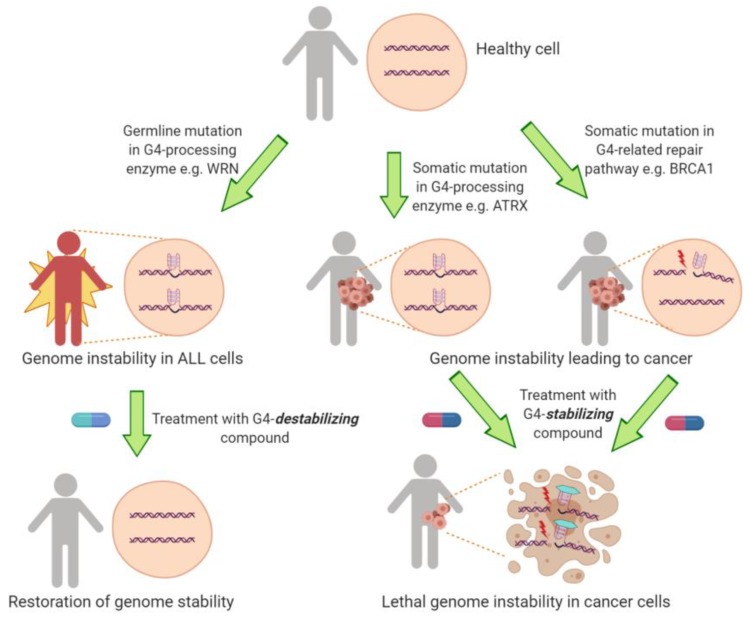
Potential therapeutic applications of G4 effects on the genome. Germline mutations in G4 helicases such as WRN or BLM lead to genomic instability throughout the body, which could be counteracted with G4-destabilizing compounds. Cancer-associated mutations in pathways that deal with G4 could form the basis of synthetic lethal approaches to cancer treatment. Figure created with BioRender.com.

References

    1. Williamson J.R., Raghuraman M.K., Cech T.R. Monovalent cation-induced structure of telomeric DNA: The G-quartet model. Cell. 1989;59:871–880. doi: 10.1016/0092-8674(89)90610-7. - DOI - PubMed
    1. Huppert J.L., Balasubramanian S. Prevalence of quadruplexes in the human genome. Nucleic Acids Res. 2005;33:2908–2916. doi: 10.1093/nar/gki609. - DOI - PMC - PubMed
    1. Todd A.K., Johnston M., Neidle S. Highly prevalent putative quadruplex sequence motifs in human DNA. Nucleic Acids Res. 2005;33:2901–2907. doi: 10.1093/nar/gki553. - DOI - PMC - PubMed
    1. Bedrat A., Lacroix L., Mergny J.L. Re-evaluation of G-quadruplex propensity with G4Hunter. Nucleic Acids Res. 2016;44:1746–1759. doi: 10.1093/nar/gkw006. - DOI - PMC - PubMed
    1. Chambers V.S., Marsico G., Boutell J.M., Di Antonio M., Smith G.P., Balasubramanian S. High-throughput sequencing of DNA G-quadruplex structures in the human genome. Nat. Biotechnol. 2015;33:877–881. doi: 10.1038/nbt.3295. - DOI - PubMed