


Associations Between Sub-Clinical Markers of Cardiometabolic Risk and Exposure to Residential Indoor Air Pollutants in Healthy Adults in Perth, Western Australia: A Study Protocol
- PMID: 31546738
- PMCID: PMC6801858
- DOI: 10.3390/ijerph16193548
Associations Between Sub-Clinical Markers of Cardiometabolic Risk and Exposure to Residential Indoor Air Pollutants in Healthy Adults in Perth, Western Australia: A Study Protocol
Abstract
Background: A growing body of epidemiological and clinical evidence has implicated air pollution as an emerging risk factor for cardiometabolic disease. Whilst individuals spend up to two-thirds of daily time in their domestic residential environment, very few studies have been designed to objectively measure the sub-clinical markers of cardiometabolic risk with exposure to domestic indoor air pollutants. This cross-sectional study aims to investigate associations between the components of domestic indoor air quality and selected sub-clinical cardiometabolic risk factors in a cohort of healthy adults living in Perth, Western Australia.
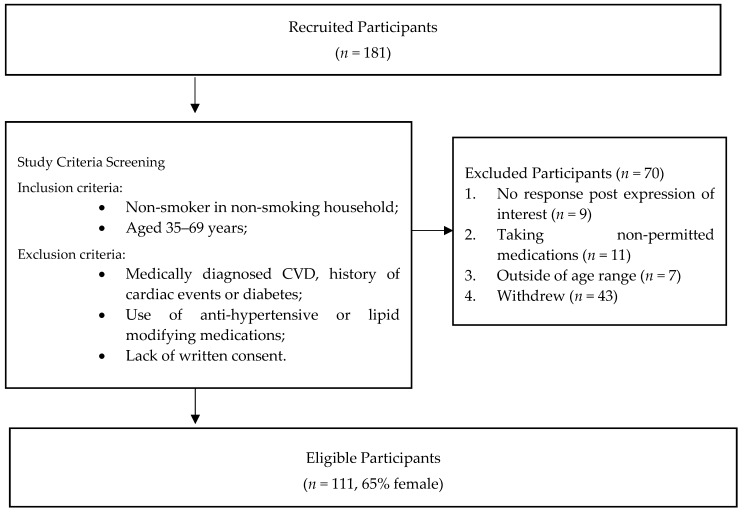
Methods: One hundred and eleven non-smoking adults (65% female) living in non-smoking households who were aged between 35-69 years were recruited for the project. Study subjects were invited to participate in all sections of the study, which included: Domestic indoor air monitoring along with the concurrent 24 h ambulatory monitoring of peripheral and central blood pressure and measures of central hemodynamic indices, standardized questionnaires on aspects relating to current health status and the domestic environment, a 24 h time-activity diary during the monitoring period, and clinic-based health assessment involving collection of blood and urine biomarkers for lipid and glucose profiles, as well as measures of renal function and an analysis of central pulse wave and pulse wave velocity.
Results: This study provides a standardized approach to the study of sub-clinical cardiometabolic health effects that are related to the exposure to indoor air pollution.
Conclusion: The findings of this study may provide direction for future research that will further contribute to our understanding of the relationship that exists between indoor air pollution and sub-clinical markers of cardiometabolic risk.
Keywords: Indoor air pollution; blood pressure; cardiovascular; diabetes mellitus; metabolic; risk factors.
Conflict of interest statement
The authors declare no conflict of interest.
Figures
References
-
- Munzel T., Sorensen M., Gori T., Schmidt F.P., Rao X., Brook J., Chen L.C., Brook R.D., Rajagopalan S. Environmental stressors and cardio-metabolic disease: Part i-epidemiologic evidence supporting a role for noise and air pollution and effects of mitigation strategies. Eur. Heart J. 2017;38:550–556. doi: 10.1093/eurheartj/ehw269. - DOI - PubMed
-
- Brook R.D., Bard R.L., Burnett R.T., Shin H.H., Vette A., Croghan C., Phillips M., Rodes C., Thornburg J., Williams R. Differences in blood pressure and vascular responses associated with ambient fine particulate matter exposures measured at the personal versus community level. Occup. Environ. Med. 2011;68:224–230. doi: 10.1136/oem.2009.053991. - DOI - PubMed
-
- Dvonch T.J., Kannan J.S., Schulz J.A., Keeler L.G., Mentz D.G., House D.J., Benjamin D.A., Max D.P., Bard D.R., Brook D.R. Acute effects of ambient particulate matter on blood pressure: Differential effects across urban communities. Hypertension. 2009;53:853–859. doi: 10.1161/HYPERTENSIONAHA.108.123877. - DOI - PMC - PubMed
Publication types
MeSH terms
Substances
LinkOut - more resources
Full Text Sources
Medical
