Review
. 2019 Sep 19;9(3):110.
doi: 10.3390/bios9030110.

Latest Trends in Biosensing for Microphysiological Organs-on-a-Chip and Body-on-a-Chip Systems

Affiliations
Review

Latest Trends in Biosensing for Microphysiological Organs-on-a-Chip and Body-on-a-Chip Systems

Sebastian Rudi Adam Kratz et al. Biosensors (Basel). .

Abstract

Organs-on-chips are considered next generation in vitro tools capable of recreating in vivo like, physiological-relevant microenvironments needed to cultivate 3D tissue-engineered constructs (e.g., hydrogel-based organoids and spheroids) as well as tissue barriers. These microphysiological systems are ideally suited to (a) reduce animal testing by generating human organ models, (b) facilitate drug development and (c) perform personalized medicine by integrating patient-derived cells and patient-derived induced pluripotent stem cells (iPSCs) into microfluidic devices. An important aspect of any diagnostic device and cell analysis platform, however, is the integration and application of a variety of sensing strategies to provide reliable, high-content information on the health status of the in vitro model of choice. To overcome the analytical limitations of organs-on-a-chip systems a variety of biosensors have been integrated to provide continuous data on organ-specific reactions and dynamic tissue responses. Here, we review the latest trends in biosensors fit for monitoring human physiology in organs-on-a-chip systems including optical and electrochemical biosensors.

Keywords: biosensors; body-on-a-chip; electrical biosensors; microphysiological systems; optical biosensors; organ-on-a-chip.


Conflict of interest statement

The authors declare no conflict of interest.

Figures

Figure 1
Figure 1
(a) Liver-on-a-chip for multiplexed culture of nine HepG2/C3A liver organoids with organoid integrated 400 µm oxygen sensing microprobes. (b) Correlation of oxygen uptake, glucose uptake and lactate production in healthy cells, dead cells and cells with mitochondrial dysfunction. (c) Influence of rotenone and troglitazone exposure on oxygen uptake, glucose uptake and lactate production of HepG2/C3A organoids. [41] Copyright 2016 National Academy of Science.
Figure 2
Figure 2
(a) Schematic view of hanging-drop chip for cancer organoids with an attached biosensor. (b) Measurement of glucose consumption and lactate secretion. (Adapted from [42] with permission from Nature Publishing Group 2019).
Figure 3
Figure 3
Microfluidic chip with 4 optical sensors for oxygen measurement in 3D vascular networks: (a) chip layout. (b) Simultaneous partial oxygen pressure measurement at 4 points in the chip. (c) Vascular network morphology (GFP-HUVEC cells are depicted green) at day 6 post-seeding with a medium perfusion speed of 5 μL/min. Scale bar 50 μm. (Reproduced from [29]).
Figure 4
Figure 4
(a) Microimpedance tomography (MITO) system within lung-on-a-chip including sensing electrodes (SE) and working electrodes (WE). (b) Changes in impedance resulting from the respiratory movements of the cell culture membrane. The relative impedance changes result from the permeabilization of the epithelial monolayer. (c) Time-lapse relative impedance magnitude at a frequency of 1 kHz. (Adapted from [45] with permission from Elsevier).
Figure 5
Figure 5
(a) Schematic cross-sectional sketch of the cell culture device with the perfusion setup as well as 3D schematic view of three parallel cell culture chambers including electrodes for TEER measurements and image of the fabricated chip. (b) TEER significantly decreases after 24 h of incubation with nickel sulfate while no obvious change is detectable after treatment with LPS, cobalt sulfate, or glycerol (* p < 0.05, ** p < 0.1). (c) The TEER value decreased to 82% of its original value upon UV irradiation. (Adapted from [47] with permission from The Royal Society of Chemistry).
Figure 6
Figure 6
(a) Microfluidic setup for in vitro culture and stimulation of muscle tissue (murine C2C12 skeletal myoblasts) and subsequent analysis of IL-6 (Interleukin-6) and TNF-α (Tumor necrosis factor alpha) content. High-sensitivity screen-printed gold electrodes (SPGEs); indium tin oxide (ITO)- interdigitated array (IDA) electrodes (b) Increase in cytokine concentration was detected in the relaxation periods after electrical stimulation and also during stimulation with lipopolysaccharide (LPS). (Adapted from [50] with permission from The Royal Society of Chemistry).
Figure 7
Figure 7
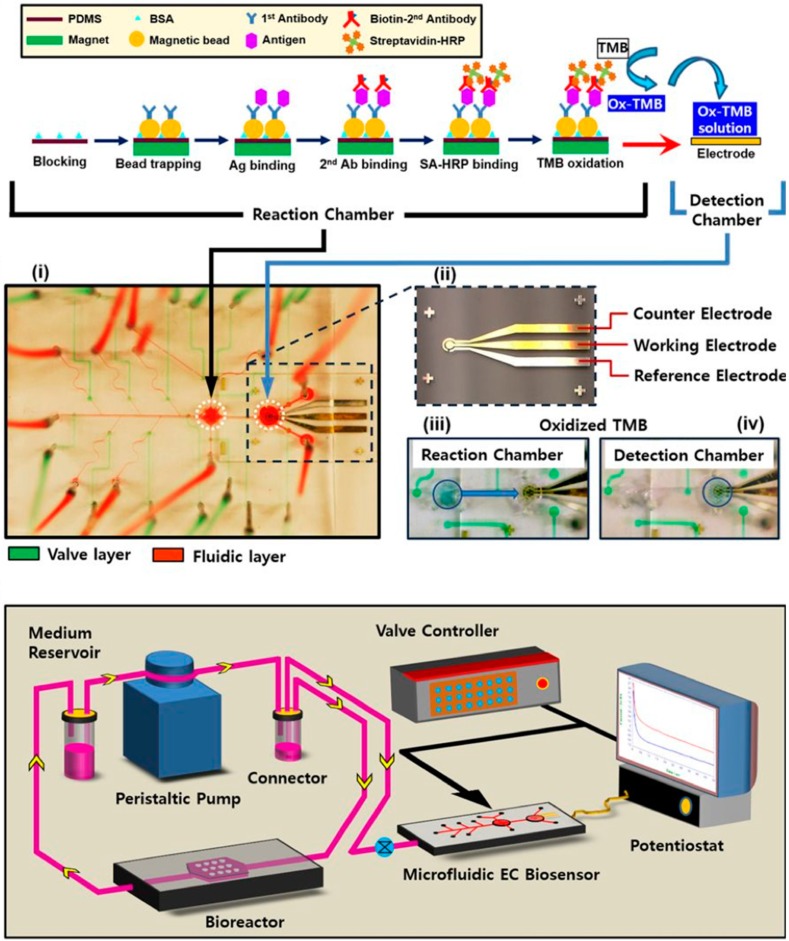
Immunosensing principle with the EC sensor for detection of target biomarkers and fabricated microfluidic sensing chip, (i) photograph (ii) microelectrodes, (iii) reaction chamber with oxidized TMB, (iv) transfer of oxidized TMB to the detection chamber and microfluidic sensing system. Bovine serum albumin (BSA); Horseradish peroxidase (HRP); Tetramethylbenzidine (TMB) (Reproduced from [57]).
Figure 8
Figure 8
(a) Microfluidic device temporarily bonded by vacuum and composed of two layers: (I) Microfluidic layer and (II) PDMS membrane featuring two sets of two capped pillars measuring muscle deflection. (b) Muscle and neurite growth over 16 days and muscle contraction measurement. (Reprinted from [61] with permission from AAAS).
Figure 9
Figure 9
(a) Overview of microfluidic chip and oxygen sensing principle, particles have a size of 5 μm. (b) Morphology changes after 4-h period of normoxia conditions and under oxygen-glucose-deprivation (OGD). Arrows indicate ruptures in the cell barrier. (c) Oxygen measurement during normoxia conditions and under OGD. (d) Expression of VEGF and GLUT-1 in blood-brain-barrier model under normoxia (with and without glucose) and under OGD conditions. Reproduced with permission from [62] Copyright 2019 American Chemical Society.
Figure 10
Figure 10
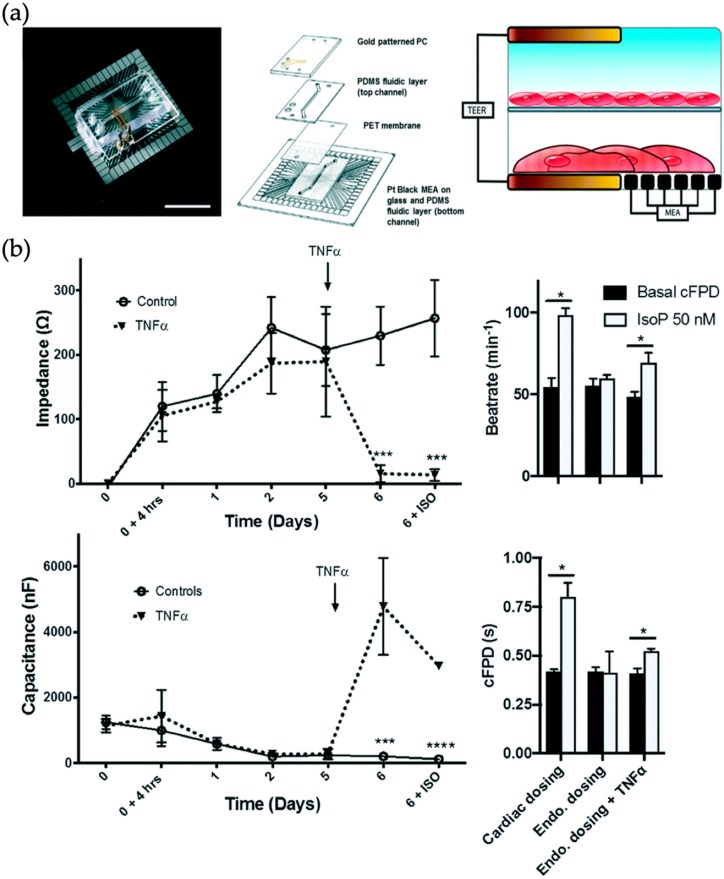
(a) TEER–MEA chip—endothelial cell layer on top of the PET membrane and cardiomyocytes on top of MEA—measuring TEER of both cell layers. (b) Influence of TNF-α on TEER and capacitance of the endothelial cell layer. (Adapted from [65] with permission from The Royal Society of Chemistry).
Figure 11
Figure 11
Heart model with integrated cantilever for continuous electrical measurement of cardiomyocyte activity. (Reproduced from [65] with permission from John Wiley & Sons, Inc., Hoboken, USA).
Figure 12
Figure 12
“plug-and-play” 3-tissue-representative organ-on-a-chip system. Liver and cardiac modules are created by bioprinting spherical organoids within customized bioinks, resulting in 3D hydrogel constructs that are placed into the microreactor devices. Lung modules are formed by creating layers of cells over porous membranes within microfluidic devices. Introduction of TEER sensors allows monitoring of tissue barrier function integrity over time. (Reproduced from [68]).
Figure 13
Figure 13
Non-invasive monitoring of cellular function in a 4-organ system measuring the mechanical and electrical functional activity of cardiomyocytes and motoneurons as well as secretion of hepatocytes. (Reproduced from [69]).

References

    1. Mak I.W., Evaniew N., Ghert M. Lost in translation: Animal models and clinical trials in cancer treatment. Am. J. Transl. Res. 2014;6:114. - PMC - PubMed
    1. Liu K.D., Humphreys B.D., Endre Z.H. The ten barriers for translation of animal data on AKI to the clinical setting. Intensive Care Med. 2017;43:898–900. doi: 10.1007/s00134-017-4810-4. - DOI - PMC - PubMed
    1. Leenaars C.H., Kouwenaar C., Stafleu F.R., Bleich A., Ritskes-Hoitinga M., De Vries R.B., Meijboom F.L. Animal to human translation: A systematic scoping review of reported concordance rates. J. Transl. Med. 2019;17:223. doi: 10.1186/s12967-019-1976-2. - DOI - PMC - PubMed
    1. Rothbauer M., Rosser J.M., Zirath H., Ertl P. Tomorrow today: Organ-on-a-chip advances towards clinically relevant pharmaceutical and medical in vitro models. Curr. Opin. Biotechnol. 2019;55:81–86. doi: 10.1016/j.copbio.2018.08.009. - DOI - PubMed
    1. Huh D., Matthews B.D., Mammoto A., Montoya-Zavala M., Hsin H.Y., Ingber D.E. Reconstituting organ-level lung functions on a chip. Science. 2010;328:1662–1668. doi: 10.1126/science.1188302. - DOI - PMC - PubMed

MeSH terms

LinkOut - more resources