. 2019 Sep 20;12(4):142.
doi: 10.3390/ph12040142.

Tamoxifen Protects from Vesicular Stomatitis Virus Infection

Affiliations

Tamoxifen Protects from Vesicular Stomatitis Virus Infection

Lamin B Cham et al. Pharmaceuticals (Basel). .

Abstract

Background: Tamoxifen (TAM) is an estrogen-receptor antagonist, widely used in the adjuvant treatment of early stage estrogen-sensitive breast cancer. Several studies have revealed new biological targets of TAM that mediate the estrogen receptor independent activities of the drug. Recently, the antiviral activity of TAM on replication of human immunodeficiency virus (HIV), hepatitis C virus (HCV) and Herpes simplex virus (HSV-1) in vitro was described. In the current study, we aimed to investigate the effect of TAM on infection with vesicular stomatitis virus (VSV).

Methods: Vero cells were treated with different concentrations of TAM for 24 h and then infected with VSV. Additionally, C57BL/6 mice were pretreated with 4 mg TAM, one day and three days before infection with VSV. Results: Treatment of Vero cells with TAM suppressed the viral replication of VSV in vitro and in vivo. The inhibitory effect of TAM on VSV replication correlated with an enhanced interferon-I response and stimulation of macrophages. Conclusions: TAM was identified as being capable to protect from VSV infection in vitro and in vivo. Consequently, this antiviral function (as an advantageous side-effect of TAM) might give rise to new clinical applications, such as treatment of resistant virus infections, or serve as an add-on to standard antiviral therapy.

Keywords: antiviral activity; interferon; tamoxifen (TAM); vesicular stomatitis virus (VSV) infection.


Conflict of interest statement

The authors declare no conflict of interest.

Figures
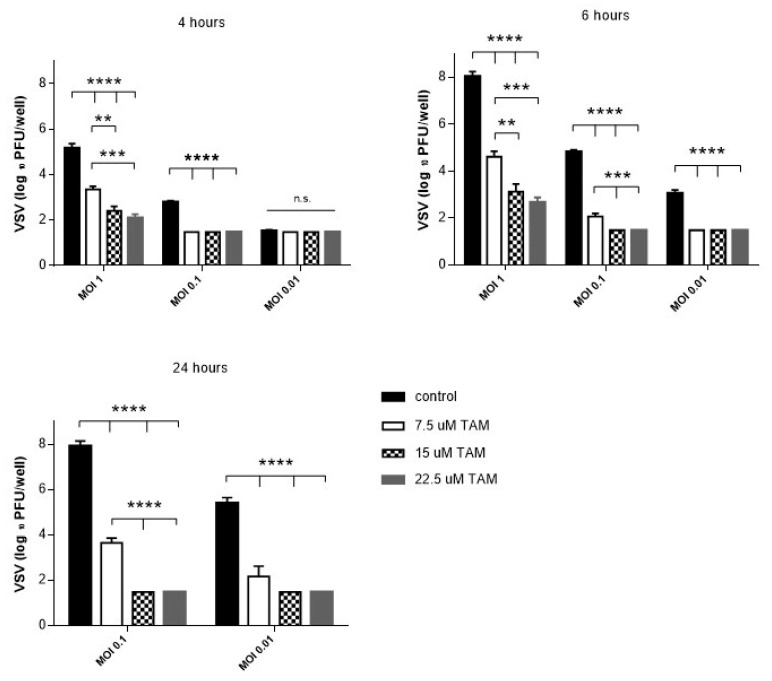
Figure 1
Figure 1
Tamosifen (TAM) pretreatment resulted in the inhibition of replication of vesicular stomatitis virus (VSV) in vitro. Vero cells were treated with 7.5 μM, 15 μM, 22.5 μM TAM, or 1 μL dimethyl sulfoxide (DMSO) used as a control for 24 h, and then infected with 0.01, 0.1, and 1 MOI of VSV for 1 h; the cells were washed with phosphate buffered saline (PBS) and fresh medium was added. VSV titers in cell supernatant were measured at 4 h, 6 h and 24 h after infection by plaque assay (n = 5). Data are expressed as means ± SEM. n.s.: not significant, ** p = 0.01; *** p = 0.001; **** p < 0.001.
Figure 2
Figure 2
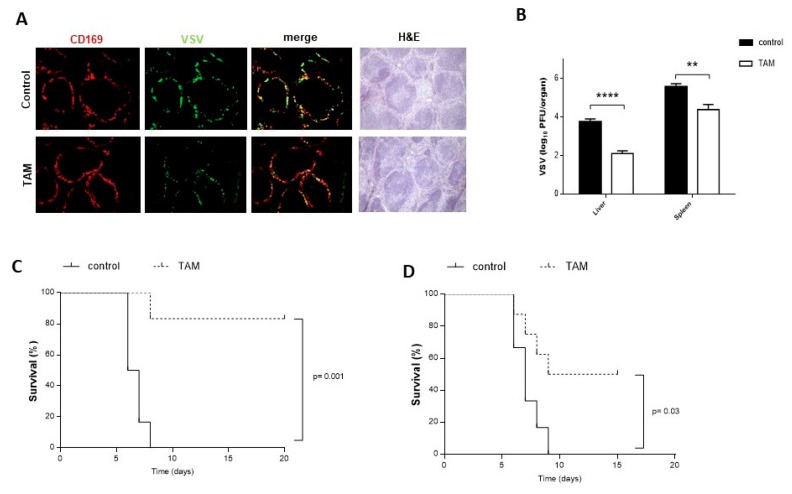
Pretreatment with TAM inhibits early VSV replication in vivo, improving survival after VSV infection. (A) Immunofluorescence and H&E staining of snap-frozen spleen tissues obtained from TAM pretreated and control mice 8 h after VSV infection. Spleen sections were stained for CD169 (red) and VSV glycoprotein (green). Scale bar = 100 μm; one representative out of 6 is shown. Fluorescent and light microscopy images were captured at 10x magnification using Keyence BZ-9000E microscope. (B) Virus titers were determined in liver and spleen tissues at 8 h post infection in TAM pretreated and control mice (n = 6). (C) C57BL/6 mice were pretreated intraperitoneally with 4 mg TAM at day -3 and day -1. Corn oil served as control. Survival was monitored in mice intravenously infected with 2 × 10⁸ PFU VSV at day 0 over the indicated period (n = 6). (D) Survival was monitored in C57BL/6 mice initially intravenously infected with 2 × 10⁸ PFU VSV at day 0 over the indicated period. TAM treatment (100 μL/4mg per mouse i.p.) was administrated twice on day 2 and 3 post VSV infection (n = 6 or 8). The error bars show SEM. ** p = 0.01; **** p < 0.001.
Figure 3
Figure 3
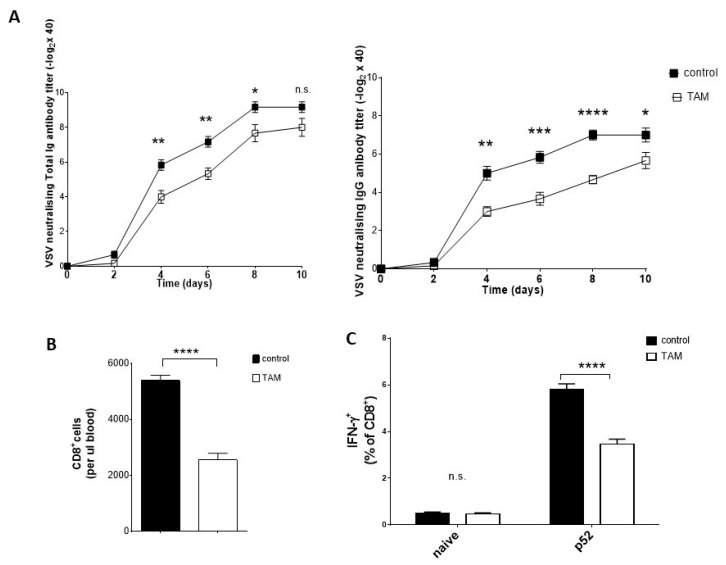
TAM suppresses the VSV neutralizing antibody response. (A) VSV neutralizing antibodies were measured in sera harvested from TAM pretreated C57BL/6 mice (4 mg TAM i.p. per mouse, applied at day -3 and -1) and control mice (treated with corm oil) at the indicated time points after infection with 2 × 10⁴ PFU VSV (n = 6). The left graph shows the total amount of VSV neutralising antibodies measured without pretreatment with β-mercaptoethanol. The right graph shows the titer of VSV neutralising IgG antibodies in serum that was pretreated with β-mercaptoethanol to remove IgM and IgA antibodies. (B) Total amount of CD8+ T cells was analyzed in blood of TAM-pretreated and control mice 10 days after VSV infection by flow cytometry (n = 6). (C) Percentage of CD8 + T cells from spleen capable to produce INF-γ after restimulation with virus-specific peptide p52 was measured in TAM pretreated and control mice 10 days after VSV infection by flow cytometry (n = 6). Data are expressed as means ± SEM. n.s.: not significant, * p = 0.05; ** p = 0.01; *** p = 0.001; **** p < 0.001.
Figure 4
Figure 4
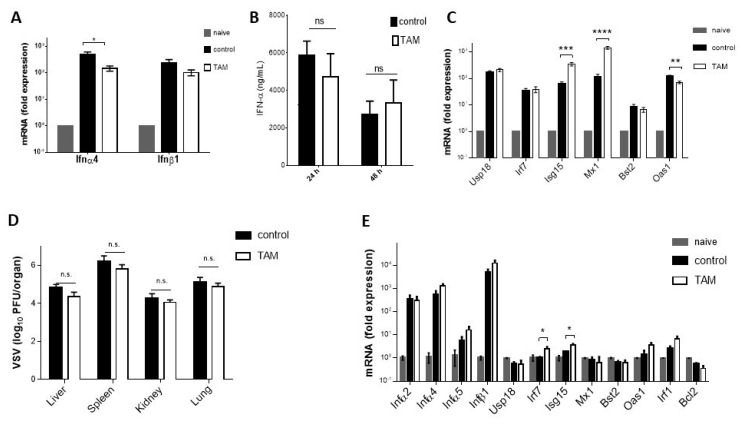
Inhibitory effect of TAM on early VSV replication requires interferon. (A) The mRNA expression of type I interferon from spleen tissue was determined by quantitative real-time PCR (qRT-PCR) 8 h after infection with 2 × 10⁸ PFU VSV in TAM pretreated and control mice (n = 5). (B) Interferon α concentrations were examined in sera of TAM-pretreated and control mice at 24 and 48 h after infection with 2 × 10⁸ PFU VSV (n = 6). (C) The mRNA expression of indicated interferon-induced genes from spleen tissue was determined by quantitative real-time PCR (qRT-PCR) 8 h after infection with 2 × 10⁸ PFU VSV in TAM-pretreated and control mice (n = 5). (D) Ifnar−/− mice were pretreated intraperitoneally with 4 mg TAM or corn oil used as control at day -3 and -1, followed by VSV infection with 2 × 10⁶ PFU. Virus titers were determined in the liver, spleen, kidney, and lung of Ifnar deficient mice tissues 8 h post infection (n = 6). (E) The mRNA expression of indicated interferon-induced genes from spleen tissue was determined by quantitative real-time PCR (qRT-PCR) in Ifnar−/− mice after treatment with 4 mg TAM at day -3 and -1 or corn oil used as control (n = 4). Spleen tissues were harvested 8 h post infection with 2 × 10⁸ PFU of VSV. Data are expressed as means ± SEM. n.s.: not significant, * p = 0.05; ** p = 0.01; *** p = 0.001; **** p < 0.001.

References

    1. Grainger D.J., Metcalfe J.C. Tamoxifen: Teaching an old drug new tricks? Nat. Med. 1996;4:381–385. doi: 10.1038/nm0496-381. - DOI - PubMed
    1. Jordan V.C. The science of selective estrogen receptor modulators: Concept to clinical practice. Clin. Cancer Res. 2006;12:5010–5013. doi: 10.1158/1078-0432.CCR-06-1136. - DOI - PubMed
    1. Shagufta, Ahmad I. Tamoxifen a pioneering drug: An update on the therapeutic potential of tamoxifen derivatives. Eur. J. Med. Chem. 2018;143:515–531. doi: 10.1016/j.ejmech.2017.11.056. - DOI - PubMed
    1. Heery M., Corbett P., Zelkowitz R. Precautions for patients taking tamoxifen. J. Adv. Pract. Oncol. 2018;9:78–83. - PMC - PubMed
    1. Allred D.C., Anderson S.J., Paik S., Wickerham D.L., Nagtegaal I.D., Swain S.M., Mamounas E.P., Julian T.B., Geyer C.E., Jr., Costantino J.P., et al. Adjuvant tamoxifen reduces subsequent breast cancer in women with estrogen receptor-positive ductal carcinoma in situ: a study based on NSABP protocol B-24. J. Clin. Oncol. 2012;30:1268–1273. doi: 10.1200/JCO.2010.34.0141. - DOI - PMC - PubMed

LinkOut - more resources