Review
. 2019 Sep 12;8(9):344.
doi: 10.3390/plants8090344.

Sugarcane Omics: An Update on the Current Status of Research and Crop Improvement

Affiliations
Review

Sugarcane Omics: An Update on the Current Status of Research and Crop Improvement

Ahmad Ali et al. Plants (Basel). .

Abstract

Sugarcane is an important crop from Poaceae family, contributing about 80% of the total world's sucrose with an annual value of around US$150 billion. In addition, sugarcane is utilized as a raw material for the production of bioethanol, which is an alternate source of renewable energy. Moving towards sugarcane omics, a remarkable success has been achieved in gene transfer from a wide variety of plant and non-plant sources to sugarcane, with the accessibility of efficient transformation systems, selectable marker genes, and genetic engineering gears. Genetic engineering techniques make possible to clone and characterize useful genes and also to improve commercially important traits in elite sugarcane clones that subsequently lead to the development of an ideal cultivar. Sugarcane is a complex polyploidy crop, and hence no single technique has been found to be the best for the confirmation of polygenic and phenotypic characteristics. To better understand the application of basic omics in sugarcane regarding agronomic characters and industrial quality traits as well as responses to diverse biotic and abiotic stresses, it is important to explore the physiology, genome structure, functional integrity, and collinearity of sugarcane with other more or less similar crops/plants. Genetic improvements in this crop are hampered by its complex genome, low fertility ratio, longer production cycle, and susceptibility to several biotic and abiotic stresses. Biotechnology interventions are expected to pave the way for addressing these obstacles and improving sugarcane crop. Thus, this review article highlights up to date information with respect to how advanced data of omics (genomics, transcriptomic, proteomics and metabolomics) can be employed to improve sugarcane crops.

Keywords: biotic and abiotic stresses; crop improvement and development; omics approaches; sugarcane.


Conflict of interest statement

The authors declare no conflict of interest.

Figures
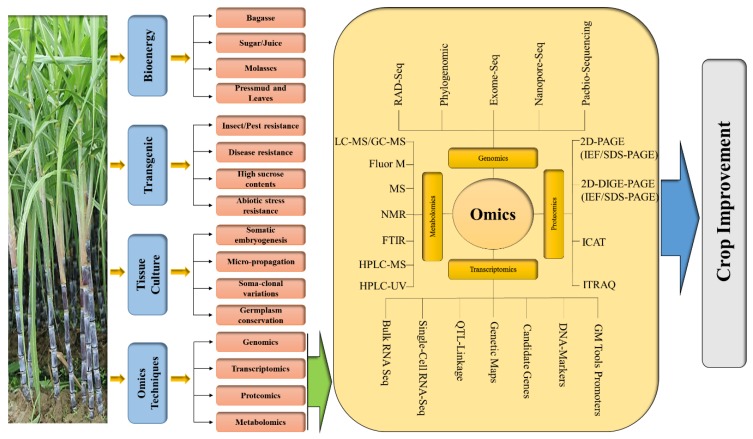
Figure 1
Figure 1
Graphical strategy showing the role of biotechnological interventions for the development of sugarcane crop. Abbreviations: LC, Liquid chromatography; MS, Mass spectrometry; GC, Gas chromatography; Flour-M, Gas chromatography; NMR, Nuclear magnetic resonance; FTIR, Fourier-transform infrared spectroscopy; HPLC, High-performance liquid chromatography; UV, Ultraviolet light; SDS, Sodium dodecyl sulfate; PAGE, polyacrylamide gel; 2D-DIGE, Two-dimensional difference gel electrophoresis; iTRAQ, Isobaric tags for relative and absolute quantitation; QTL, Quantitative trait loci; GM, Genetics modification; ICAT, Isotope-coded affinity tag; RAD-Seq, Restriction site-associated DNA sequencing.
Figure 2
Figure 2
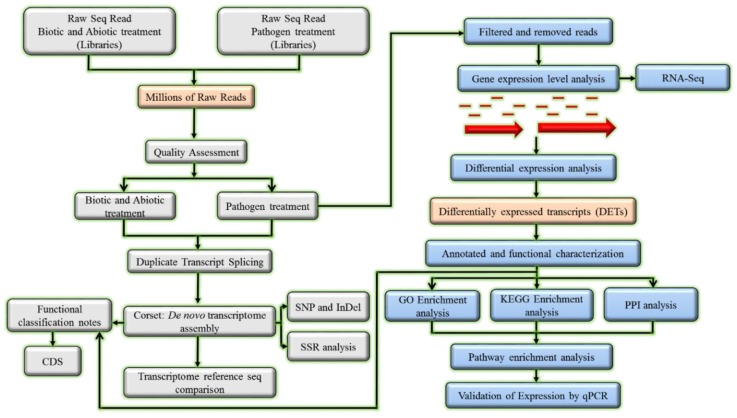
A workflow sketch of sugarcane transcriptome analysis including construction of reference transcriptome from the de novo assembly and annotation and functional characterization of differentially expressed transcripts (DETs).
Figure 3
Figure 3
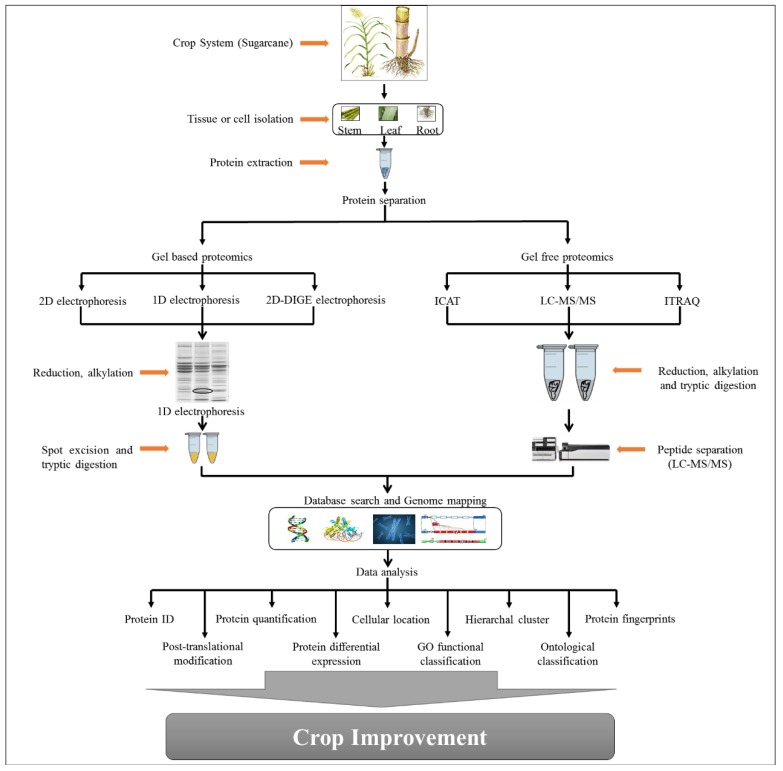
The workflow of sugarcane proteomics from crop system sampling using gel-based and gel-free proteomics approaches.
Figure 4
Figure 4
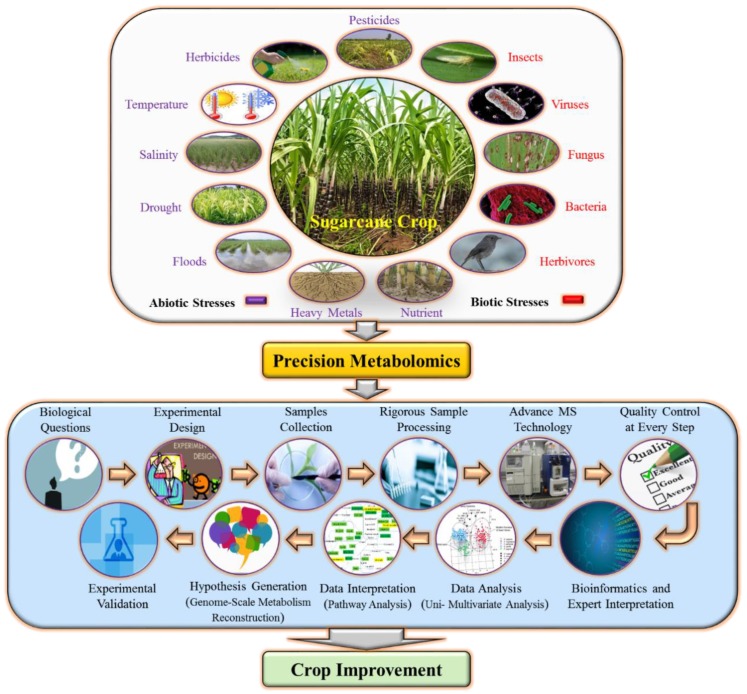
Sugarcane precision metabolomics studies: A useful tool to discover metabolome alterations during abiotic and biotic stresses and major routes of generating metabolomics data.

References

    1. Waclawovsky A.J., Sato P.M., Lembke C.G., Moore P.H., Souza G.M. Sugarcane for bioenergy production: An assessment of yield and regulation of sucrose content. Plant Biotechnol. J. 2010;8:263–276. doi: 10.1111/j.1467-7652.2009.00491.x. - DOI - PubMed
    1. Ali A., Pan Y.-B., Wang Q.-N., Wang J.-D., Chen J.-L., Gao S.-J. Genetic diversity and population structure analysis of Saccharum and Erianthus genera using microsatellite (SSR) markers. Sci. Rep. 2019;9:395. doi: 10.1038/s41598-018-36630-7. - DOI - PMC - PubMed
    1. D’Hont A., Grivet L., Feldmann P., Glaszmann J., Rao S., Berding N. Characterisation of the double genome structure of modern sugarcane cultivars (Saccharum spp.) by molecular cytogenetics. Mol. Gen. Genet. MGG. 1996;250:405–413. doi: 10.1007/s004380050092. - DOI - PubMed
    1. Zhang J., Zhang X., Tang H., Zhang Q., Hua X., Ma X., Zhu F., Jones T., Zhu X., Bowers J. Allele-defined genome of the autopolyploid sugarcane Saccharum spontaneum L. Nat. Genet. 2018;50:1565. doi: 10.1038/s41588-018-0237-2. - DOI - PubMed
    1. Garsmeur O., Droc G., Antonise R., Grimwood J., Potier B., Aitken K., Jenkins J., Martin G., Charron C., Hervouet C. A mosaic monoploid reference sequence for the highly complex genome of sugarcane. Nat. Commun. 2018;9:2638. doi: 10.1038/s41467-018-05051-5. - DOI - PMC - PubMed

LinkOut - more resources