. 2019 Oct 8;116(41):20598-20604.
doi: 10.1073/pnas.1904828116. Epub 2019 Sep 23.

Experimental evolution of immunological specificity

Affiliations

Experimental evolution of immunological specificity

Kevin Ferro et al. Proc Natl Acad Sci U S A. .

Abstract

Memory and specificity are hallmarks of the adaptive immune system. Contrary to prior belief, innate immune systems can also provide forms of immune memory, such as immune priming in invertebrates and trained immunity in vertebrates. Immune priming can even be specific but differs remarkably in cellular and molecular functionality from the well-studied adaptive immune system of vertebrates. To date, it is unknown whether and how the level of specificity in immune priming can adapt during evolution in response to natural selection. We tested the evolution of priming specificity in an invertebrate model, the beetle Tribolium castaneum Using controlled evolution experiments, we selected beetles for either specific or unspecific immune priming toward the bacteria Pseudomonas fluorescens, Lactococcus lactis, and 4 strains of the entomopathogen Bacillus thuringiensis After 14 generations of host selection, specificity of priming was not universally higher in the lines selected for specificity, but rather depended on the bacterium used for priming and challenge. The insect pathogen B. thuringiensis induced the strongest priming effect. Differences between the evolved populations were mirrored in the transcriptomic response, revealing involvement of immune, metabolic, and transcription-modifying genes. Finally, we demonstrate that the induction strength of a set of differentially expressed immune genes predicts the survival probability of the evolved lines upon infection. We conclude that high specificity of immune priming can evolve rapidly for certain bacteria, most likely due to changes in the regulation of immune genes.

Keywords: immune memory; immune priming; immunological specificity; innate immunity; trained immunity.


Conflict of interest statement

The authors declare no conflict of interest.

Figures
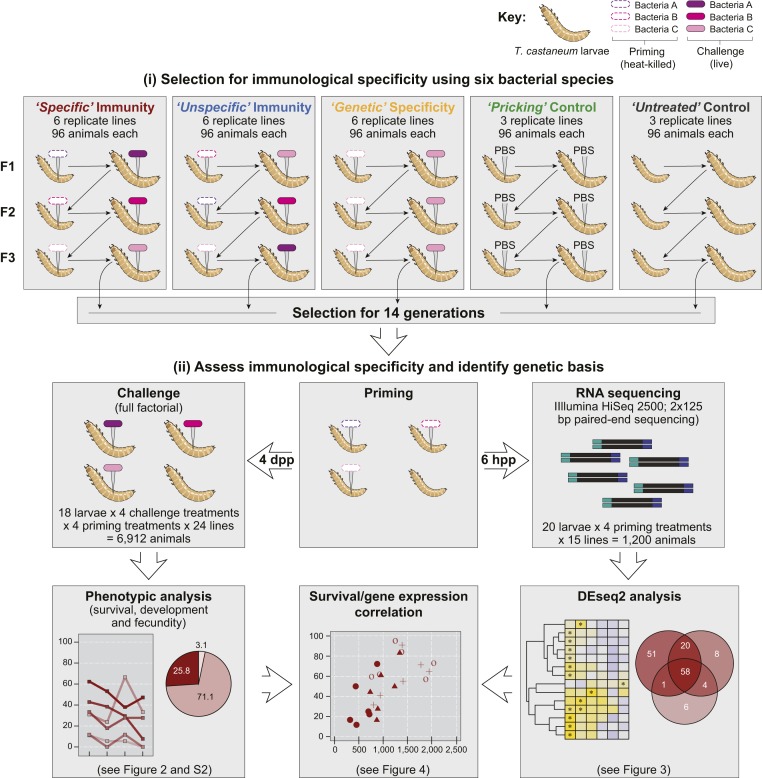
Fig. 1.
Fig. 1.
Experimental design of experimental evolution treatments and subsequent phenotypic and transcriptomic analyses. Three selection treatments were selected for specific immunity, unspecific immunity, or genetic specificity using 6 bacteria species or strains: L. lactis (Ll), P. fluorescens (Pf), B. thuringiensis tenebrionis (Btt), B. thuringiensis (Bt1), B. thuringiensis yunnanensis (Bt2), and B. thuringiensis 407 (Bt407). Two additional evolution treatments were used to control for the effect of wounding (pricking control) and laboratory conditions (untreated control). After 14 generations of evolution, several phenotypic assays and a transcriptomic analysis were performed to assess the degree of immune priming and its specificity and genetic basis in each treatment.
Fig. 2.
Fig. 2.
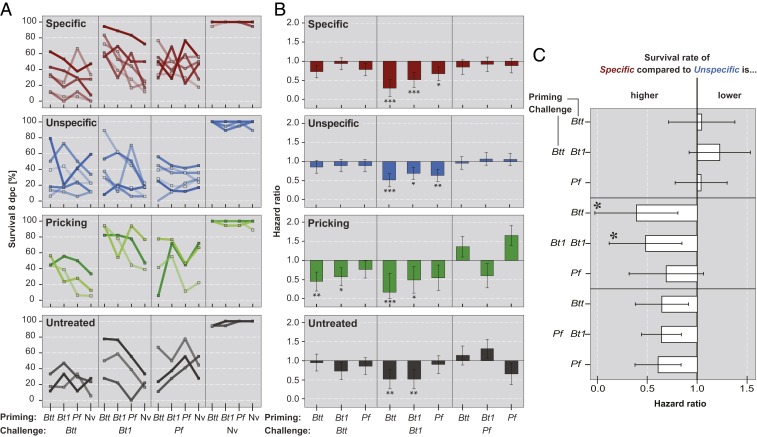
Survival of evolved populations at 8 d after priming and challenge. (A) Survival rates by selection treatment and challenge bacteria. Each line corresponds to 1 replicate line. (B) Hazard ratios of primed treatments compared with naive controls by selection treatment and challenge bacteria. Each column corresponds to the median hazard ratio of 6 replicate lines for the specific and unspecific selection treatments and 3 replicate lines for the pricking and untreated control treatments, with SEs. (C) Hazard ratios of the specific selection treatment compared with the unspecific selection treatment by priming and challenge bacteria combination.
Fig. 3.
Fig. 3.
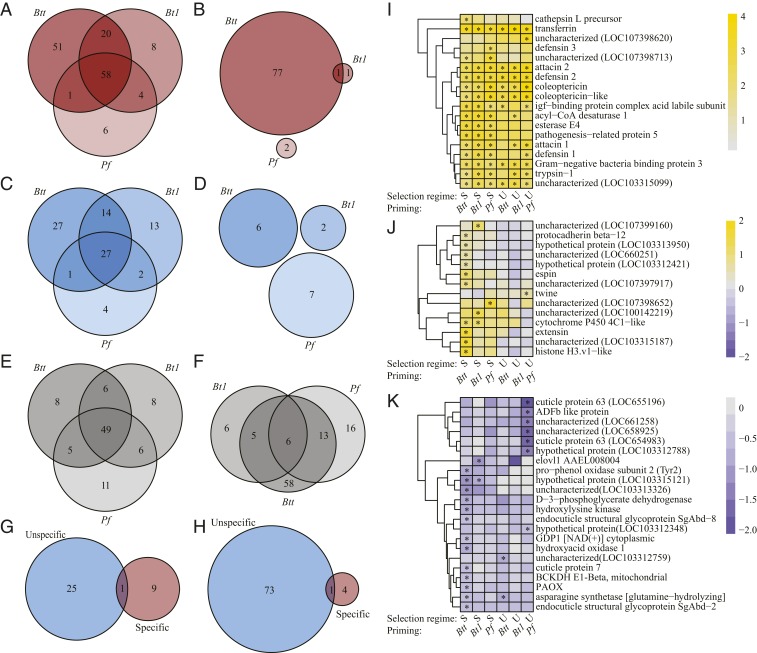
DEGs at 6 h after priming by selection treatment. (AF) The number of DEGs at 6 h after priming compared to naive (i.e., unprimed) animals. (A) Specific treatment, up-regulated. (B) Specific treatment, down-regulated. (C) Unspecific treatment, up-regulated. (D) Unspecific treatment, down-regulated. (E) Untreated treatment, up-regulated. (F) Untreated treatment, down-regulated. (G and H) DEGs of naive (i.e., unprimed) animals of the specific and unspecific selection treatments compared with the untreated control treatment. (G) Up-regulated. (H) Down-regulated. (IK) Heatmaps for selected genes that were significantly differentially regulated for at least 1 of the 6 selection/priming treatment combinations, indicated by asterisks. (I) Heatmap of the 10 most up-regulated genes for each treatment combination. (J) Heatmap of genes showing contrasting expression patterns among the treatment combinations. (K) Heatmap of the 10 most down-regulated genes for each treatment combination. For IK, DEGs that are shared by treatments are shown only once.
Fig. 4.
Fig. 4.
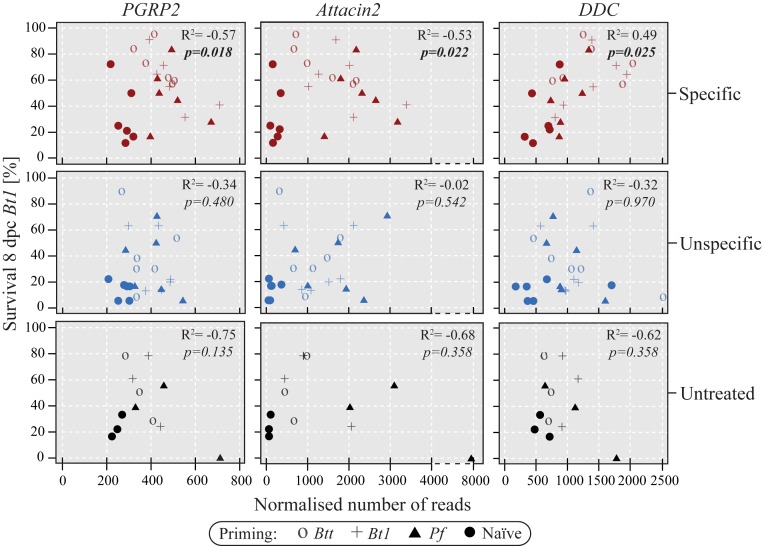
Correlation of survival rates and absolute expression levels for immune DEGs. Absolute transcript levels after normalization with DESeq2 were correlated with survival rates after Bt1 challenge for immune DEGs in all primed groups. Correlations are shown separately for the specific (red) and unspecific (blue) selection treatments and the untreated (gray) control treatment from left to right per gene. n = 6 for specific and unspecific; n = 3 for untreated.

References

    1. Murphy K. P., Janeway C. A., Mowat A., Janeway’s Immunobiology (Garland Science, New York, ed. 8, 2012).
    1. Netea M. G., Quintin J., van der Meer J. W. M., Trained immunity: A memory for innate host defense. Cell Host Microbe 9, 355–361 (2011). - PubMed
    1. Reimer-Michalski E.-M., Conrath U., Innate immune memory in plants. Semin. Immunol. 28, 319–327 (2016). - PubMed
    1. Milutinović B., Kurtz J., Immune memory in invertebrates. Semin. Immunol. 28, 328–342 (2016). - PubMed
    1. Kurtz J., Specific memory within innate immune systems. Trends Immunol. 26, 186–192 (2005). - PubMed

Publication types