. 2019 Oct 8;116(41):20568-20573.
doi: 10.1073/pnas.1905878116. Epub 2019 Sep 23.

A marine plasmid hitchhiking vast phylogenetic and geographic distances

Affiliations

A marine plasmid hitchhiking vast phylogenetic and geographic distances

Jörn Petersen et al. Proc Natl Acad Sci U S A. .

Abstract

Horizontal gene transfer (HGT) plays an important role in bacterial evolution and serves as a driving force for bacterial diversity and versatility. HGT events often involve mobile genetic elements like plasmids, which can promote their own dissemination by associating with adaptive traits in the gene pool of the so-called mobilome. Novel traits that evolve through HGT can therefore lead to the exploitation of new ecological niches, prompting an adaptive radiation of bacterial species. In this study, we present phylogenetic, biogeographic, and functional analyses of a previously unrecognized RepL-type plasmid found in diverse members of the marine Roseobacter group across the globe. Noteworthy, 100% identical plasmids were detected in phylogenetically and geographically distant bacteria, revealing a so-far overlooked, but environmentally highly relevant vector for HGT. The genomic and functional characterization of this plasmid showed a completely conserved backbone dedicated to replication, stability, and mobilization as well as an interchangeable gene cassette with highly diverse, but recurring motifs. The majority of the latter appear to be involved in mechanisms coping with toxins and/or pollutants in the marine environment. Furthermore, we provide experimental evidence that the plasmid has the potential to be transmitted across bacterial orders, thereby increasing our understanding of evolution and microbial niche adaptation in the environment.

Keywords: RepL-type plasmid; Roseobacter group; chromate resistance; horizontal gene transfer.


Conflict of interest statement

The authors declare no conflict of interest.

Figures
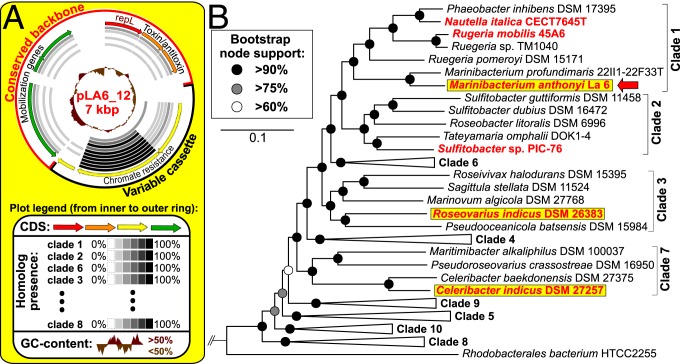
Fig. 1.
Fig. 1.
(A) Circular visualization of the pLA6_12 plasmid and (B) phylogenomic maximum likelihood tree of Roseobacter group members. Multi locus sequence alignment is based on 582 orthologous proteins with 182,693 amino acid positions. Strains with identical RepL-type plasmids are highlighted in yellow. Roseobacter group members containing a RepL-type plasmid with a backbone >92% identical to those of pLA6_12 are marked in red. Clades are shown partially collapsed. A noncollapsed version is given in SI Appendix, Fig. S3.
Fig. 2.
Fig. 2.
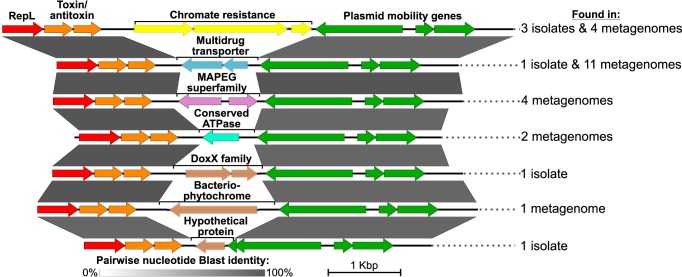
Linear representation of pLA6_12-like plasmids with different integration cassette motifs in isolates and environmental samples. Alignment visualization was produced using EasyFig. Pairwise Blast identities are indicated by gray shading showing a conserved backbone region. Only 1 representative is shown for each integration motif. The number of instances the motif was found in isolates and/or metagenomes is given on the Right. A detailed overview of all complete plasmid instances found for each integration motif is given in SI Appendix, Fig. S5.
Fig. 3.
Fig. 3.
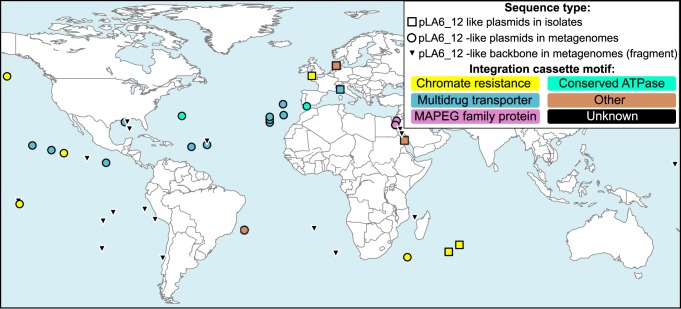
Biogeography of pLA6_12-like plasmids. Sampling locations of Roseobacter group isolates are shown in squares. Locations where metagenomes have been obtained are shown in circles and triangles. Integration cassette motifs are indicated by a color code consistent with Fig. 2. pLA6_12-like plasmids were found exclusively in marine environments, but scattered across the world. Black triangles represent metagenome fragments, which encode pLA6_12-like repL genes, but are too incomplete to allow conclusions on the respective integration cassette.
Fig. 4.
Fig. 4.
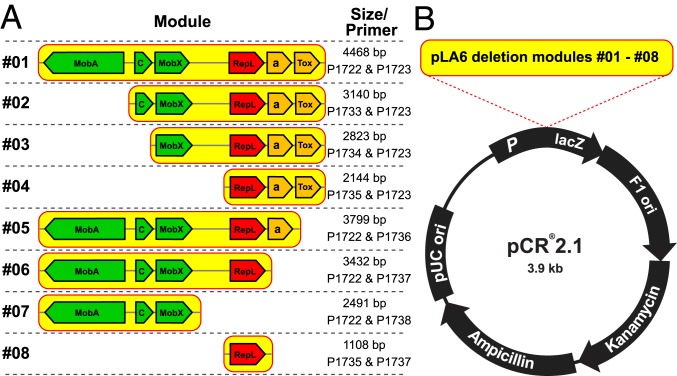
Deletion series of the conserved backbone from pLA6_12. (A) Module #01 with the complete pLA6_12 backbone and modules #02 to #08, representing stepwise deletions of each of the 6 backbone genes mobACX, repL, and the toxin/antitoxin system genes (here designated “Tox” and “a,” respectively), were amplified from pLA6_12 via specific PCRs. The size of each module and the primers used for its respective creation are listed to the Right. The respective primer sequences are given in SI Appendix, Table S4. (B) Each module was individually cloned into the commercially available E. coli vector pCR2.1 encoding kanamycin resistance as a universal selective marker.
Fig. 5.
Fig. 5.
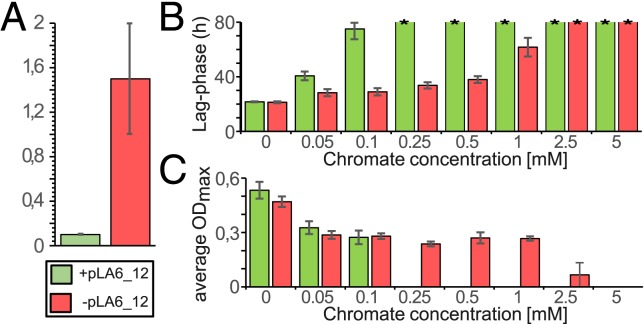
Influence of pLA6_12 on the chromate tolerance of P. inhibens DSM 17395 ∆65/3. Comparative growth experiments of P. inhibens Δ65/3 (lacking pLA6_12) and the transformant P. inhibens Δ65/3+pLA6_12 were performed with chromate (K2CrO4) concentrations between 0 and 5 mM. (A) Maximum chromate tolerance was found to be 10 to 20× higher in strains containing pLA6_12. (B and C) Susceptibility or resistance to chromate manifested in form of changes in lag-phase duration and maximum optical density. The length of the lag phase was determined by the “threshold hour” (Ht), at which OD600 exceeded a predefined threshold of 0.03. *, infinity. The corresponding growth curves are shown in SI Appendix, Fig. S15.

References

    1. Koonin E. V., Horizontal gene transfer: Essentiality and evolvability in prokaryotes, and roles in evolutionary transitions. F1000 Res. 5, 1805 (2016). - PMC - PubMed
    1. Lang A. S., Zhaxybayeva O., Beatty J. T., Gene transfer agents: Phage-like elements of genetic exchange. Nat. Rev. Microbiol. 10, 472–482 (2012). - PMC - PubMed
    1. Ramsay J. P., et al. , An updated view of plasmid conjugation and mobilization in Staphylococcus. Mob. Genet. Elements 6, e1208317 (2016). - PMC - PubMed
    1. Wallden K., Rivera-Calzada A., Waksman G., Type IV secretion systems: Versatility and diversity in function. Cell. Microbiol. 12, 1203–1212 (2010). - PMC - PubMed
    1. Petersen J., Wagner-Döbler I., Plasmid transfer in the ocean–A case study from the Roseobacter group. Front. Microbiol. 8, 1350 (2017). - PMC - PubMed

Publication types

Substances

LinkOut - more resources