. 2019 Sep 23;9(1):13689.
doi: 10.1038/s41598-019-49835-1.

Pioglitazone attenuates kidney injury in an experimental model of gentamicin-induced nephrotoxicity in rats

Affiliations

Pioglitazone attenuates kidney injury in an experimental model of gentamicin-induced nephrotoxicity in rats

Branislava Medić et al. Sci Rep. .

Abstract

Gentamicin, belonging to the aminoglycosides, possesses the greatest nephrotoxic effect of all other antibiotics from this group. On the other hand, pioglitazone, which represents peroxisome proliferator-activated receptor γ (PPARγ) agonist recently showed antiinflamatory, antioxidative effects, amelioration of endothelial dysfunction etc. Therefore, the goal of our study was to investigate the effects of pioglitazone on kidney injury in an experimental model of gentamicin-induced nephrotoxicity in rats. These effects were observed by following values of biochemical (serum urea and creatinine) parametars, total histological kidney score, urine level of kidney injury molecule-1 (KIM-1) and neutrophil gelatinase-associated lipocalin (NGAL) as well as parametars of oxidative stress (malondialdehyde, superoxide dismutase, catalase, total oxidant status, total antioxidant status, oxidative stress index and advanced oxidation protein products). It seems that pioglitazone protects the injured rat kidney in a U-shaped manner. Medium dose of pioglitazone (1 mg/kg, i.p.) was protective regarding biochemical (serum urea and creatinine), total histological score and the values of kidney injury molecule-1 (KIM-1) (P < 0.05 vs. control group, i.e. rats injected with gentamicin only). This finding could be of great importance for the wider use of aminoglycosides, with therapy that would reduce the occurrence of serious adverse effects, such as nephrotoxicity and acute renal failure.


Conflict of interest statement

The authors declare no competing interests.

Figures
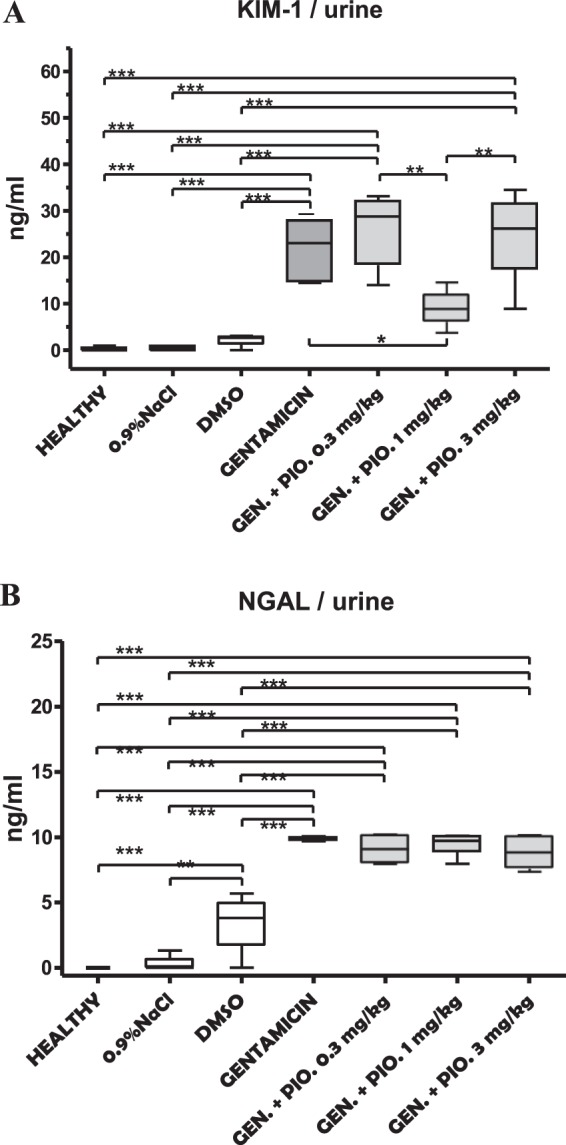
Figure 1
Figure 1
Box and whiskers plots showing urine levels of KIM-1 (A) and NGAL (B) in healthy, sham (0,9% NaCl), DMSO, gentamicin, and gentamicin plus pioglitazone in dose of 0.3, 1 and 3 mg/kg. The upper and the lower hinge of the boxes represent the interquartile range, the midline represents the median value, and the whiskers represent maximum and minimum values. *P < 0.05, **P < 0.01, ***P < 0.001.
Figure 2
Figure 2
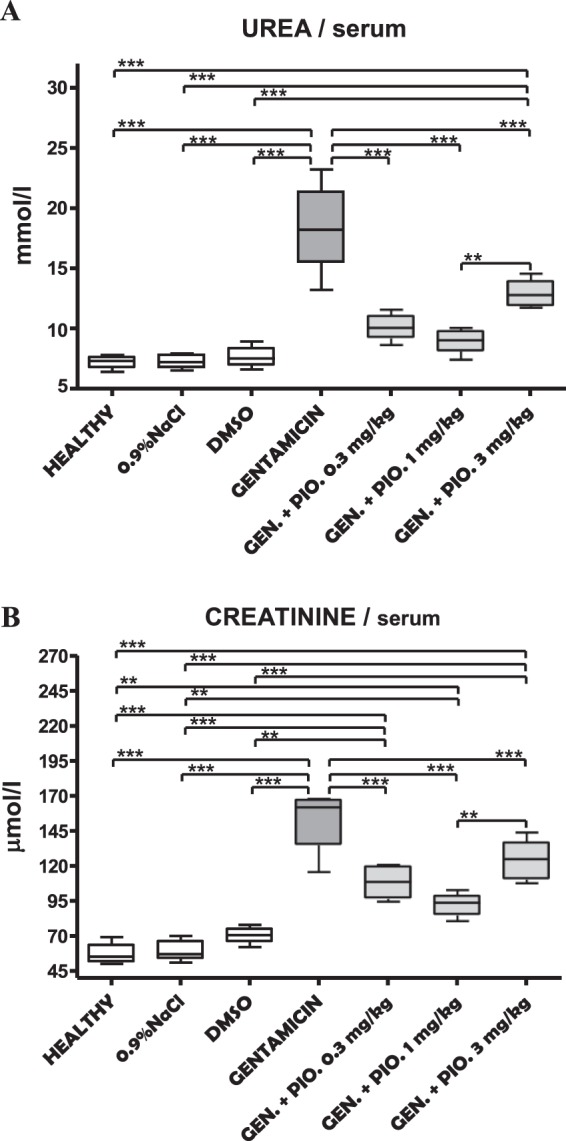
Box and whiskers plots showing serum levels of urea (A) and creatinine (B) in healthy, sham (0,9% NaCl), DMSO, gentamicin, and gentamicin plus pioglitazone in dose of 0.3, 1 and 3 mg/kg groups. The upper and the lower hinge of the boxes represent the interquartile range, the midline represents the median value, and the whiskers represent maximum and minimum values. **P < 0.01, ***P < 0.001.
Figure 3
Figure 3
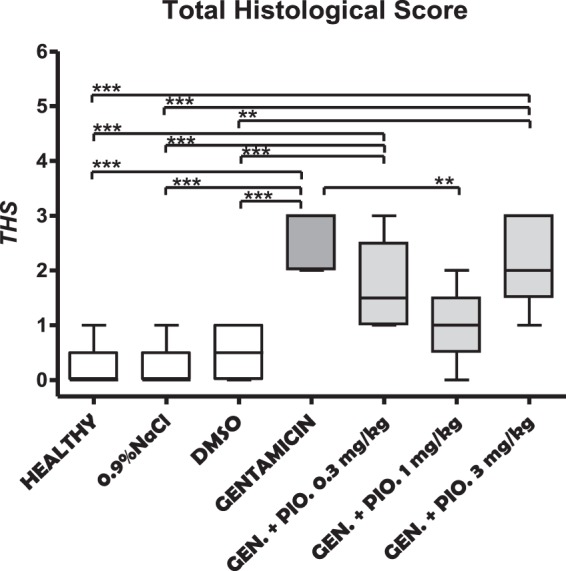
Box and whiskers plots showing total histological score (THS) in kidneys obtained from healthy, sham (0,9% NaCl), DMSO, gentamicin, and gentamicin plus pioglitazone in dose of 0.3, 1 and 3 mg/kg groups. The upper and the lower hinge of the boxes represent the interquartile range, the midline represents the median value, and the whiskers represent maximum and minimum values. **P < 0.01, ***P < 0.001.
Figure 4
Figure 4
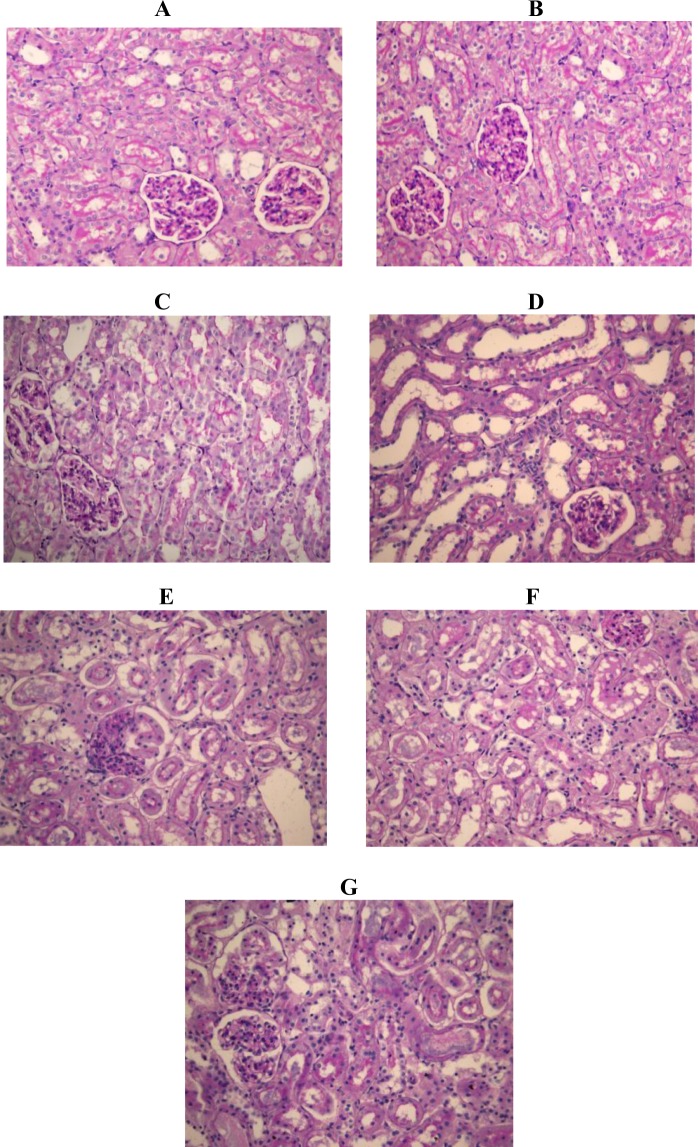
The effects of pioglitazone (0.3 mg/kg; 1 mg/kg; 3 mg/kg) on histological micrographs of renal tissues. Periodic acid–Schiff (PAS) stain coloring. Original magnification ×20. Figures were randomly chosen from the series of at least 6 experiments (Panels A–G). Panel A: Healthy animal - normal renal parenchyma (PAS staining). Panel B: Animals treated with DMSO only - normal renal parenchyma (PAS staining). Panel C: Animals treated with saline only - normal renal parenchyma (PAS staining). Panel D: Rats subjected to gentamicin-induced nephrotoxicity- marked kidney damage, interstitial edema diffusely present, proximal tubules show loss of brush border and lumen dilatation and loss of nuclei in some epithelial cells. Panel E: Rats subjected to gentamicin induced nephrotoxicity, treated with pioglitazone at dose of 0.3 mg/kg - moderate kidney damage, loss of brush border was observed in half of proximal tubules, in addition to dilatation of lumen and loss of nuclei in some epithelial cells. Panel F: Rats subjected to gentamicin induced nephrotoxicity, treated with pioglitazone at dose of 1 mg/kg –minimal to moderate kidney damage. Panel G: Rats subjected to gentamicin induced nephrotoxicity, treated with pioglitazone at 3 mg/kg – moderate to marked kidney damage, two thirds of proximal tubules show loss of brush border, dilatation of lumen and loss of nuclei in majority of epithelial cells (marked necrosis).

References

    1. Trevor, A., Katzung, B. & Kruidering-Hall, M. Toxicity. In: Weitz, M & Lebowitz, H. editors. Pharmacology examination & board review. 11th edition. New York: McGraw-Hill; p. 378–379 (2015).
    1. Al-Azzam SI, Abdul-Razzak KK, Jarada MW. The nephroprotective effects of pioglitazone and glibenclamide against gentamicin-induced nephrotoxicity in rats: a comparative study. J. Chemother. 2010;22(2):88–91. doi: 10.1179/joc.2010.22.2.88. - DOI - PubMed
    1. Polat A, et al. Protective role of aminoguanidine on gentamicin-induced acute renal failure in rats. Acta. Histochem. 2006;108(5):365–71. doi: 10.1016/j.acthis.2006.06.005. - DOI - PubMed
    1. Karatas Y, et al. Effect of tempol (4-hydroxy tempo) on gentamicin-induced nephrotoxicity in rats. Fundam. Clin. Pharmacol. 2004;18(1):79–83. doi: 10.1046/j.0767-3981.2003.00211.x. - DOI - PubMed
    1. Ghaznavi R, Faghihi M, Kadkhodaee M, Shams S, Khastar H. Effects of nitric oxide on gentamicin toxicity in isolated perfused rat kidneys. J. Nephrol. 2005;18(5):548–52. - PubMed

Publication types

MeSH terms