


Inherited Thrombophilia and the Risk of Arterial Ischemic Stroke: A Systematic Review and Meta-Analysis
- PMID: 31549567
- PMCID: PMC6806047
- DOI: 10.1161/JAHA.119.012877
Inherited Thrombophilia and the Risk of Arterial Ischemic Stroke: A Systematic Review and Meta-Analysis
Abstract
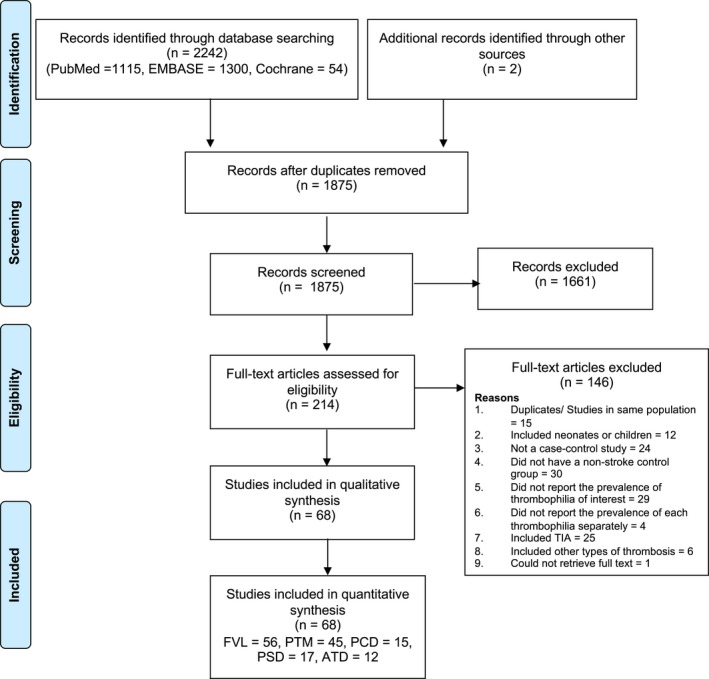
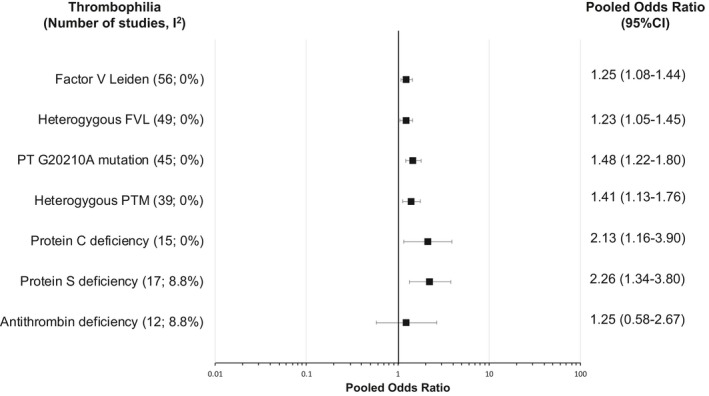
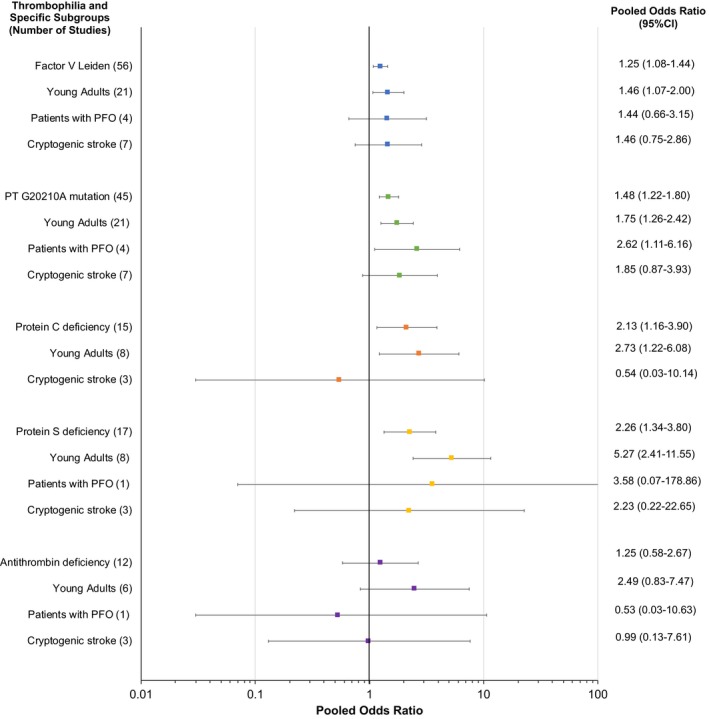
Background Inherited thrombophilias are well-established predisposing factors for venous thromboembolism, but their role in arterial thrombosis, such as arterial ischemic stroke, remains uncertain. We aimed to evaluate the association between inherited thrombophilia (factor V Leiden, prothrombin G20210A mutation, protein C deficiency, protein S deficiency, and antithrombin deficiency) and risk of arterial ischemic stroke in adults. Methods and Results We searched PubMed, EMBASE, and Cochrane Library Databases from inception to December 31, 2018. We included case-control or cohort studies of adults reporting the prevalence of inherited thrombophilias in those with arterial ischemic stroke and subjects without arterial ischemic stroke. Two reviewers (T.C., E.D.) independently searched the literature and extracted data. Pooled odds ratios (ORs) and 95% CIs were calculated using random-effects model. We identified 68 eligible studies, which collectively enrolled 11 916 stroke patients and 96 057 controls. The number of studies reporting factor V Leiden, prothrombin G20210A mutation, protein C deficiency, protein S deficiency, and antithrombin deficiency were 56, 45, 15, 17, and 12, respectively. Compared with controls, patients with arterial ischemic stroke were significantly more likely to have the following inherited thrombophilias: factor V Leiden (OR, 1.25; 95% CI, 1.08-1.44; I2=0%), prothrombin G20210A mutation (OR, 1.48; 95% CI, 1.22-1.80; I2=0%), protein C deficiency (OR, 2.13; 95% CI, 1.16-3.90; I2=0%), and protein S deficiency (OR, 2.26; 95% CI, 1.34-3.80; I2=8.8%). Statistical significance was not reached for antithrombin deficiency (OR, 1.25; 95% CI, 0.58-2.67; I2=8.8%). Conclusions Inherited thrombophilias (factor V Leiden, prothrombin G20210A mutation, protein C deficiency, and protein S deficiency) are associated with an increased risk of arterial ischemic stroke in adults. The implications of these findings with respect to clinical management of patients with ischemic stroke require further investigation.
Keywords: hypercoagulopathy; stroke; stroke, ischemic; thrombosis.
Figures
References
-
- Middeldorp S, Meinardi JR, Koopman MM, van Pampus EC, Hamulyak K, van Der Meer J, Prins MH, Buller HR. A prospective study of asymptomatic carriers of the factor V Leiden mutation to determine the incidence of venous thromboembolism. Ann Intern Med. 2001;135:322–327. - PubMed
-
- Coppens M, van de Poel MH, Bank I, Hamulyak K, van der Meer J, Veeger NJ, Prins MH, Buller HR, Middeldorp S. A prospective cohort study on the absolute incidence of venous thromboembolism and arterial cardiovascular disease in asymptomatic carriers of the prothrombin 20210A mutation. Blood. 2006;108:2604–2607. - PubMed
-
- Kim K, Cox N, Witt DM. Stroke diagnosis associated with thrombophilia testing overutilization. Thromb Res. 2017;157:139–141. - PubMed
-
- Powers WJ, Rabinstein AA, Ackerson T, Adeoye OM, Bambakidis NC, Becker K, Biller J, Brown M, Demaerschalk BM, Hoh B, Jauch EC, Kidwell CS, Leslie‐Mazwi TM, Ovbiagele B, Scott PA, Sheth KN, Southerland AM, Summers DV, Tirschwell DL; American Heart Association Stroke Council . 2018 Guidelines for the early management of patients with acute ischemic stroke: a guideline for healthcare professionals from the American Heart Association/American Stroke Association. Stroke. 2018;49:e46–e110. - PubMed
Publication types
MeSH terms
LinkOut - more resources
Full Text Sources
Medical
