


Predictors of Recurrence, and Progression-Free and Overall Survival following Open versus Robotic Radical Cystectomy: Analysis from the RAZOR Trial with a 3-Year Followup
- PMID: 31549935
- PMCID: PMC7487279
- DOI: 10.1097/JU.0000000000000565
Predictors of Recurrence, and Progression-Free and Overall Survival following Open versus Robotic Radical Cystectomy: Analysis from the RAZOR Trial with a 3-Year Followup
Abstract
Purpose: The RAZOR (Randomized Open versus Robotic Cystectomy) trial revealed noninferior 2-year progression-free survival for robotic radical cystectomy. This update was performed with extended followup for 3 years to determine potential differences between the approaches. We also report 3-year overall survival and sought to identify factors predicting recurrence, and progression-free and overall survival.
Materials and methods: We analyzed the per protocol population of 302 patients from the RAZOR study. Cumulative recurrence was estimated using nonbladder cancer death as the competing risk event and the Gray test was applied to assess significance in differences. Progression-free survival and overall survival were estimated by the Kaplan-Meier method and compared with the log rank test. Predictors of outcomes were determined by Cox proportional hazard analysis.
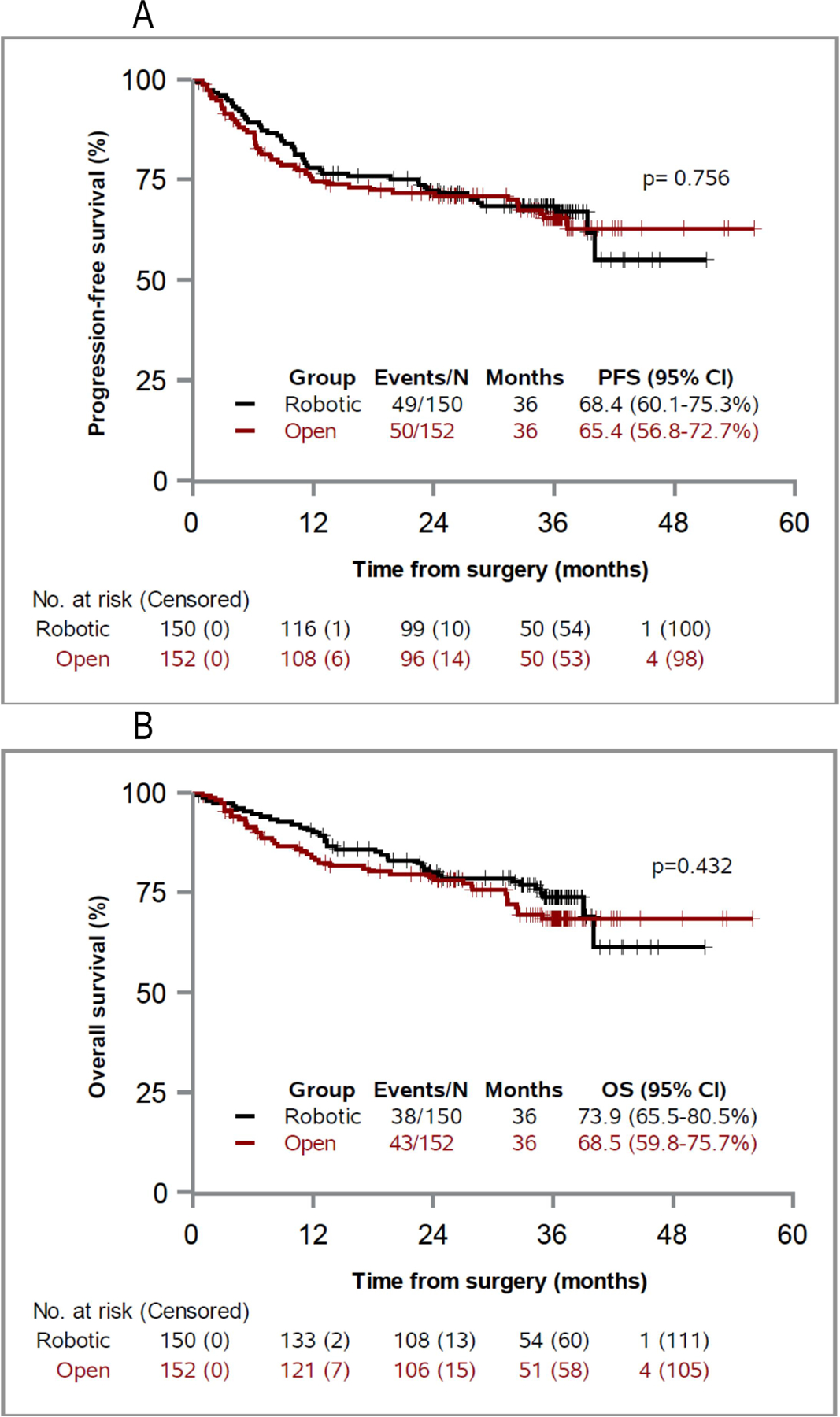
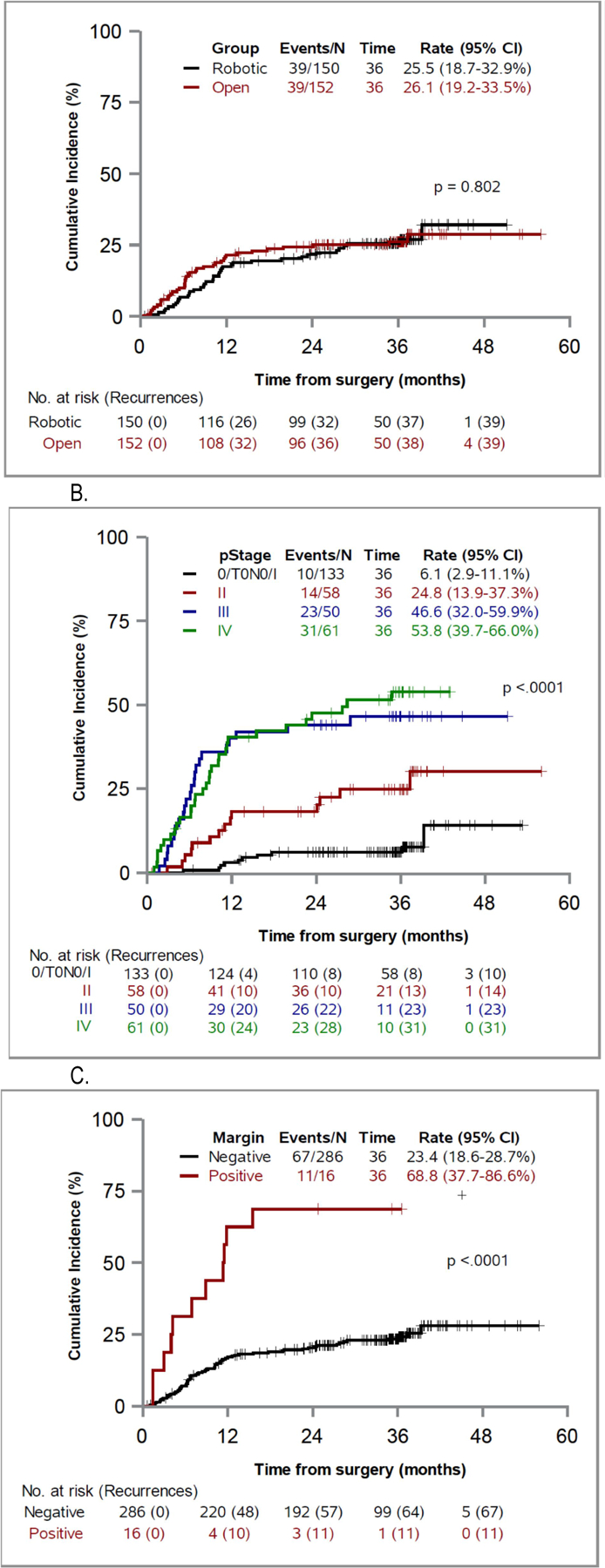
Results: Estimated progression-free survival at 36 months was 68.4% (95% CI 60.1-75.3) and 65.4% (95% CI 56.8-72.7) in the robotic and open groups, respectively (p=0.600). At 36 months overall survival was 73.9% (95% CI 65.5-80.5) and 68.5% (95% CI 59.8-75.7) in the robotic and open groups, respectively (p=0.334). There was no significant difference in the cumulative incidence rates of recurrence (p=0.802). Patient age greater than 70 years, poor performance status and major complications were significant predictors of 36-month progression-free survival. Stage and positive margins were significant predictors of recurrence, and progression-free and overall survival. Surgical approach was not a significant predictor of any outcome.
Conclusions: This analysis showed no difference in recurrence, 3-year progression-free survival or 3-year overall survival for robotic vs open radical cystectomy. It provides important prospective data on the oncologic efficacy of robotic radical cystectomy and high level data for patient counseling.
Keywords: bladder neoplasms; cystectomy; mortality; neoplasm recurrence; robotic surgical procedures.
Conflict of interest statement
Financial interest and/or other relationship with UNC Urology.
Figures
References
-
- Parekh DJ, Reis IM, Castle EP et al. : Robot-assisted radical cystectomy versus open radical cystectomy in patients with bladder cancer (RAZOR): an open-label, randomised, phase 3, non-inferiority trial. Lancet 2018; 391: 2525. - PubMed
-
- Herr HW, Faulkner JR, Grossman HB et al. : Surgical factors influence bladder cancer outcomes: a cooperative group report. J Clin Oncol 2004; 22: 2781. - PubMed
-
- Pintilie M: Competing Risks: A Practical Perspective. Hoboken, New Jersey: Wiley; 2006.
-
- Gray RJ: A class of K-sample tests for comparing the cumulative incidence of a competing risk. Ann Stat 1988; 16: 1141.
