Intergenerational effects of early adversity on survival in wild baboons
- PMID: 31549964
- PMCID: PMC6759315
- DOI: 10.7554/eLife.47433
Intergenerational effects of early adversity on survival in wild baboons
Abstract
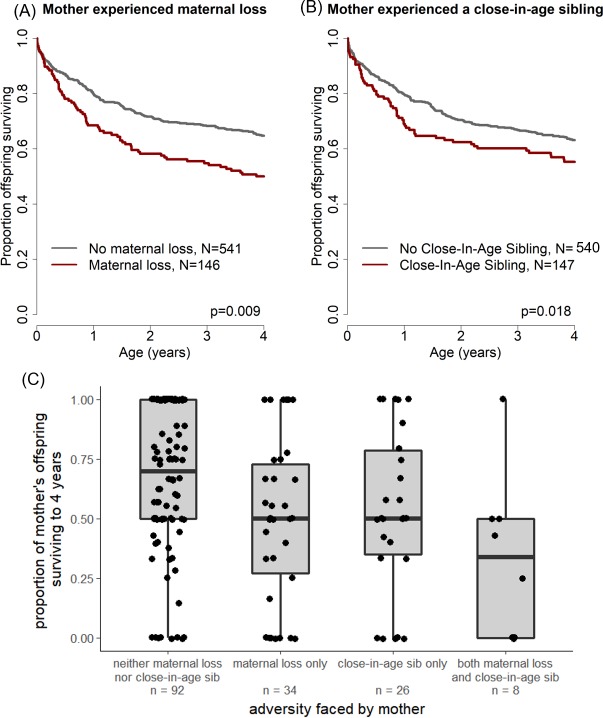
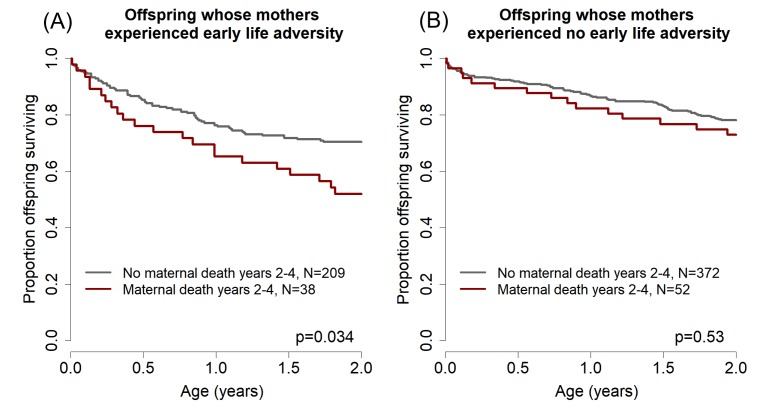
Early life adversity can affect an individual's health, survival, and fertility for many years after the adverse experience. Whether early life adversity also imposes intergenerational effects on the exposed individual's offspring is not well understood. We fill this gap by leveraging prospective, longitudinal data on a wild, long-lived primate. We find that juveniles whose mothers experienced early life adversity exhibit high mortality before age 4, independent of the juvenile's own experience of early adversity. These juveniles often preceded their mothers in death by 1 to 2 years, indicating that high adversity females decline in their ability to raise offspring near the end of life. While we cannot exclude direct effects of a parent's environment on offspring quality (e.g., inherited epigenetic changes), our results are completely consistent with a classic parental effect, in which the environment experienced by a parent affects its future phenotype and therefore its offspring's phenotype.
Keywords: P. cynocephalus; developmental constraints; early adversity; ecology; evolutionary biology; intergenerational effects; maternal effects.
© 2019, Zipple et al.
Conflict of interest statement
MZ, EA, JT, JA, SA No competing interests declared
Figures
Comment in
-
How maternal adversity impacts offspring.Elife. 2019 Sep 25;8:e51206. doi: 10.7554/eLife.51206. Elife. 2019. PMID: 31553306 Free PMC article.
References
-
- Alberts SC, Altmann J. The amboseli baboon research project: 40 years of continuity and change. In: Kappeler P, Watts D, editors. Long-Term Field Studies of Primates. Berlin: Springer; 2012. pp. 261–287. - DOI
-
- Alonso-Alvarez C, Bertrand S, Sorci G. Sex-specific transgenerational effects of early developmental conditions in a passerine. Biological Journal of the Linnean Society. 2007;91:469–474. doi: 10.1111/j.1095-8312.2007.00811.x. - DOI
Publication types
MeSH terms
Associated data
Grants and funding
LinkOut - more resources
Full Text Sources
Other Literature Sources
Miscellaneous