Review
. 2020 Jan:83:7-21.
doi: 10.1016/j.bbi.2019.09.016. Epub 2019 Sep 21.

Novel neuroimmunologic therapeutics in depression: A clinical perspective on what we know so far

Affiliations
Review

Novel neuroimmunologic therapeutics in depression: A clinical perspective on what we know so far

Michael Roman et al. Brain Behav Immun. 2020 Jan.

Abstract

Depression, one of the most common mental health disorders, is among the leading causes of health-related disability worldwide. Although antidepressant treatment has been available for decades, depression remains largely refractory to the prevailing limited treatment approach of monoamine transmission modulation. Fortunately, recent evidence points to a link between depression and inflammatory factors within the innate and the adaptive immune system. The purpose of this review is to evaluate current and potential clinical immunotherapies for depression, as contextually focused by an immunologic lens of the pathophysiologic mechanisms of depression. The utility of pro-inflammatory cytokines (primarily interleukin-1β, interleukin -6 and tumor necrosis factor-α) is considered in their role as screening biomarkers in prediction of treatment response or nonresponse. The evidence base of numerous recent clinical studies is discussed as related to their antidepressant efficacy and favorable safety profile, with consideration of multiple agents that target inflammatory mechanisms linked to depression including nonsteroidal anti-inflammatory pathways (i.e., aspirin, celecoxib), cytokine antagonism (i.e., etanercept, infliximab), N-methyl-D-aspartate receptor (NMDA) receptor antagonism (i.e., ketamine), and modulation of kynurenine pathways (i.e., minocycline). Additionally, new and exciting directions in targeting inflammatory mechanisms in the treatment of depression are underway, and future investigation is also warranted to explore the utility of inflammation in diagnosing depression, guiding clinical treatment decision-making, and monitoring disease burden and relapse risk.

Keywords: Depression; Immunotherapy; Inflammation; Mood disorders.


Figures

Fig. 1.
Fig. 1.
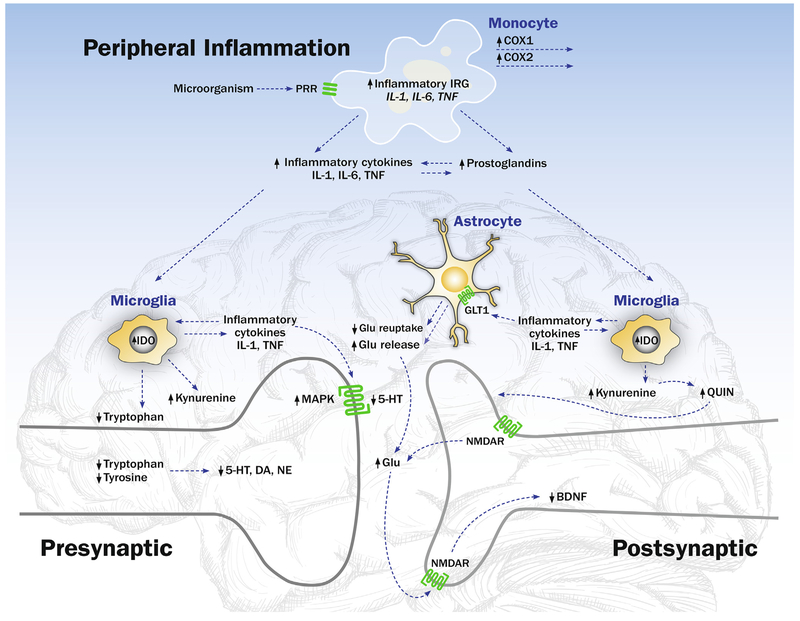
The Effects of the Peripheral and CNS Inflammatory Signaling on Monoamine and Glutaminergic Neurotransmission. Innate immune cells such as monocytes use invariant, pattern recognition receptors (PRR), to sense highly conserved features of microbes or pathogen-associated molecular patterns. Activation of this PRR such as Toll-like receptor-4 TLR4 induces increases of intracellular transcription factors such as nuclear factor-κB (NF-κB) and activator protein 1 (AP-1), which drive the expression of pro-inflammatory immune response genes such as tumor necrosis factor-α (TNF-α), interleukin-6 (IL-6) and interleukin-1 (IL-1), and translation and production of respective pro-inflammatory cytokines such as IL-1, IL-6, and TNF. The release of inflammatory cytokines induces increases in the activity of cyclooxygenases (COX-1 and COX-2), that generates increases in prostaglandins and the promotion of further increases in inflammation. In the brain, microglia, analogous to the macrophages of the peripheral immune system, are primary cellular recipients of peripheral inflammatory signals. Activation of these microglia lead to a shift in their morphology to an amoeboid shape with release of pro-inflammatory cytokines (IL-6, TNF-α, IL-1β) within the CNS. Microglial release of pro-inflammatory cytokines regulate monoamine metabolism by activating mitogen-activated protein kinase (MAPK), which increases the number and activity of presynaptic reuptake pumps, and acts to reduce the availability of monoamines — serotonin (5-HT), dopamine (DA) and noradrenaline (NE) in the neuronal synapse. Microglial release of proinflammatory cytokines also activates the enzyme indoleamine 2,3 dioxygenase (IDO), which metabolizes tryptophan into kynurenine and decreases the availability of tryptophan for serotonin (5HT) synthesis. Addditionally, activated microglia convert kynurenine into quinolinic acid, which binds to the N-methyl-d-aspartate receptor (NMDAR), a glutamate receptor, leading to increased release of glutamate (Glu), an excitatory amino acid neurotransmitter. Inflammatory cytokines also act on astrocytes and induce a reduction of glutamate reuptake and an increase in the release of glutamate. Excessive amounts of glutamate bind to extrasynaptic NMDARs, which can lead to a reduction in synthesis of brain-derived neurotrophic factor (BDNF) with effects on neuronal integrity, including neurogenesis.

References

    1. Abbasi SH, Hosseini F, Modabbernia A, Ashrafi M, Akhondzadeh S, 2012. Effect of celecoxib add-on treatment on symptoms and serum il-6 concentrations in patients with major depressive disorder: Randomized double-blind placebo-controlled study. J. Affect. Disord 141, 308–314. 10.1016/j.jad.2012.03.033. - DOI - PubMed
    1. Aguzzi A, Barres BA, Bennett ML, 2013. Microglia: scapegoat, saboteur, or something else? Science 339, 156–161. 10.1126/science.1227901. - DOI - PMC - PubMed
    1. Akhondzadeh S, Jafari S, Raisi F, Nasehi AA, Ghoreishi A, Salehi B, Mohebbi-Rasa S, Raznahan M, Kamalipour A, 2009. Clinical trial of adjunctive celecoxib treatment in patients with major depression: a double blind and placebo controlled trial. Depress Anxiety 26, 607–611. 10.1002/da.20589. - DOI - PubMed
    1. Alexopoulos GS, 2005. Depression in the elderly. Lancet 365, 1961–1970. 10.1016/S0140-6736(05)66665-2. - DOI - PubMed
    1. Almeida OP, Alfonso H, Jamrozik K, Hankey GJ, Flicker L, 2010. Aspirin use, depression, and cognitive impairment in later life: the health in men study. J. Am. Geriatr. Soc 58, 990–992. 10.1111/j.1532-5415.2010.02827.x. - DOI - PubMed

Publication types

MeSH terms